ISLAMABAD: Saudi Crown Prince Mohammed bin Salman flew out of Pakistan after a two-day visit that ratified growing closeness between the historic allies with investment agreements worth $20 billion and an announcement that over 2,100 Pakistani prisoners in Saudi jails would be immediately released.
The crown prince was on a two-day visit to Pakistan as part of a rare Asian tour. His next stop is Pakistan’s arch-rival India, followed by China, a close political ally and economic partner to Pakistan.
On Monday, Pakistani President Arif Alvi awarded the crown prince the country’s highest civilian medal, the Nishan-e-Pakistan. Earlier in the day, the Pakistani foreign minister said the crown prince had honored a personal request of Prime Minister Imran Khan and announced the release of 2,107 Pakistanis languishing in Saudi prisons.
Saudi Arabia has not yet commented on the Pakistani announcement of a prisoner release.
Pakistan and Saudi Arabia also signed seven short-, mid- and long-term investment agreements worth $20 billion on Sunday night, including for a $10 billion oil refinery.
“Your Highness if you stood for elections in Pakistan today, you would get more votes than me,” Pakistani Prime Minister Imran Khan said to the crown prince at a press conference moments before his departure. “On behalf of the people of Pakistan, I want to thank you. I’m really grateful to you for these prisoners that you have very generously announced [to release] this morning.”
Commenting on the investment deals, the prime minister said this was the “first time we have a relationship that is now developing into other spheres,” referring to the expansion of ties, largely confined to oil imports and strategic and defense pacts, into the fields of renewable energy, petrochemicals, minerals, construction, and food and agricultural products.
The crown prince said Pakistan’s economy had the potential to compete with what he said would be the two largest economies by 2030, India and China.
“We believe in Pakistan’s future,” Crown Prince Salman said at the press conference. “We believe Pakistan has huge potential ... it could be one of the biggest twenty economies in the future, easily.”
The Saudi royal family, as the custodians of holy sites in the birthplace of Islam, carries widespread influence in Pakistan, a mainly Muslim nation of 208 million people. Saudi Arabia has also come to Pakistan’s financial rescue many times in its history, including last year by offering $3 billion in foreign currency support for a year and a further loan worth up to $3 billion in deferred payments for oil imports to help stave off a current account crisis.
In return for its economic largess, Pakistan’s powerful army and government have for decades alleged unflinching support to Saudi Arabia. Last year Pakistan said it was sending troops to Saudi Arabia on a “training and advise mission,” adding to about 750-800 Pakistani servicemen already present in Saudi Arabia, in part to guard Islamic holy sites. Last year, then-Defense Minister Khurram Dastagir said Pakistan was currently training 10,000 Saudi Arabian soldiers.
Pakistan’s retired army chief, General Raheel Sharif, also commands a Saudi-led Islamic military alliance to fight terrorism.
“Pakistan needs Saudi Arabia’s petrodollars and investments to shore up its economy, while Saudi Arabia needs the military and strategic support of the only nuclear-armed Muslim nation in the world,” said Uzair Younus, Director South Asia at the global strategy firm, Albright Stonebridge Group.
Saudi Arabia’s push to diversify ties with Pakistan is part of a larger shift in its overall economic outlook. In India too, it is building a $44 billion oil refinery, giving it the guarantee of oil purchases from Delhi as well as returns once the crude is refined into value-added petroleum products.
“The Saudis are now keen to become vertically integrated and not be limited to just supplying crude oil to the rest of the world,” Younus said.
In Gwadartoo, Saudi Arabia hopes to make a profit both by selling crude and finished petroleum products to Pakistan, which would “allow Saudi Arabia to capture a greater share of the oil market in Pakistan,” Younus said. The U.A.E. is currently the largest supplier of oil to Pakistan.
The investment in Gwadar also plugs into Saudi Arabia’s hope of becoming a partner in Beijing’s $60 billion China-Pakistan Economic Corridor (CPEC) of infrastructure and energy projects of which the port in Gwadar is the crown jewel.
“This [Saudi] investment [in Gwadar] also aligns with Chinese interests, who may seek to use CPEC’s western corridor as an alternative route for energy supplies from the Middle East,” Younus said.
“The bottom line,” Michael Kugelman, a South Asia senior associate at The Wilson Center, said, “is that Saudi Arabia derives economic, reputational, and strategic benefits from maintaining a partnership with Islamabad.”


![]()

Pakistan trumpets $20 billion in Saudi deals as crown prince departs
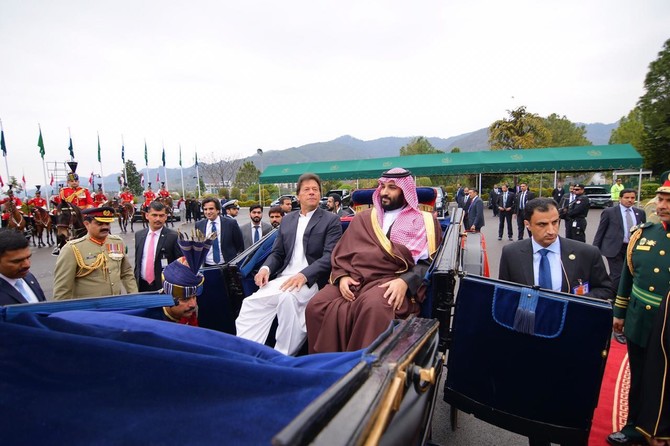
Pakistan trumpets $20 billion in Saudi deals as crown prince departs
- Highlights of two-day visit include announcement to release 2,107 prisoners from Saudi jails, highest civilian award for crown prince
- If crown prince stood for elections in Pakistan today, he would get more votes than me, Pakistani PM says
Latest updates


© 2026 SAUDI RESEARCH & PUBLISHING COMPANY, All Rights Reserved And subject to Terms of Use Agreement.