



DUBAI: Rami Malek is no stranger to breaking ground for Arabs in Hollywood. In 2016, he became the first actor of Arab descent to win Best Actor in a Drama Series at the Emmys for his performance in the hit television show “Mr. Robot.” In 2019, Malek has become the star of awards season for his turn as the legendary Queen singer Freddie Mercury in the film “Bohemian Rhapsody,” picking up Best Actor at the Golden Globes, the Screen Actors Guild Awards and the BAFTAs.
But it is Malek’s nomination for Best Actor at the 91st Academy Awards, to be held on February 24 that may be the biggest honor of all, as an Oscar has long been the most coveted award in the field, transforming careers and capturing international attention like no other.
Malek, 37, born to Egyptian immigrant parents in Los Angeles, has been hugely deferential to his collaborators throughout the process. And when Arab News speaks to Malek about the honor, he remains as respectful as ever.
“I want to say thank you to the Academy for recognizing the work of so many from the cast and crew who made all of this possible, I’m beyond grateful to Graham King, Denis O’Sullivan, 20th Century Fox, New Regency and to Brian May, Roger Taylor and Queen,” Malek tells Arab News.
Though Mercury died in 1991, his legacy has loomed large, and though Queen has remained popular since his death, the film “Bohemian Rhapsody” has helped make Mercury and Queen a global phenomenon all over again. On the streaming giant Spotify, Queen’s “Bohemian Rhapsody” became the platform’s most popular song from the 20th century. The film itself has currently grossed $844 million worldwide at the box office, making it the most popular musical biopic of all time.
Malek’s transformative performance has helped bring Mercury to life for a new generation of fans, and, in his eyes, his award wins and nominations are a testament to Mercury’s enduring popularity.
“I have absolutely treasured playing Freddie Mercury and I am so profoundly humbled and thrilled to honor him this way,” Malek tells Arab News.
“Bohemian Rhapsody” picked up five Oscar nominations in total, including Best Picture. Graham King, the film’s producer, is just as grateful as Malek for the Academy’s recognition.
“A heartfelt thank you to the Academy for recognizing a film that has been a true collaboration from a team with a specific vision and determination to honor Freddie Mercury and Queen. I’m extraordinarily proud of all of the nominations and the entire ‘Bohemian Rhapsody’ team. It has taken nearly a decade to bring this project to the screen, so to see the world celebrate this film is incredibly thrilling,” King tells Arab News.
The global reach of Freddie Mercury and Queen is awe-inspiring — even Malek has been continually surprised to see their profound reach.
“I knew that Queen was massive and Freddie Mercury was an icon and a hero to so many, but I don’t think I completely understood just how important he is to so many people across the world,” he says.
In order to become Mercury, however, Malek had to forget the daunting size of Mercury’s shadow, and instead tried to put all of that out of his mind and focus on the core of his character.
“I stripped out his achievements in terms of his performing — his ability to rule the stage, his singing, his piano playing — and found a very complicated man at the center, who was trying to discover his identity. That was something I knew how to tackle. If I could start there I would be able to have the initial building blocks that get you the confidence to do all those other things,” says Malek.

Rami Malek at the New York premier of 'Bohemian Rhapsody.' (AFP)
What made Mercury such an incredible performer, in Malek’s eyes, goes beyond just his incredible magnetism.
“What was magical about him was the exchange with everyone in the audience where everyone was allowed to feel the same thing — he could reach you as if you’re the only person in the room — and it’s that exchange that makes him one of the most unique and remarkable and revolutionary artists of our time or any time,” says Malek.
In order to capture the physicality of the role, Malek worked extensively with a movement coach. Together, they studied not just Mercury, but every influence upon him, from his early days in Zanzibar to his love of Liza Minnelli, David Bowie and Mick Jagger of the Rolling Stones.
“We didn’t want an impersonation of Freddie, but rather to understand why he did what he did. So looking at all those performers and films and choreographers who influenced him was incredibly useful in getting to the heart of how he moved and performed,” says Malek.
The film climaxes at what is widely considered the band’s greatest moment, and according to a 2005 poll, the greatest live performance in the history of rock — Queen’s 21 minutes on stage at the 1985 benefit concert Live Aid.
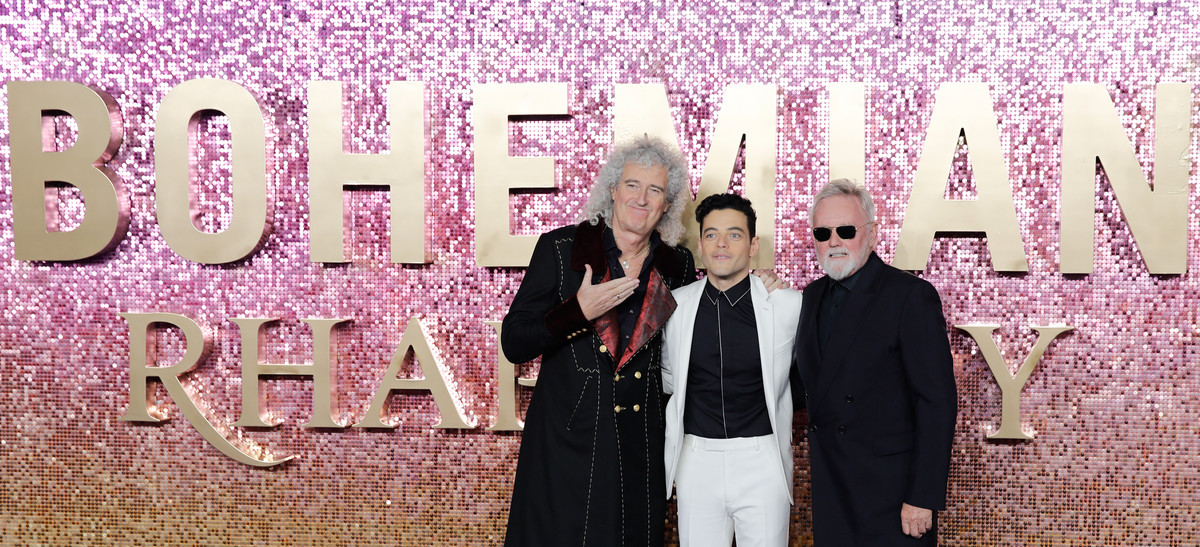
Rami Malek and members of the rock band Queen pose at the 'Bohemian Rhapsody' film premier in London. (AFP)
Organized by British musicians Bob Geldof and Midge Ure as a fundraising venture to tackle the Ethiopian famine, the concert was reportedly watched by nearly two billion people across the world. Capturing that moment was for Malek perhaps the most surreal and powerful experience of the entire shoot.
“Stepping out onto that stage for the Live Aid scenes was the most remarkable feeling. Even though there wasn’t an audience there, it was completely nerve-wracking. But also invigorating. I mean, they had recreated that stage perfectly, so you got the feeling that it’s the real deal,” says Malek.
Malek and the cast and crew were not alone in recreating the band’s most remarkable moments — original Queen band members Roger Taylor and Brian May have been a part of production from the beginning, personally approving Malek for the role and working with him to help learn more about Mercury and the band’s adventures.
“Their insight was invaluable. It was also a terrific boost to our confidence just having them there cheering us on. Knowing that they were there and watching raised our game,” says Malek. “It’s very difficult putting your story in the hands of strangers, but we really got to know them, and there was this trust level where we did not want to let them down.”


