

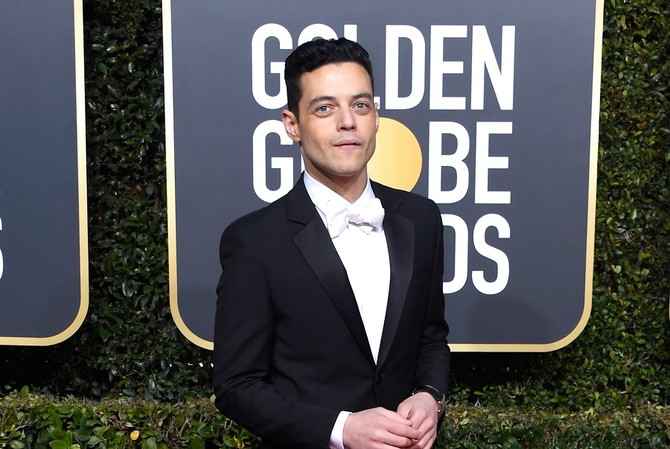
Arab star Rami Malek wins big at Golden Globes

1 / 4
Rami Malek won best actor for his role in the film "Bohemian Rhapsody." (Frazer Harrison/AFP)
2 / 4
This is Malek's first Golden Globes win. (AFP)
3 / 4
Malek was born in the US to Egyptian immigrants. (AFP)
4 / 4
"Bohemian Rhapsody" bagged the top motion picture award. (AFP)
Updated 07 January 2019
Follow

Arab star Rami Malek wins big at Golden Globes

  • Egyptian-American actor Rami Malek beat off a tough competition including Bradley Cooper
  • Lebanese director Nadine Labaki missed out on a Golden Globe against Oscar-winning director of Roma

DUBAI: Egyptian-American Rami Malek scooped the best actor award at the Golden Globes on Sunday, one of the major awards in the 76th annual ceremony that is seen as a rough precursor to the Oscar nominations to be released this month.

Malek, who went up against fan favorite Bradley Cooper in the category, won the award for his performance as rock icon Freddie Mercury from the British band Queen in the highly-acclaimed blockbuster “Bohemian Rhapsody.”

Beating off a tough bunch in a category that also included veteran Willem Dafoe, Malek received his first Globe trophy, thanking Queen band members Brian May and Roger Taylor, as well as Mercury for “providing the role of a lifetime.”

“This is a profound honor to receive this and to be counted among such extraordinary actors,” he said.

Malek was born in the US to Egyptian immigrants Said Malek and Nelly Abdel-Malek. “My mum and dad left Cairo in 1978. My dad was working as a travel agent there, and he would pick up visitors from the west. Through them he saw this other world that existed and he was fascinated by it,” he recently told British national newspaper The Guardian.

Confessing to be a Queen fan himself, Malek said: "I related it to him being an immigrant struggling to discover his identity. I tried to take everything he was struggling with, his complication, his chaos, his turmoil and this beauty inside of him. He lifted me up to be everything I could be in this film," explained the actor, whose win was quickly applauded up by his Arab fans on Twitter.

Bohemian Rhapsody, directed by Bryan Singer, also bagged the best motion picture award in the drama category, edging out Oscar heavyweight “A Star is Born,” which ultimately walked away with just one Globe trophy for best original song, “Shallow.”

Glenn Close, whose shocked reaction quickly became an internet meme, was hailed as the best actress in a drama movie for “The Wife,” again besting hotly tipped Lady Gaga.

Civil rights dramedy “Green Book,” which didn’t sit well with film critics, won three awards overall, including the best supporting actor in a comedy movie for Muslim star Mahershala Ali, in an awards night that recognized a significantly diverse set of winners.

“Grey’s Anatomy” star Sandra Oh became the first Asian woman to host the Golden Globes, as well as to win a top acting prize in the ceremony, for the TV series “Killing Eve.”

Meanwhile, Nadine Labaki’s “Capernaum” missed out on what could’ve been a historic Golden Globe win.
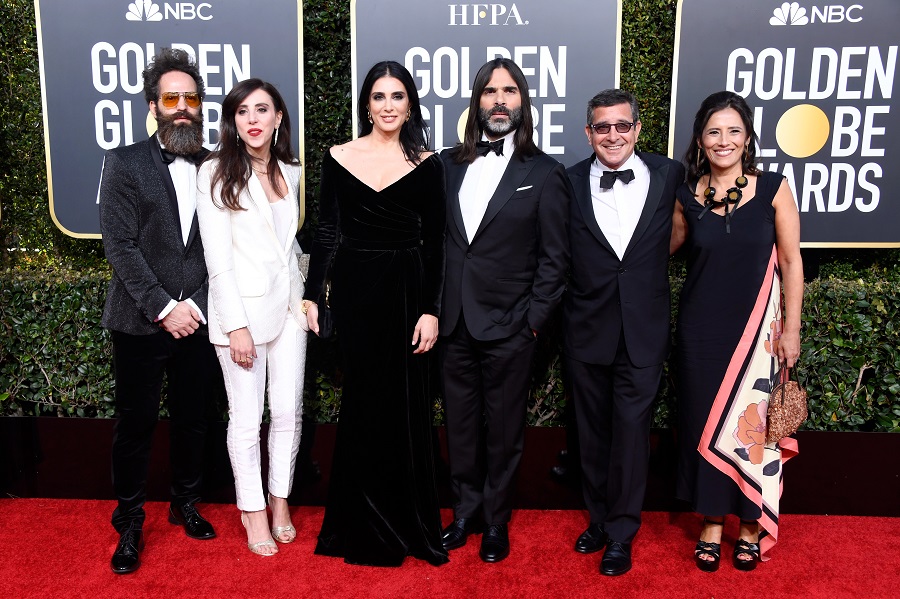


Nadine Labaki with other guests at the Golden Globes red carpet. (AFP)

The movie nominated for best motion picture in the foreign language category was beaten out by Alfonso Cuaron’s black-and-white film “Roma,” which is also seen as a tough contender in the upcoming Oscars.

Although Labaki lost to the Oscar-winning director, her nomination was notable, as she’s the only female director in the category. “I do have this sort of pride being a woman director among all these amazing filmmakers,” she told US-based entertainment website Variety.

“But of course there’s this other surprise when you feel like you’re the only one, when I know that there are so many women making films that are so interesting and so very important out there,” Labaki added.

The film is also Lebanon’s entry to the best foreign language film in the upcoming Oscars. It sits along nine other shortlisted films from different countries, while the final five nominees will be announced on Jan. 22.

Also spelt “Capharnaüm,” the Lebanese drama is about a 12-year-old and his difficult life in Lebanon, which leads to him to sue his parents. The other nominees were Girl (Belgium), Never Look Away (Germany), and Shoplifters (Japan).

The Golden Globes are decided by the 93-member Hollywood Foreign Press Association that recognizes excellence in both film and television.


Real-life horror to TV drama: Feared Syria sites become sets for series

Updated 56 min 51 sec ago
Follow

Real-life horror to TV drama: Feared Syria sites become sets for series

  • At a Damascus air base once off-limits under Bashar Assad, a crew films a TV series about the final months of the ousted leader’s rule as seen through the eyes of a Syrian family

DAMASCUS: At a Damascus air base once off-limits under Bashar Assad, a crew films a TV series about the final months of the ousted leader’s rule as seen through the eyes of a Syrian family.
“It’s hard to believe we’re filming here,” director Mohamad Abdul Aziz said from the Mazzeh base, which was once also a notorious detention center run by Assad’s air force intelligence branch, known for its terrible cruelty.
The site in the capital’s southwestern suburbs “used to be a symbol of military power. Now we are making a show about the fall of that power,” he told AFP.
Assad fled to Russia as an Islamist-led offensive closed in on Damascus, taking it without a fight on December 8 last year after nearly 14 years of civil war and half a century of Assad dynasty rule.
The scene at the Mazzeh base depicts the escape of a figure close to Assad, and is set to feature in “The King’s Family” filmed in high-security locations once feared by regular Syrians.
The series is to be aired in February during the Muslim holy month of Ramadan, primetime viewing in the Arab world, when channels and outlets vie for the attention of eager audiences.
Dozens of actors, directors and other show business figures who were opposed to Assad have returned to Syria since his ouster, giving the local industry a major boost, while other series have also chosen to film at former military or security sites.
’Impossible before’
“It’s a strange feeling... The places where Syria used to be ruled from have been transformed” into creative spaces, Abdul Aziz said.
Elsewhere in Damascus, his cameras and crew now fill offices at the former military intelligence facility known as Palestine Branch, where detainees once underwent interrogation so brutal that some never came out alive.
“Palestine Branch was one of the pillars of the security apparatus — just mentioning its name caused terror,” Abdul Aziz said of the facility, known for torture and abuse.
Outside among charred vehicles, explosions and other special effects, the team was recreating a scene depicting “the release of detainees when the security services collapsed,” he said.
Thousands of detainees were freed when jails were thrown open as Assad fell last year, and desperate Syrians converged on the facilities in search of loved ones who disappeared into the prison system, thousands of whom are still missing.
Assad’s luxurious, high-security residence, which was stormed and looted after he fled to Russia, is also part of the new series.
Abdul Aziz said he filmed a fight scene involving more than 150 people and gunfire in front of the residence in Damascus’s upscale Malki district.
“This was impossible to do before,” he said.
‘Fear’ 
The series’ scriptwriter Maan Sakbani, 35, expressed cautious relief that the days of full-blown censorship under Assad were over.
The new authorities’ information ministry still reviews scripts but the censor’s comments on “The King’s Family” were very minor, he said from a traditional Damascus house where the team was discussing the order of scenes.
Sakbani said he was uncertain how long the relative freedom would last, and was waiting to see the reaction to the Ramadan productions once they were aired.
Several other series inspired by the Assad era are also planned for release at that time, including “Enemy Syrians,” which depicts citizens living under the eyes of the security services.
Another, “Going Out to the Well,” directed by Mohammed Lutfi and featuring several prominent Syrian actors, is about deadly prison riots in the infamous Saydnaya facility in 2008.
Rights group Amnesty International had called the facility a “human slaughterhouse.”
“The show was written more than two years ago and we intended to film it before Assad’s fall,” Lutfi said.
But several actors feared the former authorities’ reaction and they were unable to find a suitable location since filming in Syria was impossible.
Now, they plan to film on site.
“The new authorities welcomed the project and provided extensive logistical support and facilities for filming inside Saydnaya prison,” Lutfi said.
As a result, it will be possible “to convey the prisoners’ suffering and the regime’s practices — from the inside the actual location,” he said.