PESHAWAR: In Pakistan’s north-western province of Khyber Pakhtunkhwa (KP), six-year old Khadija babysits the children of Peshawar’s privileged families for a few hundred rupees a month. She is one of 1.8 million of the province’s seven million children who are currently out of school, according to Ziaullah Bangash, an education adviser to the provincial government.
“My mother works in nearby homes,” Khadija says. “I go with her and take care of people’s babies.”
A July 2018 report by the federal education ministry reported that out of a total 51.5 million children in Pakistan between the ages of five and 16, 22.5 million were out of school.
According to Pakistan’s constitution, children less than 16 years of age cannot be employed in any industry. But due to poverty, natural calamities, a weak industrial base, and still reeling from the effects of war and militancy, KP has some of the highest number of out-of-school and child labor cases in the country.
A few months ago, Shanaz Khan, a UNICEF employee and social worker making the rounds in Pawaki, an impoverished area of Peshawar where Khadija lives with her family, entered their home and proposed that Khadija be enrolled in a small, free school to get basic maths, reading and writing practice. The school, yet unnamed, is Khan’s own, personally funded initiative and aims to deliver basic literacy to children out of school or employed in child labor.
Khan, who comes from a family of government workers and business people, launched her first “school” in October last year by renting a room in a local house for a few hours every day and requesting families to register their children by going door-to-door.
“In the blink of an eye, I had 25 registered children,” she says.
Only four months on, there are four such “schools” in the Pawaki, Speena Warai, Miskeenabad and Gulabad areas of Peshawar where 150 children, both boys and girls, come and get basic education. The space is sparse and simple, with rooms in houses rented for a few hours of afternoon classes where children of varying ages are taught by a single female teacher.
Many of Khan’s students work in brick kilns, as domestic workers, in garment factories, the restaurant business and at wagon workshops.
“We are not only providing education to these street children,” Khan says, “We are also working to make society aware, so that no child is left out of school. It was a big task to convince parents to prefer education over jobs for their children.”
The need for such initiatives has risen in part due to the government’s inability to implement laws already in place, according to renowned documentary film-maker and human rights activist Samar Minallah.
“The government needs to act on the Elimination of Child Labour Act of 2015 and the Right to Education Act of 2017,” she says and adds that the constitution gives all Pakistani children the right to a free education.
But even as government adviser Ziaullah Bangash concedes that millions of children are currently out of school in KP province, he says the PTI government in its last tenure has already “improved the conditions of 50 percent of government schools” and has a plan for the next five years.
“We have a strategy to establish schools in rented buildings and are going to make public-private partnerships to bring these out-of-school children into the classroom,” he says.
“We also introduced independent monitoring unit systems to ensure the attendance of teachers,” he adds.
A damning 2014 report funded by the UK Department for International Development found that Peshawar had some of the highest rates of absentee teachers in the country, citing almost 5,000 teachers were missing from government schools on a daily basis and another 15,000 teachers were absent due to sanctioned leave every day.
In 2017, the provincial government reported that its monitoring systems had led to a 3% increase in the rate of daily teacher turnout, and last year, the KP Chief Minister kicked off an enrollment campaign to get 2.5 million out-of-school children into schools.
Meanwhile, in Peshawar, Khan says one day she hopes to rent a building where her students can have a proper school. Until then, her informal teaching rooms are doing their quiet work, appealing for donations and according to Khan, “extinguishing a thirst and fulfilling the dream of a basic education.”


![]()
![]()

The teaching rooms of Peshawar
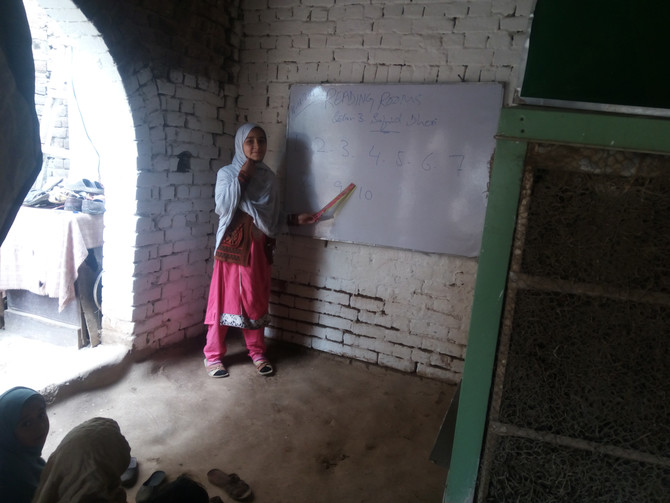
The teaching rooms of Peshawar
- KP has the highest number of out-of-school and child labor cases in Pakistan
- A staggering 22.5 million Pakistani children out of 55.1 million are out of school
Latest updates


© 2026 SAUDI RESEARCH & PUBLISHING COMPANY, All Rights Reserved And subject to Terms of Use Agreement.