

China’s presence at Gwadar for trade, not military purposes — Pakistan

1 / 3
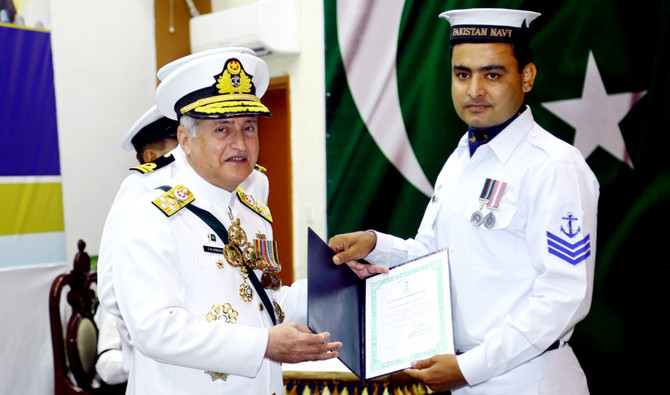
Chief of Naval staff Admiral Zaffar Mahmood Abbasi awarding letter of commendation to Pakistan Navy sailor in Karachi. (ISPR/File)
2 / 3
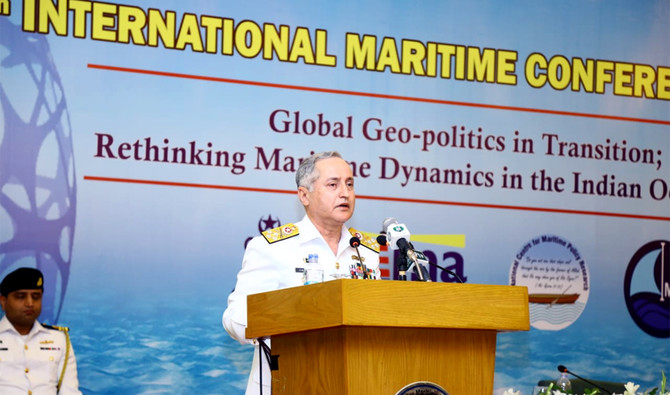
Chief of Pakistan's naval forces, Admiral Zaffar Mahmood Abbasi addressing the open session of an international maritime seminar in Karachi on Saturday. (Photo by Pakistan Navy)
3 / 3
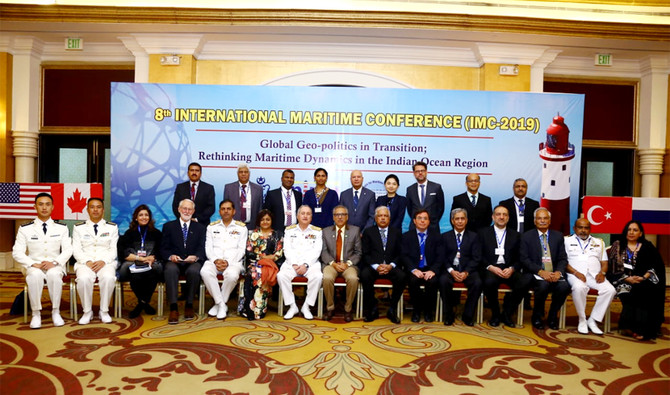
Pakistan President Dr. Arif Alvi also attended the inaugural session of the three day maritime seminar, group photo with participants. (Photo by Pakistan Navy)
Updated 09 February 2019
Follow

China’s presence at Gwadar for trade, not military purposes — Pakistan

  • The naval base in Gwadar belongs to Pakistan, says naval chief
  • CPEC is a totally economic project, Chinese experts

KARACHI: Chief of Pakistan's naval forces, Admiral Zaffar Mahmood Abbasi dismissed reports that China was constructing its overseas military base in Pakistan, and said the naval base in Gwadar belonged to Pakistan, while addressing the open session of an international maritime seminar in Karachi on Saturday.

The over $60 billion development project underway in the deepwater port city of Gwadar in Pakistan’s southwestern province of Balochistan has ambitious Chinese investors pouring in billions but has also drawn a spate of controversy which highlights a growing unease among Pakistanis that Chinese interests might be more than trade-related.  

“I must say it very clearly that there is no reality in such assertions. Gwadar will have a naval base but it will be Pakistan’s,” he said.

The naval chief’s statements came on the second day of the sixth AMAN-2019, an international naval exercise that focuses on maritime cooperation and security and is hosted in Pakistan once every two years, with 46 countries participating this year.  

Referring to earlier reports that accused China of pushing for greater military and power projection capabilities along strategic sea routes, Abbasi said the sole purpose of China’s presence in Gwadar was economic.

Mrs. Yan Yan, deputy director at a research center for oceans’ law and policy, also spoke at Aman-2019 and reasserted this position, and said China’s only designs for the Indian ocean were trade related. 

“As Pakistan’s naval chief said, China’s presence is for trade and economic purposes,” she said.

Dubbing reports to the contrary as “fake news,” Yan said that CPEC was totally an economic project for the mutual benefit of participating countries sans any military designs. 

“China has no military designs and the CPEC is totally an economic project with huge economic benefits for both China and Pakistan,” she said, adding that 90 percent of world trade and 45 percent of Chinese trade went through Indian Ocean routes. 

Pakistan President Dr. Arif Alvi, who was chief guest at the inaugural session of the three day maritime seminar, said the Indian Ocean was a dominant place for international trade. 

“All regional powers are hopeful that Pakistan will not allow the trade channel to be disturbed,” he said.

CPEC, he said, is all about trade through the Indian Ocean, to enable peaceful transportation of goods to parts of the world. 

“Pakistan is for peace. Pakistan is a changing place with booming economy and great future. Today’s Pakistan is the most secure Pakistan,” he said.


Pakistan assesses EU-India trade deal as industry warns $9 billion exports at risk

Updated 5 sec ago
Follow

Pakistan assesses EU-India trade deal as industry warns $9 billion exports at risk

  • Textile exporters say India’s tariff-free EU access erodes Pakistan’s GSP+ advantage
  • Analysts urge lower energy costs as commerce ministry meets to assess impact

KARACHI: Pakistan’s government is assessing the impact of a newly signed free trade agreement between India and the European Union, as industry leaders and economists warn the deal could sharply undermine Pakistan’s exports unless production costs, particularly energy tariffs, are urgently reduced.

Officials at the commerce ministry and leading trade bodies held multiple meetings in Islamabad on Wednesday to evaluate how the EU-India agreement may affect Pakistan’s access to European markets, a key destination for the country’s textile and apparel exports.

“There is a meeting scheduled today [Jan.28] to discuss the issue,” a commerce ministry official told Arab News on condition of anonymity, saying the government would be better placed to respond once consultations concluded on the impact of the EI-India FTA. 

The agreement, which India’s Prime Minister Narendra Modi described as the “mother of all trade deals,” grants Indian exporters sweeping tariff-free access to the EU, Pakistan’s second-largest export market. European Commission President Ursula von der Leyen said the deal created a free trade zone of two billion people.

For Pakistan, the concern is that the deal erodes its long-standing tariff advantage under the EU’s Generalized Scheme of Preferences Plus (GSP+), which has allowed duty-free access for many Pakistani exports in return for commitments on labor rights, human rights and governance.

“The European Union is a critical market for Pakistan’s exports,” said Kamran Arshad, chairman of the All Pakistan Textile Mills Association (APTMA), the country’s largest textile trade body.

He said the EU’s 27 member states buy about $8.8 billion, or 27.2 percent, of Pakistan’s total exports and nearly $7 billion, or 39 percent, of its textile shipments each year.

Under GSP+, Pakistan currently enjoys duty-free access on around 66 percent of EU tariff lines, while Indian textile and apparel products previously faced duties of up to 12 percent.

“This dynamic has now fundamentally changed,” Arshad said, adding that India has secured immediate duty-free access on 100 percent of its textile and apparel tariff lines under the new agreement.

“India has become significantly more competitive in the EU market, effectively neutralizing and, in several segments, overtaking Pakistan’s existing GSP+ advantage,” he said.

“NARROW ADVANTAGE“

The shift comes at a fragile moment for Pakistan’s exports. After rising 5 percent to $32.1 billion last fiscal year, exports fell 9 percent to $15.2 billion in the first half of the current year through December, according to Pakistan Bureau of Statistics data.

Analysts say Pakistan’s competitiveness gap is being widened not only by tariff changes, but also by higher domestic production costs.

“The EU-India FTA will have a definite impact on Pakistan’s textile exports to the EU,” said Shankar Talreja, head of research at Karachi-based Topline Securities Ltd.

“Pakistani companies’ competitive advantage to compete against a giant like India needs to be restored in the form of regionally aligned energy tariffs and policy certainty,” he said.

Muhammad Waqas Ghani, head of research at JS Global Capital, said Pakistan’s advantage over India had already been narrow.

“With the FTA now in effect, Pakistan risks losing this already narrow comparative advantage, particularly as India’s higher value addition and stronger vertical integration enhance its competitiveness,” he told Arab News.

Industry executives echoed those concerns. 
Musadaq Zulqarnain, chairman of Interloop Holdings — one of Pakistan’s largest textile exporters supplying global brands such as Nike, Adidas, H&M, Marks & Spencer and Zara — said higher energy costs were the sector’s biggest handicap.

“The real problem for us is the cost of production,” Zulqarnain told Arab News from Faisalabad, Pakistan’s main textile hub. “Because of this, the entire textile industry is suffering.”

He said industrial electricity tariffs in Pakistan were 25–30 percent higher than those faced by regional competitors, adding that electricity prices should fall below 8–10 rupees per unit to remain competitive.

In Islamabad, an APTMA delegation also briefed Finance Minister Muhammad Aurangzeb on the impact of rising input costs and shifting global trade dynamics.

“The government is actively reviewing various issues affecting the cost of doing business for export-oriented industries,” the finance ministry said in a statement, citing Aurangzeb.

Former commerce minister Gohar Ejaz warned that preferential access alone could no longer sustain exports.

“The decision must be taken today, $9 billion exports to EU and 10 million jobs are at risk,” Ejaz said in a post on X.