
KARACHI/ISLAMABAD: Pakistan said on Thursday it was reviewing the implications of a new free trade agreement between India and the European Union, while reaffirming its commitment to long-standing trade relations with the bloc, as exporters and analysts warned the deal could weaken Pakistan’s competitive position in Europe.
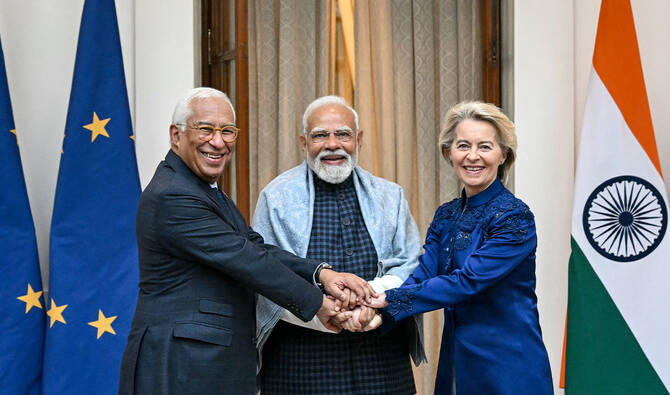
The agreement, which Indian Prime Minister Narendra Modi described as the “mother of all trade deals,” grants Indian exporters sweeping tariff-free access to the EU, Pakistan’s second-largest export market. European Commission President Ursula von der Leyen said the deal created a free trade zone of two billion people.
For Pakistan, the concern is that the deal may erode its tariff advantage under the EU’s Generalized Scheme of Preferences Plus, which allows duty-free access for many Pakistani exports in return for commitments on labor rights, human rights and governance.
At a weekly press briefing, Foreign Office spokesman Tahir Andrabi said Islamabad was aware of the agreement and continued to view its trade relationship with the EU, particularly under the GSP+, as mutually beneficial.
“Pakistan maintains long-standing, friendly, and usually beneficial relation with the EU. The GSP plus scheme for Pakistan has proven to be a win-win template for bilateral cooperation,” Andrabi told reporters.
“Both for Pakistan and EU, and import of textile and apparels, from Pakistan to UK, for the consumer market tripled, providing them with uninterrupted supply of affordable goods through the arrangement, and the total volume between our two sides stand close to over 12 billion euros,” the spokesman added.
“We remain committed to further strengthening relations with the EU in all areas of mutual interest, including trade.”
The comments come as the commerce ministry and leading trade bodies assess how the EU-India agreement could affect Pakistan’s access to European markets, a key destination for the country’s textile and apparel exports, following meetings held in Islamabad this week.
“The European Union is a critical market for Pakistan’s exports,” said Kamran Arshad, chairman of the All Pakistan Textile Mills Association (APTMA).
He said the EU’s 27 member states bought about $8.8 billion, or 27.2 percent, of Pakistan’s total exports and nearly $7 billion, or 39 percent, of its textile shipments each year.
Under GSP+, Pakistan currently enjoys duty-free access on around 66 percent of EU tariff lines, while Indian textile and apparel products previously faced duties of up to 12 percent.
“This dynamic has now fundamentally changed,” Arshad said, adding that India has secured immediate duty-free access on 100 percent of its textile and apparel tariff lines.
“India has become significantly more competitive in the EU market, effectively neutralizing and, in several segments, overtaking Pakistan’s existing GSP+ advantage,” he said.
‘NARROW ADVANTAGE’
The shift comes at a fragile moment for Pakistan’s exports. After rising 5 percent to $32.1 billion last fiscal year, exports fell 9 percent to $15.2 billion in the first half of the current year through December, according to Pakistan Bureau of Statistics data.
Analysts say Pakistan’s competitiveness gap is being widened not only by tariff changes, but also by higher domestic production costs.
“The EU-India FTA will have a definite impact on Pakistan’s textile exports to the EU,” said Shankar Talreja, head of research at Karachi-based Topline Securities Ltd.
“Pakistani companies’ competitive advantage to compete against a giant like India needs to be restored in the form of regionally aligned energy tariffs and policy certainty.”
Muhammad Waqas Ghani, head of research at JS Global Capital, said Pakistan’s advantage over India had already been narrow.
“With the FTA now in effect, Pakistan risks losing this already narrow comparative advantage, particularly as India’s higher value addition and stronger vertical integration enhance its competitiveness,” he told Arab News.
Industry executives echoed those concerns.
Musadaq Zulqarnain, chairman of Interloop Holdings, one of Pakistan’s largest textile exporters supplying global brands such as Nike, Adidas, H&M, Marks & Spencer and Zara, said high energy costs were the sector’s biggest handicap.
“The real problem for us is the cost of production,” Zulqarnain told Arab News from Faisalabad. “Because of this, the entire textile industry is suffering.”
He said industrial electricity tariffs in Pakistan were 25–30 percent higher than those faced by regional competitors, adding that prices needed to fall below 8–10 rupees per unit to remain competitive.
In Islamabad, an APTMA delegation also briefed Finance Minister Muhammad Aurangzeb on Wednesday on the impact of rising input costs and shifting global trade dynamics.
“The government is actively reviewing various issues affecting the cost of doing business for export-oriented industries,” the finance ministry said in a statement.
Former commerce minister Gohar Ejaz warned that preferential access alone could no longer sustain exports.
“The decision must be taken today, $9 billion exports to EU and 10 million jobs are at risk,” Ejaz said in a post on X.