


First cinema in Jeddah opens

1 / 4
Bader Alzahrani, center, CEO, General Commission of Audiovisual Media, cuts the ribbon at Monday’s opening of the first cinema in Jeddah. (Photo by Huda Bashatah)
2 / 4
Jeddah has the region’s first dedicated children’s cinema. (AN photo by Huda Bashatah)
3 / 4
Jeddah has the region’s first dedicated children’s cinema. (AN photo by Huda Bashatah)
4 / 4
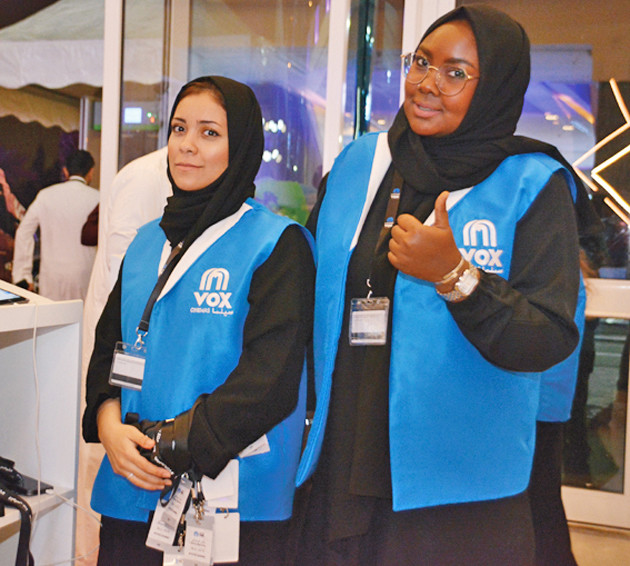
Ushers welcome moviegoers during Monday’s opening of the first cinema in Jeddah. (Photo by Huda Bashatah )
Updated 29 January 2019
Follow

First cinema in Jeddah opens

  • Total revenue expected to reach $1.5 billion by 2030: PwC Middle East
  • Decades-long cinema ban ended last April.

JEDDAH: Jeddah’s first cinema opened its doors to the public on Monday, and an industry expert told Arab News he expected up to 35 million people in the Kingdom to go to the movies every year. 

Cinemas were banned in the country for decades until the first one opened last April in Riyadh. 

Cameron Mitchell, CEO of the regional cinema chain Majid Al Futtaim, said Saudi Arabia had the capacity for high audience numbers.


He was speaking at the opening ceremony for Vox Cinemas in Jeddah‘s Red Sea Mall.

“If you look at Dubai we have some 15 million customers there per annum. On the short-term goal in Saudi Arabia we are expecting the market to reach about 30 million customers,” he said.

Research from PwC Middle East in November estimated that total cinema revenue in Saudi Arabia would reach $1.5 billion by 2030. The forecast was based on a projected 2030 population of 39.5 million, and 6.6 screens per 100,000 people. 

Last year, Vox Cinemas said it would be investing $533 million to open 600 theaters in the next five years.

“Some 95 percent of our employees here are from Saudi Arabia. In any country where we operate cinemas, we localize the team. We have an Egyptian team in Egypt and a Lebanese team in Lebanon and of course Saudis in Saudi Arabia,” Mitchell said. 

“We expect the cinemas in the Red Sea Mall to be showing…a mix of films, probably about 300 films per year with at least six new movies every single week. It will take a while for us to have enough cinemas for everyone to get to go to the cinema whenever they want to. 

“In my opinion, the cinema is a good place for families to spend time together in a social environment, especially in hot summer days, when outdoor activities are limited.” 


There will be cinemas in Tabuk by the end of this year or by early 2020 and the Saudi government has been very helpful, he said, adding: “We got the license last April and we were keen to do the required steps and follow the regulations, and that went smoothly.”

There would be no issues with gender segregation as there were cinemas for families and separate ones for bachelors, according to Mitchell.

The lifting of the cinema ban is part of the Vision 2030 reform plan.


Saudi authority sets new standards for beach operators on the Red Sea

Updated 5 sec ago
Follow

Saudi authority sets new standards for beach operators on the Red Sea

JEDDAH: The Saudi Red Sea Authority has announced a new regulatory framework for beach operations, redefining beaches as managed operating sites rather than informal recreational spaces, the Saudi Press Agency reported.

The framework introduces standardized requirements for beach operators, focusing on licensing, safety, risk management and service quality across coastal tourism activities.

Under the regulations, beach operations will be permitted only through licensed entities, with license issued for two-year periods. 

Renewal applications must be submitted at least 30 days before expiration. The authority said the system is intended to bring consistency to beach management and provide operators with clearer operational timelines.

The framework applies along more than 1,800 km of Red Sea coastline and establishes a unified national approach to regulating beach activities. The authority said no beach operation will be allowed without an official license. 

The initiative supports the authority’s broader objectives to develop a coastal tourism sector that contributes SR85 billion ($22.66 billion) to GDP by 2030, creates approximately 210,000 jobs, and attracts 19 million visitors, the SPA noted. 

To ensure a smooth transition, the regulations will come into effect one month after their announcement, while existing operators will be granted a one-year grace period to comply. 

Safety forms a central pillar of the new framework. Licensing conditions include environmental permits, insurance coverage, approved safety plans, defined activity zones, and assessments of beach capacity.

Operators will also be required to provide licensed lifeguards, safety equipment, and systems for incident reporting and analysis.

The requirements extend to infrastructure and operation standards, including compliance with the Saudi Building Code to ensure accessibility for people with disabilities and structural safety.

Operators are also encouraged to align with international benchmarks such as Blue Flag standards and the ISO 13009:2024 for beach management, the SPA added.

The authority said this framework is designed to reduce operational risks, improve oversight and support the sustainable development of coastal tourism.

Unified requirements reduce operational risks, minimize inconsistencies, and improve the sector’s ability to attract financing and scale sustainably.