

Private sector must ‘step up’ for Saudi Vision 2030 goals, says Crescent’s Badr Jafar

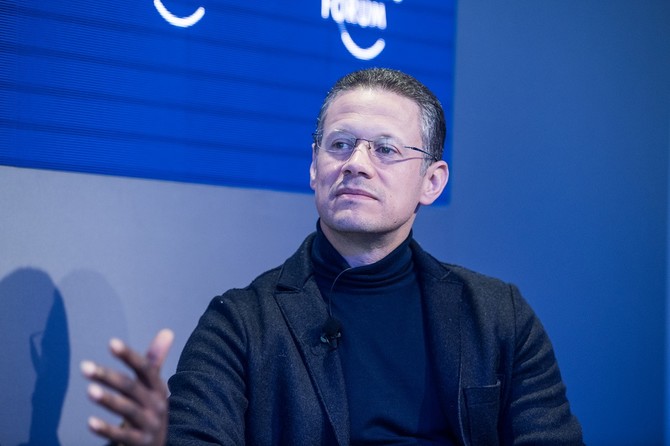
Badr Jafar has been involved in panels on philanthropy and family businesses at Davos, among others. (Courtesy WEF)
Updated 30 January 2019
Follow

Private sector must ‘step up’ for Saudi Vision 2030 goals, says Crescent’s Badr Jafar

  • Badr Jafar: The private sector in Saudi Arabia has to step up and take authentic ownership of the Saudi Vision 2030
  • Badr Jafar: From our perspective, what is going on in Saudi Arabia is a tremendous opportunity, and we want to work toward delivering on the Vision 2030 strategy

DAVOS: One of the Arabian Gulf’s leading businessmen believes the private sector in Saudi Arabia must play a greater role in the Vision 2030 strategy to diversify the nation’s economy and reduce its dependency on oil revenue.
“The private sector in Saudi Arabia has to step up and take authentic ownership of the Saudi Vision 2030,” said Badr Jafar, president of Crescent Petroleum and CEO of Crescent Enterprises, the Sharjah-based international conglomerate with interests in shipping, ports, energy and several other industrial sectors.
Speaking to Arab News on the sidelines of the World Economic Forum (WEF) Annual Meeting in Davos, he added: “When people think of a country in the Middle East region, they tend to think of just its government but I like to think of the whole ecosystem, both public and private sector. I believe the private sector has to play a bigger part in both Saudi Arabia and the UAE.”
Jafar acknowledged that there are some critics who doubt the ability of the Saudi government to successfully implement the Vision 2030 transformation, but added: “If there were no skeptics, I think that would tell you the Vision isn’t big enough. There will always be skeptics, and in some ways that is a healthy thing because it adds an element of accountability.”
Jafar said that Gulftainer’s port terminal operations in Saudi Arabia, at Jeddah and Jubail, are being expanded. Gulftainer is a subsidiary of Crescent Enterprises.
“We see ourselves as an Emirati company but also as a part of the Gulf community,” he explained. “From our perspective, what is going on in Saudi Arabia is a tremendous opportunity, and we want to work toward delivering on the Vision 2030 strategy. It is too important to fail and we all have a vested interest in making it succeed.”
He said there will be challenges along the way but that Saudi policymakers should ensure that there is enough flexibility in the economic and political systems to overcome them.
“It is all about building into the system sufficient resilience to cancel out the shocks,” Jafar added. “This is the Middle East; there will always be shocks. But one way to do it is to empower the private sector to take charge of its own destiny.”
Gulftainer, of which Jafar is also chairman, recently pulled off a business coup with its $600 million plan to redevelop and operate the port in Wilmington, Delaware, as a major port facility on the US east coast. The US ports sector has presented challenges to Gulf businesses in the past but Jafar said that Crescent’s pedigree in the UAE, combined with its existing ports business at Canaveral, Florida, and its efficiency record in the industry, had helped ease the deal through.
“We had the acceptance and trust of the local community,” he said.
Jafar has been involved in various sessions at Davos, including panels on philanthropy and family businesses. He echoed the views of WEF founder Klaus Schwab that there should be a new approach to philanthropy based on a coordinated, rather than a collaborative, approach.
“What inspires philanthropists in Saudi Arabia or the UAE is not the same as what inspires them in New York and Beijing,” he said.
He sees a strong affinity between philanthropy and family businesses, especially in the Islamic world where the payment of charitable taxes — zakat — is a religious duty. The top 500 family businesses in the world generate sales in excess of $6.5 trillion, making them the third-largest global economy, and they employ 50 million people, he said.

The above text has been changed to make it clear that Badr Jafar is also CEO of Crescent Enterprises, and that Gulftainer, a subsidiary of Crescent Enterprises, runs port terminal operations in Saudi Arabia, at Jeddah and Jubail. The top 500 family businesses generate sales in excess of $6.5 trillion, rather than being valued at that amount. 


UAE’s Masdar seals deal for 200MW floating solar project in Malaysia 

Updated 11 sec ago
Follow

UAE’s Masdar seals deal for 200MW floating solar project in Malaysia 

RIYADH: Abu Dhabi’s renewable energy firm Masdar has signed its first partnership in Malaysia, setting the stage for the largest floating solar project in Southeast Asia. 

Masdar, together with Malaysian partners Citaglobal and Tiza Global, has signed a power purchase agreement with national utility Tenaga Nasional Berhad to develop a pioneering 200-megawatt floating photovoltaic plant at the Chereh Dam in Pahang state, the Emirates News Agency reported. 

Spanning approximately 950 acres of reservoir surface, the Chereh Dam plant will boast a generation capacity exceeding 300MW-peak, delivering clean electricity equivalent to the needs of more than 100,000 homes. 

With an estimated project value exceeding $208 million, the venture represents a significant step toward Malaysia’s goal of deriving 35 percent of its national energy mix from renewables by 2030. 

Mohamed Jameel Al-Ramahi, CEO of Masdar, said: “This is a milestone project, our largest floating solar development globally and our inaugural project in Malaysia, reaffirms Masdar’s expertise in floating solar and our position as a trusted partner across the region.” 

He added: “By leveraging our experience in delivering utility-scale solutions worldwide, we can provide affordable, secure, clean energy to the Malaysian people.” 

The CEO said he looked forward to working closely with Citaglobal, Tiza Global, and the Malaysian government to help deliver the country’s ambitious renewable energy roadmap. 

The consortium secured the project through a competitive tender under Malaysia’s Large Scale Solar Cycle 5+ program, offering the lowest tariff in its category, supported by Masdar’s global supply-chain capabilities and regional experience, including the 145-MW Cirata floating solar plant in Indonesia. 

Tan Sri Mohamad Norza Zakaria, executive chairman and president of Citaglobal Berhad, said: “This collaboration gives us confidence that the Chereh floating solar project will be delivered to the highest international standards, while strengthening Malaysia’s energy security and long-term economic resilience.” 

The Chereh floating solar plant will be the first project under the 10-gigawatt renewable energy roadmap agreed in 2023 between Masdar and the Malaysian Investment Development Authority, the WAM report added. 

Beyond Pahang, Masdar is advancing a feasibility study for a major floating solar installation at Sarawak’s Murum reservoir, in collaboration with Sarawak Energy and Gentari, initiatives aligned with Malaysia’s National Energy Transition Roadmap and New Industrial Master Plan 2030. 

The Chereh Dam project also emphasizes local integration, partnering with Pahang Water & Energy Resources for execution. It will deploy advanced floating solar technology tailored to the dam’s topography, optimizing performance while conserving freshwater. 

Financed through a non-recourse structure with international lenders, the project reflects strong market confidence. Floating solar is particularly well suited to Malaysia, offering a land-efficient, scalable solution enhanced by natural water-cooling effects.