

Private sector must ‘step up’ for Saudi Vision 2030 goals, says Crescent’s Badr Jafar

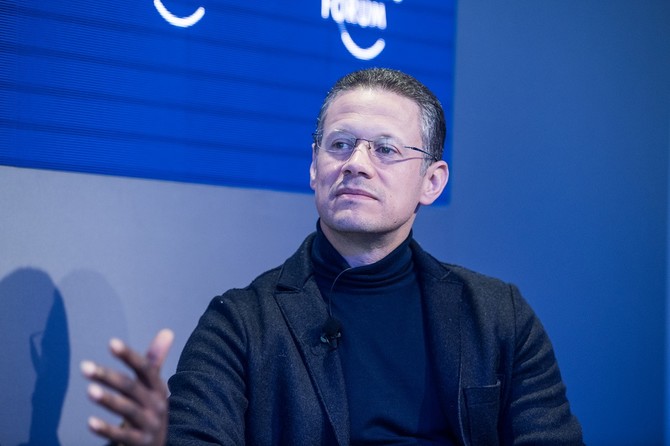
Badr Jafar has been involved in panels on philanthropy and family businesses at Davos, among others. (Courtesy WEF)
Updated 30 January 2019
Follow

Private sector must ‘step up’ for Saudi Vision 2030 goals, says Crescent’s Badr Jafar

  • Badr Jafar: The private sector in Saudi Arabia has to step up and take authentic ownership of the Saudi Vision 2030
  • Badr Jafar: From our perspective, what is going on in Saudi Arabia is a tremendous opportunity, and we want to work toward delivering on the Vision 2030 strategy

DAVOS: One of the Arabian Gulf’s leading businessmen believes the private sector in Saudi Arabia must play a greater role in the Vision 2030 strategy to diversify the nation’s economy and reduce its dependency on oil revenue.
“The private sector in Saudi Arabia has to step up and take authentic ownership of the Saudi Vision 2030,” said Badr Jafar, president of Crescent Petroleum and CEO of Crescent Enterprises, the Sharjah-based international conglomerate with interests in shipping, ports, energy and several other industrial sectors.
Speaking to Arab News on the sidelines of the World Economic Forum (WEF) Annual Meeting in Davos, he added: “When people think of a country in the Middle East region, they tend to think of just its government but I like to think of the whole ecosystem, both public and private sector. I believe the private sector has to play a bigger part in both Saudi Arabia and the UAE.”
Jafar acknowledged that there are some critics who doubt the ability of the Saudi government to successfully implement the Vision 2030 transformation, but added: “If there were no skeptics, I think that would tell you the Vision isn’t big enough. There will always be skeptics, and in some ways that is a healthy thing because it adds an element of accountability.”
Jafar said that Gulftainer’s port terminal operations in Saudi Arabia, at Jeddah and Jubail, are being expanded. Gulftainer is a subsidiary of Crescent Enterprises.
“We see ourselves as an Emirati company but also as a part of the Gulf community,” he explained. “From our perspective, what is going on in Saudi Arabia is a tremendous opportunity, and we want to work toward delivering on the Vision 2030 strategy. It is too important to fail and we all have a vested interest in making it succeed.”
He said there will be challenges along the way but that Saudi policymakers should ensure that there is enough flexibility in the economic and political systems to overcome them.
“It is all about building into the system sufficient resilience to cancel out the shocks,” Jafar added. “This is the Middle East; there will always be shocks. But one way to do it is to empower the private sector to take charge of its own destiny.”
Gulftainer, of which Jafar is also chairman, recently pulled off a business coup with its $600 million plan to redevelop and operate the port in Wilmington, Delaware, as a major port facility on the US east coast. The US ports sector has presented challenges to Gulf businesses in the past but Jafar said that Crescent’s pedigree in the UAE, combined with its existing ports business at Canaveral, Florida, and its efficiency record in the industry, had helped ease the deal through.
“We had the acceptance and trust of the local community,” he said.
Jafar has been involved in various sessions at Davos, including panels on philanthropy and family businesses. He echoed the views of WEF founder Klaus Schwab that there should be a new approach to philanthropy based on a coordinated, rather than a collaborative, approach.
“What inspires philanthropists in Saudi Arabia or the UAE is not the same as what inspires them in New York and Beijing,” he said.
He sees a strong affinity between philanthropy and family businesses, especially in the Islamic world where the payment of charitable taxes — zakat — is a religious duty. The top 500 family businesses in the world generate sales in excess of $6.5 trillion, making them the third-largest global economy, and they employ 50 million people, he said.

The above text has been changed to make it clear that Badr Jafar is also CEO of Crescent Enterprises, and that Gulftainer, a subsidiary of Crescent Enterprises, runs port terminal operations in Saudi Arabia, at Jeddah and Jubail. The top 500 family businesses generate sales in excess of $6.5 trillion, rather than being valued at that amount. 


Reforms target sustained growth in Saudi real estate sector, says Al-Hogail

Updated 26 January 2026
Follow

Reforms target sustained growth in Saudi real estate sector, says Al-Hogail

RIYADH: The Real Estate Future Forum opened its doors for its first day at the Four Seasons Riyadh, with prominent global and local figures coming together to engage with one of the Kingdom’s most prospering sectors.

With new regulations, laws, and investments underway, 2026 is expected to be a year of momentous progress for the real estate sector in the Kingdom.

The forum opened with a video highlighting the sector’s progress in the Kingdom, during which an emphasis was placed on the forum’s ability to create global reach, representation, as well as agreements worth a cumulative $50 billion

With the Kingdom now opening up real estate ownership to foreigners, this year’s Real Estate Future Forum is placing a great deal of importance on this new milestone and its desired outcomes and impact on the market. 

Aside from this year’s forum’s unique discussions surrounding those developments, it will also be the first of its kind to launch the Real Estate Excellence Award and announce its finalist during the three-day summit.

Minister of Municipalities and Housing and Chairman of the Real Estate General Authority Majed Al-Hogail took to stage to address the diverse audience on the real estate market’s achievements thus far and its milestones to come.

Of those important milestones, he underscored “real estate balance” as a key pillar of the sector’s decisions to implement regulatory tools “with the aim of constant growth which can maintain the vitality of this sector.” He pointed to examples of those regulatory measures, such as the White Land Tax.

On 2025’s progress, the minister highlighted the jump in Saudi family home ownership, which went from 47 percent in 2016 to 66 percent in 2025, keeping the Kingdom’s Vision 2030 goal of 70 percent by the end of the decade on track.

He said the opening of the real estate market to foreigners is an indicator of the sector’s maturity under the leadership of Crown Prince Mohammed bin Salman. He said his ministry plans to build over 300,000 housing units in Riyadh over the next three years.

Speaking to Arab News,  Al-Hogail elaborated on these achievements, stating: “Today, demand, especially local demand, has grown significantly. The mortgage market has reached record levels, exceeding SR900 billion ($240 billion) in mortgage financing, we are now seeing SRC (Saudi Real Estate Refinance Co.) injecting both local and foreign liquidity on a large scale, reaching more than SR54 billion”

Al-Hogail described Makkah and Madinah as unique and special points in the Kingdom’s real estate market as he spoke of the sector’s attractiveness.

 “Today, the Kingdom of Saudi Arabia has become, in international investment indices, one that takes a good share of the Middle East, and based on this, many real estate investment portfolios have begun to come in,” he said. 

Al-Ahsa Gov. Prince Saud bin Talal bin Badr Al-Saud told Arab News the Kingdom’s ability to balance both heritage sites with real estate is one of its strengths.

He said: “Actually the real estate market supports the whole infrastructure … the whole ecosystem goes back together in the foundation of the real estate; if we have the right infrastructure we can leverage more on tourism plus we can leverage more on the quality of life … we’re looking at 2030, this is the vision … to have the right infrastructure the time for more investors to come in real estate, entertainment, plus tourism and culture.”