



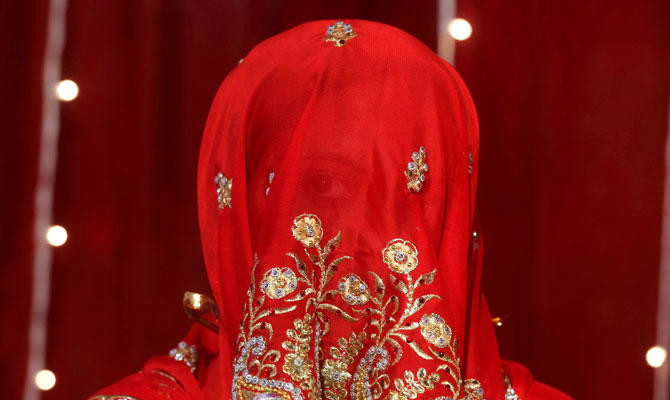
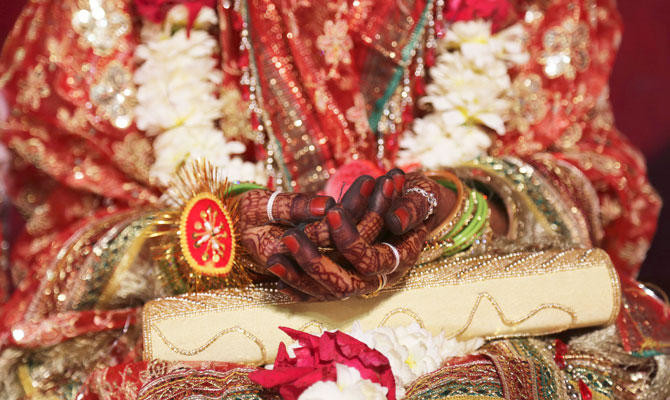
BUXWAHA, INDIA: For his 16-year-old daughter’s wedding last year, Makhanlal Ahirwal bought Bhawani saris, bangles and anklets, got her in-laws a water cooler, a bed, and utensils as dowry and threw a feast for 500 people in his village in central India.
The celebrations added 200,000 rupees ($2,800) to an unpaid debt of about 100,000 rupees that he’d already taken on for the wedding of another daughter.
To repay the original debt he had traveled 800 kilometers (497 miles) to Delhi the previous year, where he was lured by a promise of good pay at a construction site.
Instead, he was held against his will and denied wages and food for three months before he was rescued.
His experience is not uncommon in India, which is home to 8 million of a global estimated total of 40 million slaves — and where many poor families take out loans to cover marriages and then fall into modern slavery while trying to repay the money.
“I worked over 12 hours and lived in a tent, but wasn’t paid a penny,” Ahirwal said, sitting outside his clay hut in Dharampura village in the central state of Madhya Pradesh.
“I had taken that loan to get my elder daughter married. She was 14 then. But I did not get paid. I had another four daughters to marry, so I took one more loan last year,” he said.
“There is no way I can repay the loan if I don’t migrate and look for work again.”
Landless, and at the bottom in the hierarchy of the Indian caste system, the Ahirwals in Dharampura lean on local landlords who lend money at 4 percent interest.
Villagers take loans for major expenses, which in most cases are related to health care and or their daughters’ marriages.
With no work in villages, many migrate to cities and send earnings home to repay the money lenders, campaigners say.
But in many cases, unscrupulous employers dupe them into working long hours with the promise of good money, knowing they have debts to repay.
Bosses sometimes withhold pay — a practice that can trap villagers for years and is widely seen as a form of slavery.
Makhanlal Ahirwal was among the 22 people from Dharampura who were rescued from bondage two years ago and are entitled to government benefits such as cash compensation and housing.
Each of them had outstanding loans when they migrated.
“Most of us had taken loans for weddings of our children. One daughter’s marriage means four years of debt,” said Nirmal Ahirwal, who was trapped in bondage along with Makhanlal.
UNDERAGE AND OVERLEVERAGED
Many parents in Dharampura plan debt cycles around their daughters’ ages, ensuring the older ones are married before the younger ones attain puberty to avoid clustering wedding loans.
Despite being illegal, nearly 27 percent of girls get married before they turn 18 in India, accounting for the highest rates of child marriages across South Asia.
The practice is especially prevalent among the poorest and the most marginalized and officials said they lean on awareness drives to enforce the law as action against the parents would further victimize families.
Madhya Pradesh is among India’s poorest states and in Chattarpur district — home to Dharampura village — more than half the women were married before 18, government data shows.
Weddings cost up to 200,000 rupees and in many cases push entire families into modern slavery even as young girls are pulled out of schools and pushed into adulthood.
“Both parents and their daughters are victims in these cases ... they are both bonded in different forms of slavery,” said Nirmal Gorana, convener of the National Campaign Committee for Eradication of Bonded Labour.
“Workers we rescue from bondage often cite loans they took for their child’s marriage for taking up the work,” he added.
VOICELESS
Bhawani, Makhanlal’s 16-year-old daughter, comes across as a coy new bride as she walks into her parents’ home, dressed in a pink sari and faux gold bangles, a streak of red vermillion along the parting of her hair and her eyes lined with kohl.
“I never liked dressing up. But now I do what they (her in-laws) like,” she told the Thomson Reuters Foundation.
“I wanted to study. I never said I wanted to get married. But people start talking of even 15-year-olds as 20.”
Teenage girls in the village fetch water, cook, and clean and roll “beedis” (traditional cigarettes) to supplement family income. Most drop out of school young and are wed soon after.
Child marriage without consent is a form of slavery as it pushes children into sexual and domestic servitude, experts say.
“We don’t ask our parents anything. We do as they say,” said Rekha Ahirwal, 14, who dropped out after the ninth grade.
A MOMENT OF PRIDE
Many parents do not see a future for their young daughters so take loans to marry them off, said Bhuwan Ribhu, an activist with the non-profit Kailash Satyarthi Children’s Foundation.
“Besides, the girl’s marriage is a moment of pride for the family in the village as they discuss with the community what all they did, what they gave her,” he said.
Awareness drives have checked the practice, but only to some extent, according to activists and officials.
“We explain there are cash incentives if they get their daughters married after 18, but parents believe the right age ... is 12,” said Ramesh Bhandari, Chattarpur district head.
Bhawani recalls feeling crushed when her father returned exhausted and penniless from Delhi after he was rescued.
“His debt has only increased after my marriage,” she said.
But she has another loan to worry about — that of her in-laws. She will take the risk of migrating “to some city wherever there is work” with her husband to repay the 150,000 rupees they borrowed for their son’s own wedding festivities.
“This is not a big amount,” her husband Paras, 22, said.
“Weddings cost as much. We will find work soon to repay the loan.”


