


DUBAI: With Saudi Arabia standing 66th out of 134 countries in the Global Knowledge Index, the Kingdom is hoping that a focus on innovative education will boost its ranking.
Improving the quality and nature of education to enable youth to innovate and be creative will prove key to achieving that goal.
The index results were announced in Dubai last month by the Mohammed bin Rashid Al Maktoum Knowledge Foundation, in partnership with the UN Development Programme (UNDP), to measure the knowledge sector in 134 countries.
“With Saudi Arabia, we obtained the information from international organizations which were provided data from the government,” said Dr. Hany Torky, chief technical adviser at the UNDP and project director at the Arab Knowledge Project.
“We rely on international organizations like the World Bank and UNESCO (the UN Educational, Scientific and Cultural Organization),” but Arab countries “don’t convey data to international organizations” or they do so “very late,” he added.
The aim of the index is to map trends in different areas of knowledge to be able to identify challenges facing countries in the field.
Saudi Arabia scored high in sectors such as health and environment, information and communications technology, and features of the labor market. It also proved strong in research, development and innovation, ranking 38th, and the economy, at 47th.
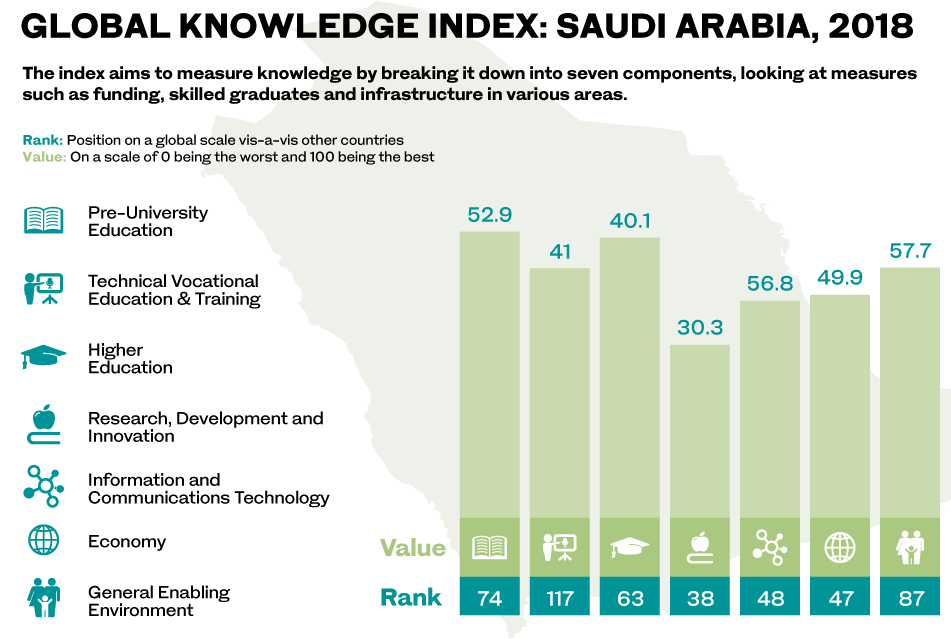
But in other sectors, the Kingdom scored relatively low. Technical and vocational education and training landed it in the 117th position, followed by 87th in the general enabling environment.
Khaled Abdul Shafi, director of the regional bureau for the UNDP, said focusing on education will be paramount for Arab countries.
“Education can give young people this freedom and not consider that it should be based on memorization,” he added.
“All the stages of education are important, and if Arab countries focus on education, we’ll be in a much better position compared to where we stand now.”
The knowledge gap between the Arab world and the West is large, with the exception of the UAE and a few other countries.
Abdul Shafi blamed this on the quality of education in the Arab world, which he said is based on spoon-feeding and does not encourage innovation as much as it should.
“It’s also not really related to the marketplace, so students are graduating without really having the skills required for the economy,” he added.
“Education is the main reason, so we need to pay a lot of attention to the education sector in all its different stages to enhance its quality. It’s very important to determine where the problem is to work on dealing with it.”
He said research, development and innovation as a whole are lacking in the Arab world compared to other countries, with an absence of youth participation and the unavailability of data and research.
“The importance of the index isn’t the ranking of countries, but to analyze the knowledge status in each country,” he added.
“They’ll be able to put their hands on their weak points and work on further enhancing these indicators to achieve much more progress,” said Abdul Shafi.
“We encourage countries and work with them to transfer the practices of developed countries to less-developed ones, so we’re not just producing a report, we’re also collaborating with some of these countries to transfer their experience and knowledge.”
As part of Saudi Arabia’s Vision 2030 reform plan, a major focus has been placed on youth and their education.
With a predominantly young population, the Kingdom has identified and developed initiatives to bridge the knowledge gap between the Arab world and the West.
Some include the Misk Global Forum, the flagship platform of Crown Prince Mohammed bin Salman’s foundation, which held its “Skills for Our Tomorrow” conference in November to focus on youth, knowledge and innovation.
The Misk Foundation has also launched a number of programs to foster talent across the Kingdom, with the aim of developing a knowledge-based economy as the country shifts away from oil.
“The report enables us to face reality,” said Aysha Al-Mansouri, a Saudi specialist in youth capabilities development.
“In Saudi, we have a clear vision and a future objective, which we hope to achieve through our Vision 2030. We need to do right by our youth and our country.”
But with 30 million illiterate people under the age of 18 in the Arab world, the task at hand is momentous.
“It’s shameful for us as Arabs, and I was surprised to see so many young illiterates,” said Jamal bin Huwaireb, CEO of the Mohammed bin Rashid Al Maktoum Knowledge Foundation.
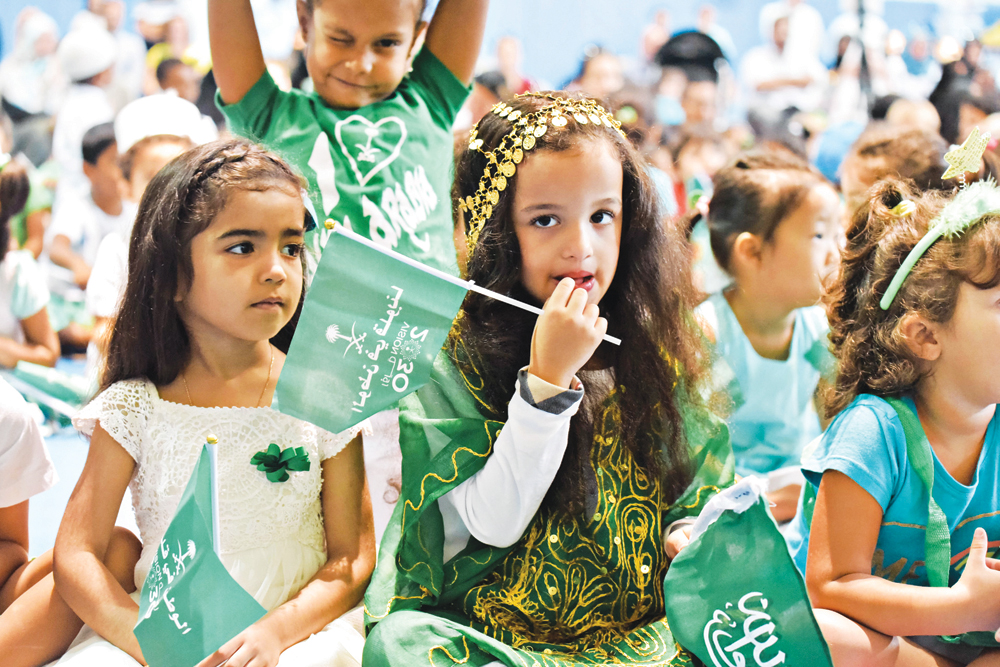
With 30 million illiterate people under the age of 18 in the Arab world, the task at hand is momentous.
“Success is going to be the result of those who work continuously and have a clear strategy. In 40 years, illiteracy was completely eliminated in the UAE, so countries like Egypt or Iraq, which used to disseminate knowledge for centuries, should work on this. We all share the same goal, so it’s not impossible.”
The challenge remains in changing a mindset in the Arab world, which Torky said still focuses on the number of graduates rather than the quality of education.
“What’s the point in having 100 percent of graduates if they don’t have the skills required for the labor market?” he asked.
“Investment in education is almost the same in all Arab (Gulf) countries, but the process and deliverables of education are problematic. To maintain the status quo is a failure, and we need to keep improving.”
The education sector will have to keep up with the pace of technological transformation. “There are impacts of the acceleration in technology, like artificial intelligence, cybersecurity, blockchain and the Internet of Things, and the related skills that you need to acquire to deal with such developing technologies,” Torky said.
“In the near future, there will be seven countries that will lead the world in knowledge, and the UAE is one of them, having jumped six positions in the index in 2018,” he added.
“Arab countries can actually reach such status, like the US, the UK, Singapore, Finland, Sweden and Brazil.”
Bin Huwaireb expressed hope that other Arab foundations will eventually collaborate with the UNDP in disseminating knowledge.
“We have a single goal of reinforcing the concept of knowledge in the Arab world,” he said. “Over the years, we can now see that the difference is clear and everybody is speaking about knowledge, the knowledge economy, the industrial revolution and knowledge reports.”
Workshops are being held in Arab countries such as Jordan and Egypt to create momentum across the region.
“We are beginning to reap the benefits of this project,” bin Huwaireb said. “Many Arab countries have a problem with empowering environments, but they should do their best to bridge this gap between them and other developed countries so their knowledge indicators can climb to higher rankings.”
He touched on scientific research, a vital element still lagging in the region. “Scientific research centers are a real obstacle we suffer from in the Arab world, because without such centers there will be no progress and no knowledge generation,” he said.
“But there are major plans and strategies to allocate the proper funds for scientific research, and we want it to increase in all Arab countries. It needs some time, but encouragement, motivation and collaboration should continue.”


