UK court rejects case brought by mother of Daesh ‘Beatle’ held in Syria

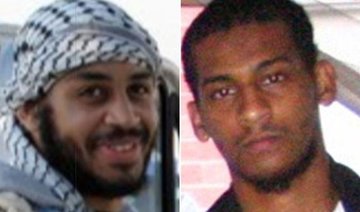
Daesh extremists Alexanda Kotey, left, and Shafee Elsheikh are detained in Syria. (Syrian Democratic Forces/Handout via Reuters)
Updated 19 January 2019
Follow

UK court rejects case brought by mother of Daesh ‘Beatle’ held in Syria

  • El Shafee Elsheikh and Alexanda Kotey are being held by Kurdish militia after being captured in Syria last year
  • United States wants to extradite them and Britain has said it will not stand in the way

LONDON: The mother of one of the British Daesh militants suspected of murdering western hostages, lost a legal challenge on Friday that it was wrong for Britain to assist a US investigation which could lead to them facing the death penalty.
Britons El Shafee Elsheikh and Alexanda Kotey — two of a notorious group of British fighters nicknamed “The Beatles” — are being held by Kurdish militia after being captured in Syria last year.
The United States wants to extradite them and Britain has said it will not stand in the way of any future US prosecution that would seek the death penalty, waiving a long-standing objection to executions.
Elsheikh’s mother, Maha El Gizouli, had sought a judicial review, saying it was unlawful for Britain’s interior minister to provide mutual legal assistance in a case which could lead to prosecutions for offenses which carried the death penalty.
Her lawyers said the minister’s actions were flawed, inconsistent with Britain’s unequivocal opposition to the death penalty and violated her son’s human rights. However, London’s High Court disagreed and dismissed her claim.
“My priority has always been to ensure we deliver justice for the victims’ families and that the individuals suspected of these sickening crimes face prosecution as quickly as possible,” Home Secretary Sajid Javid said.
“Our long-standing opposition to the death penalty has not changed. Any evidence shared with the US in this case must be for the express purpose of progressing a federal prosecution.”
The most notorious of the four of the so-called Beatles was Mohammed Emwazi, known as “Jihadi John,” who is believed to have been killed in a US-British missile strike in 2015.
He became a public face of Daesh and appeared in videos showing the murders of US journalists Steven Sotloff and James Foley, US aid worker Abdul-Rahman Kassig, British aid workers David Haines and Alan Henning, Japanese journalist Kenji Goto and other hostages.
“This group of terrorists is associated with some of the most barbaric crimes committed during the conflict in Syria,” Graeme Biggar, Director of National Security at Britain’s interior ministry, said in a written statement to the court.
Britain has said it does not want the men repatriated to the United Kingdom and their British citizenship has been withdrawn.
British prosecutors concluded they did not have the evidence to launch their own case against the men but US officials then expressed frustration with the British stance of seeking an assurance that US prosecutors would not call for the death penalty, court documents showed.
However, last June, British ministers and senior officials decided the best way of ensuring a prosecution and to protect US relations was to seek no such assurance in this case.
That decision provoked criticism from opposition lawmakers and from some in the government’s own party who accused ministers of secretly abandoning Britain’s opposition to the death penalty.


Thousands estimated to flee Cambodia scam centers after crackdown

Updated 6 sec ago
Follow

Thousands estimated to flee Cambodia scam centers after crackdown

  • Hundreds of thousands have been forced to work in online scam hubs across parts of Southeast Asia
  • New wave of releases come after Cambodian Prime Minister Hun Manet pledged fresh crackdown

JAKARTA: Thousands of people are estimated to have been released from scam compounds across Cambodia over recent days, including more than 1,400 Indonesian nationals, who according to Indonesia’s Embassy in Phnom Penh have sought consular support to return home.

The online scam industry has flourished across parts of Southeast Asia in recent years, with hundreds of thousands of people forced to work in illicit operations in countries like Cambodia, Myanmar and Laos, according to a 2023 report by the UN Office of the High Commissioner for Human Rights.

A wave of foreign nationals released from scam centers in Cambodia have been seeking assistance from their embassies since last week, after Prime Minister Hun Manet pledged a fresh crackdown on the multibillion-dollar industry.

Jakarta’s mission in Phnom Penh said it has received reports from 1,440 Indonesian nationals since Friday.

“The number is quite huge, considering the Indonesian Embassy handled a total of 5,008 cases throughout 2025. Looking at the ongoing trend of law enforcement by local authorities, we expect that the flow of Indonesian nationals (seeking our assistance) will continue for some time,” the Indonesian Embassy said in a statement issued on Wednesday.

In an earlier release, the embassy said that some Indonesians traveled from provinces like Banteay Meanchey and Mondulkiri to reach the Cambodian capital, which would take them at least five hours by car.

“Following the arrest of a number of main perpetrators in various cities, many syndicate networks then disbanded and let their workers leave,” it said, while urging Indonesians to be more cautious.

“Don’t be easily tempted by unrealistic job offers abroad, promising high salaries with minimal requirements. Don’t get involved in online fraud operations abroad.”

Many trafficked foreign nationals were employed to run “romance” and cryptocurrency scams, often recruited to deceive strangers online into transferring large amounts of money.

Large queues of Chinese nationals have also been spotted in front of the Chinese Embassy in Phnom Penh this week, while Amnesty International has pointed to recent footage showing “the mass release and escape attempts from scamming compounds” across Cambodia.

In a statement issued on Friday, Amnesty said it had geolocated 15 videos and images, and reviewed social media posts that show people leaving, or having already left, multiple locations that have been confirmed as scamming compounds or identified as suspected sites for fraud operations.

“There are no official figures on the total number of scamming compounds in Cambodia, but for an Amnesty International investigation, our team visited 52 of 53 identified scamming compounds in 16 cities … a single scamming compound can employ thousands of workers,” Amnesty International Indonesia spokesperson Haeril Halim told Arab News.

He added that “many human rights violations” were found in the scamming compounds Amnesty investigated, including human trafficking, torture and other ill-treatment, forced labor, child labor, deprivation of liberty and slavery.

The recent releases of foreign nationals came after Chen Zhi, a Chinese-born Cambodian tycoon, was arrested and extradited to China earlier this month.

Chen was sanctioned by the UK and the US in October last year, with the US Department of Treasury accusing him of running “a transnational criminal empire through online investment scams targeting Americans and others worldwide.”

Estimates from the UN Office on Drugs and Crime show that scam victims worldwide lost between $18 billion and $37 billion in 2023.