Arab News profiles four Daesh extremists who became known as the ‘Beatles Cell’

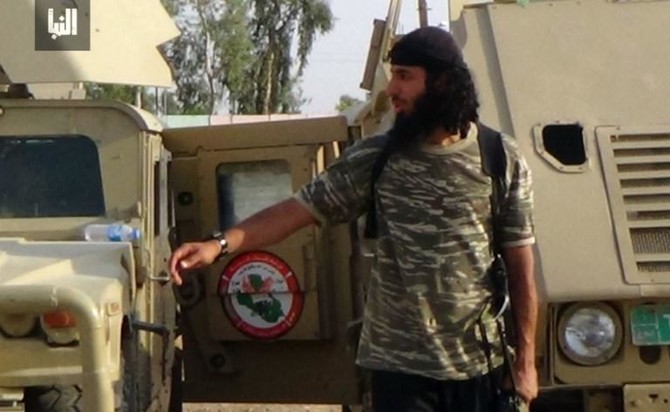
An undated image made available on Jan. 27, 2016 and published in the 15th edition of Daesh’s online Arabic-language magazine Al-Naba allegedly shows Daesh militant Mohammed Emwaz - known as ‘Jihadi John’ in western media. (AFP)
Updated 09 February 2018
Follow

Arab News profiles four Daesh extremists who became known as the ‘Beatles Cell’

Arab News profiles the four Daesh extremists who became known as the ‘Beatles Cell’. They all grew up far away from the battlefields and hardship of Syria and Iraq and hailed from West London.

- El Shafee Elsheikh, 29: Was born in Sudan, the middle of three sons, but arrived in Britain in the early 1990s when his family fled their homeland. He grew up in White City, where he worked as a mechanic mending funfair machinery and supported Queen’s Park Rangers football team. He was influenced by the sermons of a West London imam and left for Syria at the beginning of 2012. His father described his son’s radicalization as “lightning-fast”. In Syria, Elsheikh gained a reputation for using waterboarding, mock executions and crucifixion as to torture captives. His younger brother, Mahmoud, followed him to the war zone and was killed fighting for Daesh in Iraq last year. He was 17.
- Alexanda Kotey, 34: Half Ghanaian and half-Cypriot and grew up as a Greek Orthodox Christian in the Paddington area of London. A father-of-two and a convert to Islam in his late teens or early 20s, the US identified him as a cell member in Jan. 2017. According to the State Department it is likely that he took part in executions and used “exceptionally cruel torture methods, including electric shock and waterboarding.” He also acted as a recruiter for Daesh, persuading several other Britons to join the ”cause.”


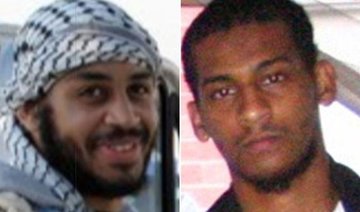
L-R: Alexanda Kotey, El-Shafee Elsheikh, Mohammed Emwazi and Aine Davis

- Mohamed Emwazi: Was the cell’s most notorious member. Nicknamed Jihadi John, he was the black-masked figure who posed in videos, speaking with an unmistakably British accent and brandishing a large knife with which he beheaded his captives. He was born in Kuwait and moved to Britain as a child, where he attended state schools and went on to study computer science at the University of Westminster. He left for Syria in 2013. He murdered American journalists James Foley and Steven Sotloff and was himself killed in an airstrike in 2015. He never showed his face publicly but is thought to have been in his mid-20s.
- Aine Davis: Grew up in Hammersmith, West London, the son of a school dinner lady and a shop assistant who worked in John Lewis, favorite department store of the middle classes. A known drug dealer, he served time in jail in 2006 for possession of a firearm. It is believed he converted to Islam in prison and befriended Emwazi because they prayed at the same West London mosque. He took the name Hamza and it is believed he went to Syria in 2012, leaving behind four children born to two different women.
He was tried and convicted of terrorism by a Turkish court last May and is now serving seven-and-half years. He denies he is a member of Daesh, saying he went to Syria to fight oppression.
UK’s Starmer calls Trump’s remarks on allies in Afghanistan ‘frankly appalling’

Updated 5 sec ago
Follow

UK’s Starmer calls Trump’s remarks on allies in Afghanistan ‘frankly appalling’

  • Britain lost 457 service personnel killed in Afghanistan, its deadliest overseas war since the 1950s

LONDON: British Prime Minister Keir Starmer called ​US President Donald Trump’s comments about European troops staying off the front lines in Afghanistan insulting and appalling, joining a chorus of criticism from other European officials and veterans.
“I consider President Trump’s remarks to be insulting and frankly appalling, and I’m not surprised they’ve caused such hurt for the loved ones of those who were killed or injured,” Starmer told reporters.
When asked whether he would demand an apology from the US leader, Starmer said: “If I had misspoken in that way or said those words, I would certainly apologize.”
Britain lost 457 service personnel killed in Afghanistan, its deadliest overseas war since the 1950s. For several of the war’s most intense years it led the allied campaign in Helmand, Afghanistan’s biggest and most violent province, ‌while also fighting as ‌the main US battlefield ally in Iraq.
Starmer’s remarks were notably strong coming ‌from ⁠a ​leader who has ‌tended to avoid direct criticism of Trump in public.
Trump told Fox Business Network’s “Mornings with Maria” on Thursday the United States had “never needed” the transatlantic alliance and accused allies of staying “a little off the front lines” in Afghanistan.
His remarks added to already strained relations with European allies after he used the World Economic Forum in the Swiss ski resort of Davos to again signal his interest in acquiring Greenland.
Dutch Foreign Minister David van Weel condemned Trump’s remarks on Afghanistan, calling them untrue and disrespectful.
Britain’s Prince Harry, who served in Afghanistan, also weighed in. “Those sacrifices deserve to be spoken about truthfully and with respect,” he said in a statement.

’WE PAID IN ⁠BLOOD FOR THIS ALLIANCE’
“We expect an apology for this statement,” Roman Polko, a retired Polish general and former special forces commander who also served in Afghanistan and ‌Iraq, told Reuters in an interview.
Trump has “crossed a red line,” he added. “We ‍paid with blood for this alliance. We truly sacrificed our ‍own lives.”
Britain’s veterans minister, Alistair Carns, whose own military service included five tours including alongside American troops in Afghanistan, called ‍Trump’s claims “utterly ridiculous.”
“We shed blood, sweat and tears together. Not everybody came home,” he said in a video posted on X.
Richard Moore, the former head of Britain’s MI6 intelligence service, said he, like many MI6 officers, had operated in dangerous environments with “brave and highly esteemed” CIA counterparts and had been proud to do so with Britain’s closest ally.
Under NATO’s founding treaty, members are bound by a collective-defense clause, Article ​5, which treats an attack on one member as an attack on all.
It has been invoked only once — after the September 11, 2001 attacks on New York and Washington, when allies pledged to support ⁠the United States. For most of the war in Afghanistan, the US-led force there was under NATO command.

POLISH SACRIFICE ‘MUST NOT BE DIMINISHED’
Some politicians noted that Trump had avoided the draft for the Vietnam War, citing bone spurs in his feet.
“Trump avoided military service 5 times,” Ed Davey, leader of Britain’s centrist Liberal Democrats, wrote on X. “How dare he question their sacrifice.”
Poland’s sacrifice “will never be forgotten and must not be diminished,” Defense Minister Wladyslaw Kosiniak-Kamysz said.
Trump’s comments were “ignorant,” said Rasmus Jarlov, an opposition Conservative Party member of Denmark’s parliament. In addition to the British deaths, more than 150 Canadians were killed in Afghanistan, along with 90 French service personnel and scores from Germany, Italy and other countries. Denmark — now under heavy pressure from Trump to transfer its semi-autonomous region of Greenland to the US — lost 44 troops, one of NATO’s highest per-capita death rates.
The United States lost about 2,460 troops in Afghanistan, according to the US Department of Defense, a figure on par per capita with those of Britain and Denmark. (Reporting by Sam ‌Tabahriti and Elizabeth Evans in London, Stine Jacobsen in Copenhagen and Terje Solsvik in Oslo, Malgorzata Wojtunik in Gdansk, additional reporting by Andrew MacAskill, Muvija M and James Davey in London and Bart Meijer in Amsterdam; Writing by Sam Tabahriti; editing by Gareth Jones, Andrew Heavens, Ros ‌Russell and Diane Craft)