Asif Khosa sworn in as Pakistan’s new chief justice

1 / 4
President Dr. Arif Alvi, second right, administering the oath of office to Justice Asif Saeed Khan Khosa, right, as Chief Justice of Pakistan in Islamabad on Jan. 18, 2019. Prime Minister Imran Khan is also present on the occasion. (Photo Courtesy: President Office)
2 / 4
Justice Asif Saeed Khosa, right, takes oath as the new Chief Justice of Pakistan on Friday. (Photo courtesy: PM Office)
3 / 4
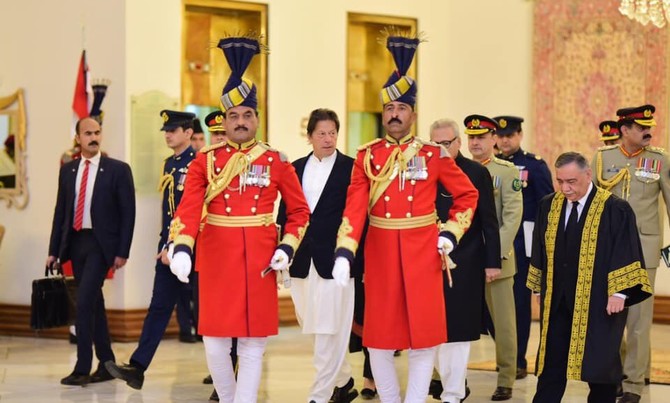
Justice Asif Saeed Khosa arrives at his oath-taking ceremony along with President Arif Alvi and Prime Minister Imran Khan. (Photo courtesy: PM Office)
4 / 4
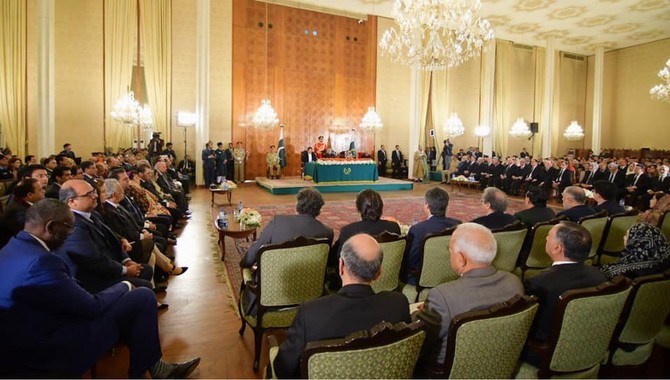
Oath-taking ceremony held at President House and attended by top civilian and military leaders, diplomats and foreign dignitaries (Photo by PM Office)
Updated 19 January 2019
Follow

Asif Khosa sworn in as Pakistan’s new chief justice

  • Vows to tackle delays in disposal of cases
  • Expected to be less activist than his predecessor

ISLAMABAD: Justice Asif Saeed Khan Khosa was sworn in as Pakistan’s new Supreme Court chief justice on Friday at a ceremony attended by top civilian and military leaders, diplomats and foreign dignitaries.
President Dr. Arif Alvi administered oath to the country’s top judge before an audience that included Prime Minister Imran Khan, Army Chief Qamar Javed Bajwa and other top government and military officials.
“I will do right to all manner of people, according to law, without fear or favor,” Khosa said as he read out the oath. 
The incoming chief justice is known as a competent and proficient judge, and has decided around 55,000 cases in a career spanning over two decades long career. 
“The legal fraternity expects him [Khosa] to devise a permanent mechanism to clear backlog of around 1.9 million cases pending in the courts as justice delayed is justice denied,” said Habibullah Khan, a senior lawyer of Supreme Court, adding that unlike his predecessor who had cultivated a reputation for judicial activism, Khosa would act as a more classical judge.
At outgoing chief justice Mian Saqib Nisar’s full court reference on Thursday, Justice Khosa said that he would try his best to remove delays in the disposition of cases at all levels of the judicial hierarchy.
In reference to the outgoing chief justice’s crusade to raise funds to build dams in Pakistan, Khosa said on Thursday: “I would also like to build some dams, a dam against undue and unnecessary delays in judicial determination of cases, a dam against frivolous litigation and a dam against fake witnesses and false testimonies and would also try to retire a debt, the debt of pending cases which must be decided at the earliest possible.”
Khosa said that he was aware of the problems in the judicial system, “but I may assure you that no stone shall be left unturned in attending to such issues and in trying to improve the situation.”
Khosa is known to have a penchant for literary quotations and began the 2017 verdict in the Panama Papers case with the line “Behind every great fortune there is a crime” from the popular 1969 novel, “The Godfather,” by Mario Puzo. 
Khosa headed the bench that upheld the death penalty for Mumtaz Qadri who murdered Punjab governor Salman Taseer in 2015 for supporting a woman wrongly accused of blasphemy, and was also part of the bench that acquitted a poor, Christian woman in a landmark blasphemy case after eight years on death row. 
Khosa will retire on December 21 this year.


Pakistan to play India in T20 World Cup, government says

Updated 09 February 2026
Follow

Pakistan to play India in T20 World Cup, government says

  • Islamabad announced boycotting the Feb. 15 match in Colombo to protest the ICC’s exclusion of Bangladesh from the T20 World Cup
  • Pakistan’s government says the decision to play India is taken to protect ‘spirit of cricket and to support the continuity of global sport’

ISLAMABAD: Pakistan Prime Minister Shehbaz Sharif has cleared the country’s cricket team to play India in the T20 World Cup on Feb. 15, the Pakistani government announced late Monday, ending a week-long standoff.

Islamabad announced boycotting the Feb. 15 match in Colombo to protest the International Cricket Council’s (ICC) exclusion of Bangladesh from the T20 World Cup, following Dhaka’s decision to not play matches in India owing to security fears.

On Sunday, ICC Deputy Chairman Imran Khwaja arrived in Lahore for talks with Pakistan Cricket Board (PCB) officials and Bangladesh Cricket Board (BCB) President Aminul Islam as the sport’s governing body strived to save the high-stakes T20 World Cup encounter.

PCB Chairman Mohsin Naqvi met PM Sharif late Monday and briefed him regarding the outcomes of high-level deliberations held between the PCB, Bangladesh board and ICC representatives, the Pakistani government said on X.

“The Government of Pakistan has reviewed the formal requests extended to the PCB by the Bangladesh Cricket Board, as well as the supporting communications from Sri Lanka, the United Arab Emirates, and other member nations. These correspondences sought Pakistan’s leadership in securing a viable solution to recent challenges,” the Pakistani government said.

“In view of the outcomes achieved in multilateral discussions, as well as the request of friendly countries, the Government of Pakistan hereby directs the Pakistan National Cricket Team to take the field on February 15, 2026, for its scheduled fixture in the ICC Men’s T20 World Cup.”

The BCB earlier thanked the PCB, ICC and all others for their positive roles in trying to “overcome recent challenges,” particularly thanking PCB Chairman Naqvi and Pakistani cricket fans for demonstrating “exemplary sportsmanship and solidarity.”

“We are deeply moved by Pakistan’s efforts to go above and beyond in supporting Bangladesh during this period. Long may our brotherhood flourish,” BCB President Islam said in a statement.

“Following my short visit to Pakistan yesterday and given the forthcoming outcomes of our discussions, I request Pakistan to play the ICC T20 World Cup game on 15 February against India for the benefit of the entire cricket ecosystem.”

The dispute stemmed from the ICC’s decision to replace Bangladesh with Scotland last month after Bangladesh refused to play tournament matches in India. Dhaka’s decision followed the removal of Mustafizur Rahman from the Indian Premier League (IPL). He was bought for $1 million by the IPL’s Kolkata Knight Riders, but on Jan. 3 the Board of Control for Cricket in India (BCCI) ordered Kolkata to release Mustafizur without a public explanation but amid regional tensions.

Pakistani cricket authorities subsequently announced boycotting the match against India at R. Premadasa Stadium in Colombo on Feb. 15. An India-Pakistan fixture is the sport’s most lucrative asset, generating a massive share of global broadcasting and sponsorship revenue.

“This decision [to play India in T20 World Cup] has been taken with the aim of protecting the spirit of cricket, and to support the continuity of this global sport in all participating nations,” the Pakistani government said.

“We remain confident that our team will carry the spirit of sportsmanship and national pride onto the field as they compete for global glory.”