

UAE passenger jet makes long haul journey on locally produced biofuel

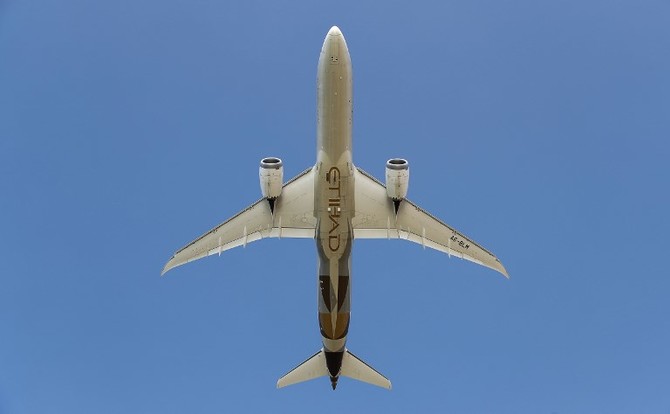
The Boeing 787 was powered by biofuel produced in the UAE and flew from Abu Dhabi to Amsterdam. (AFP)
Updated 17 January 2019
Follow

UAE passenger jet makes long haul journey on locally produced biofuel

  • The biofuel was produced from plants grown in a local saltwater ecosystem in Abu Dhabi
  • It can be refined using existing infrastructure and used with current engines and airport fueling systems

DUBAI: Etihad Airways flew the first commercial flight powered by locally produced sustainable fuel Wednesday, Emirati airlines Etihad Airways reported on their website from an announcement by the Sustainable Bioenergy Research Consortium (SBRC).

The Boeing 787, flying from Abu Dhabi to Amsterdam, used biofuel produced from the oil of Salicornia plants, which are grown in the Seawater Energy and Agriculture System (SEAS), in Masdar City near the UAE capital - Abu Dhabi.

The SEAS project is the world’s first desert ecosystem made specially to produce fuel and food in saltwater.

While Etihad is not the first airline to use biofuel in its aircraft, it is the first time in the UAE for the source of the biofuel to be grown and produced in the country.

“Etihad’s flight proves SEAS is a game-changer that can substantially benefit air transport and the world,” said Vice President of strategy and market development for Boeing International Sean Schwinn.

“The research and technology being developed shows significant promise to transform coastal deserts into productive farmland supporting food security and cleaner skies.”

The biofuel can be produced using existing refinery facilities, it can be blended with regular jet fuel, and used with existing aircraft, engines and airport fueling delivery systems

Biofuels were introduced for commercial flight use in 2011.

Since then nearly 160,000 passengers have flown on flights powered by a blend of sustainable and traditional jet fuels.

The water used for the SEAS project is drawn from fish and shrimp farmeries that produce food for the UAE.

The system is expected to expand to cover 2 mln square meters over the course of the next few years.

Riyadh Cement Co. to fully switch to natural gas by 2027: CEO

Updated 9 sec ago
Follow

Riyadh Cement Co. to fully switch to natural gas by 2027: CEO

RIYADH: Riyadh Cement Co. is expected to fully rely on natural gas as an alternative to liquid fuel in its operational processes at the beginning of 2027, CEO Shoeil Al-Ayed confirmed to Al-Eqtisadiah.

The company had announced on Tadawul at the beginning of the year the signing of a contract with Chengdu Design & Research Institute worth SR59.4 million ($15.8 million), as part of the liquid fuel displacement program. 

It noted that the contractor has taken over the site and begun project implementation as of the announcement date, and the advance payment has been made to it according to the payment terms.

In response to the sector’s suffering despite massive projects in the country, Al-Ayed told Al-Eqtisadiah: “The cement sector during the third quarter of 2025 faced some challenges represented in high clinker inventory levels for most companies, which reflected an increase in supply exceeding the actual demand in the market.”

Regarding the existence of a price war in the sector to gain market share, the top official indicated that the market has not witnessed a real price war, but rather has been subjected to increasing pressures that led to a noticeable decline in selling costs. This negatively impacted the profitability levels of cement companies during that period, according to the CEO.

The Saudi cement sector, listed on TASI, has faced significant pressure in recent years, resulting in declining profits, with the latest being a drop of more than 50 percent in third-quarter earnings, despite an increase in sales.

The shift to natural gas will be complete without phases

The CEO added: “The shift to using natural gas will be complete in one go, without phases or a gradual transition,” confirming that full reliance on gas will be immediate upon the start of application.

Regarding the expected annual cost savings upon completing the shift to gas, he indicated that this depends on the natural gas price at the time, noting that there is currently no information available about the accounting price that will be applied to the company.

Al-Ayed affirmed that the benefits of the project are not limited to the financial aspect but extend to enhancing operational sustainability, reducing the carbon footprint, and improving the environmental impact at the company’s plants.

Riyadh Cement among the first companies to benefit from the Industrial Sector Competitiveness Program

Regarding benefiting from the Industrial Sector Competitiveness Program, the top official mentioned that the company was among the first to benefit directly from the program’s support and also contributed to supporting other companies that joined the initiative.

He explained that engagement in the program helped the company reduce production costs and improve operational efficiency.

Riyadh Cement’s step comes within the framework of adjusting the prices of fuel products used in production at the beginning of 2026, following annual increases in past years, which included cement companies and industrial firms in the country.

The company stated in a disclosure on Tadawul at the beginning of the year that the adjustment of fuel product prices would lead to a 6 percent increase in production costs, and that the financial impact would start from the first quarter of this year.

To address this, the company indicated that it will continue to search for ways to reduce the financial impact of this adjustment.

It is worth noting that the firm signed two contracts with the Electrical Grid Station worth SR85 million to establish a turnkey electrical station at the company’s plant in the Nisah region, aiming to complete the connection of electrical service to the facilities.