

Governor of Tabuk meets Pakistan’s president, prime minister and army chief

1 / 5
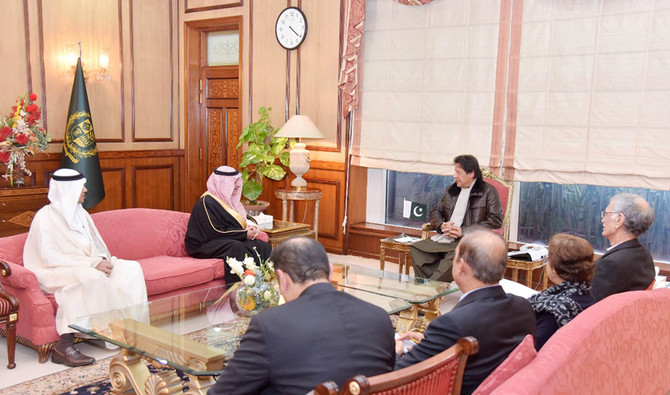
Prime Minister Imran Khan met Governor of Tabuk, Prince Fahad bin Sultan bin Abdulaziz Al Saud, in Islamabad on Monday. (PID)
2 / 5
President Arif Alvi met Governor of Tabuk, Prince Fahad bin Sultan bin Abdulaziz Al Saud, in Islamabad on Monday. (President’s Office)
3 / 5
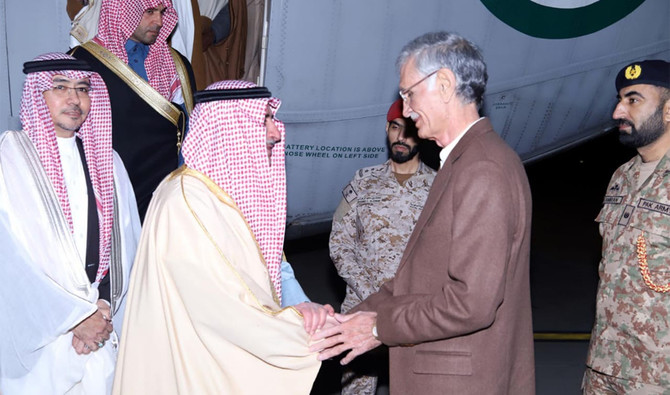
Pakistan’s Defense Minister, Pervez Khattak, received Governor of Tabuk, Prince Fahad bin Sultan bin Abdulaziz Al Saud, at the Islamabad International Airport on Monday. (PID)
4 / 5
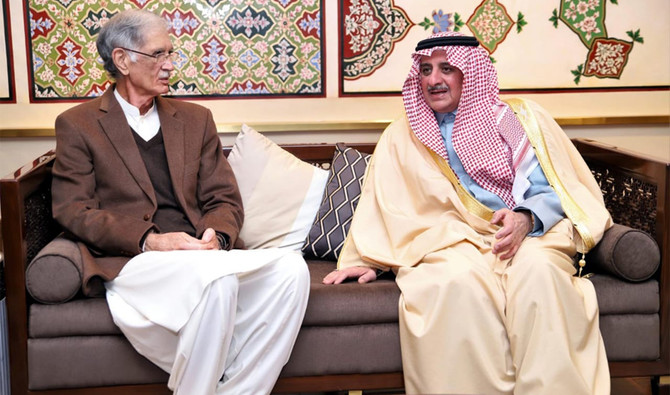
Pakistan’s Defense Minister, Pervez Khattak, can be seen talking to Governor of Tabuk, Prince Fahad bin Sultan bin Abdulaziz Al Saud, after receiving him at the Islamabad International Airport on Monday. (PID)
5 / 5
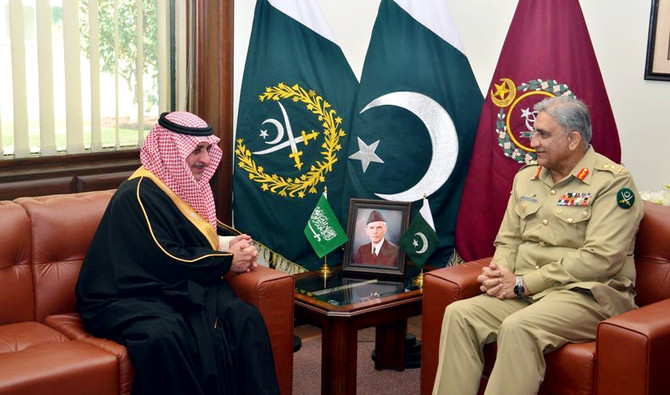
Chief of Army Staff, General Qamar Javed Bajwa, met Governor of Tabuk, Prince Fahad bin Sultan bin Abdulaziz Al Saud, at GHQ Rawalpindi on Monday. (ISPR)
Updated 14 January 2019
Follow

Governor of Tabuk meets Pakistan’s president, prime minister and army chief

  • Alvi says Pakistan committed to the protection of Harmain Sharifain
  • Among other things, the two sides discussed regional security situation

ISLAMABAD: Governor of Tabuk, Prince Fahad bin Sultan bin Abdulaziz Al Saud, called on President Arif Alvi, Prime Minister Imran Khan, and Chief of Army Staff, General Qamar Javed Bajwa, to discuss matters of mutual interests, including regional security situation, on Monday.

During his interaction with the visiting dignitary, President Alvi said that recent interactions between Pakistan and Saudi Arabia would further strengthen relations between the two countries and substantially enhance their trade and investment relationship.

He also pointed out that Pakistan greatly valued its relations with the Kingdom and wanted to further enhance them in all fields.

The president added that Pakistan remained committed to the protection of Harmain Sharifain, a traditional Muslim reference to the cities of Mecca and Medina and the two holy mosques in them.

Alvi stated that Pakistani expatriates were making valuable contributions in the progress and development of Saudi Arabia. He also noted that Pakistani community could play a vital role in the Vision 2030 projects.

The governor, who was earlier received by Pakistan’s Defense Minister, Pervez Khattak, said that the people and government of Saudi Arabia held the people and government of Pakistan in high esteem.

He further added that the strong relations between the two countries primarily owed to the people-to-people contact between them. He recognized the role the Pakistani community had been playing in the development of Saudi Arabia, adding that he hoped the two countries would strengthen their ties further in the future.

Prince Fahad also met with Prime Minister Imran Khan and General Qamar Javed Bajwa during the day. He is among several Saudi officials who have visited Pakistan ever since the new administration in the country was sworn in.


Pakistan minister orders measures to ease port congestion, speed up sugar and cement handling

Updated 08 November 2025
Follow

Pakistan minister orders measures to ease port congestion, speed up sugar and cement handling

  • Meeting in Islamabad reviewed congestion at Port Qasim and its impact on export shipments
  • Ports directed to enforce first-come, first-served berthing and penalize unnecessary delays

KARACHI: Pakistan’s Maritime Affairs Minister Junaid Anwar Chaudhry on Saturday directed authorities to streamline sugar and cement operations at Port Qasim after reports of severe congestion caused by the slow unloading of sugar consignments disrupted export activities.

The government has been working to ease port bottlenecks that have delayed shipments and raised logistics costs for exporters, particularly in the cement and clinker sectors. The initiative is part of a broader effort to improve operational efficiency and align port management with national trade and logistics priorities.

“Improving operational efficiency is vital to prevent port congestion, which can cause delays, raise costs, and disrupt the supply chain,” Chaudhry told a high-level meeting attended by senior officials from the maritime and commerce ministries, port authorities and the Trading Corporation of Pakistan.

The meeting was informed that sugar was being unloaded at a rate below Port Qasim’s potential capacity. The minister instructed the Port Qasim Authority to optimize discharge operations in line with its daily capacity of about 4,000 to 4,500 tons.

Participants also reviewed directives from the Prime Minister’s Office calling for up to 60 percent of sugar imports to be redirected to Gwadar Port to ease the load on Karachi terminals.

Officials said all vessels at Port Qasim and Karachi Port would now be berthed on a first-come, first-served basis, with penalties to be applied for unnecessary delays.

The TCP was told to improve operational planning and coordinate vessel arrivals more closely with port authorities.

Chaudhry commended the engagement of all participants and said consistent adherence to performance standards was essential to sustaining port efficiency and preventing a recurrence of logistical disruptions.