US government shutdown compromises Miami airport operations

1 / 3
In this file photo taken on June 2, 2016, travelers go through the TSA PreCheck security point at Miami International Airport. (AFP)
2 / 3
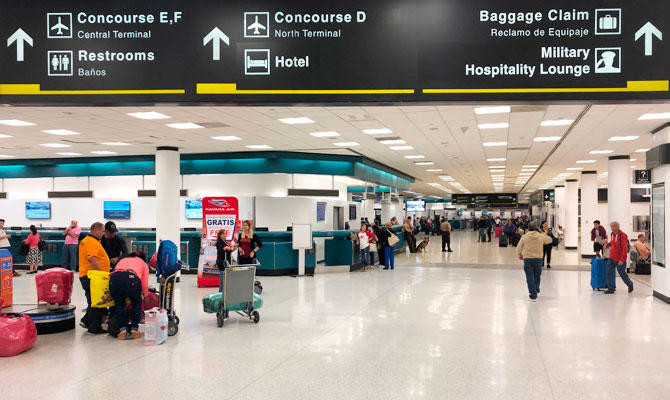
This image shows the passenger area of the Miami International airport Terminal G on January 11, 2018 one day before it closes. (AFP)
3 / 3
This image shows the passenger area of the Miami International airport Terminal G on January 11, 2018 one day before it closes. (AFP)
Updated 12 January 2019
Follow

US government shutdown compromises Miami airport operations

  • There is no sign of a compromise to end the shutdown so far: Trump is insisting on funding for a wall on the border with Mexico, but opposition Democrats are not budging

MIAMI: The international airport in Miami has been forced to shut down one of its terminals early for three days due to a shortage of security agents sparked by the partial US government shutdown now in its 21st day.
From Saturday through Monday, Terminal G — one of six at the airport — will close at 1:00 p.m. (1800 GMT).
“Flights that were previously scheduled to depart from Concourse G this Saturday, Sunday and Monday will be relocated either to Concourse F or Concourse H,” airport spokesman Greg Chin told AFP.
At issue is a lack of agents from the US Transportation Security Administration, who are seen as “essential” federal workers and hence are still on the job — but without pay until the shutdown ends.
Agents are reportedly staging “sickouts” — calling in sick in a silent protest at their situation. According to The Miami Herald, absenteeism among the Miami airport agents has more than doubled since the shutdown began.
“Right now, there’s approximately some 40 employees that are calling in sick from TSA,” meaning that “this terminal doesn’t have the manpower to accommodate all the passengers,” airport spokesman Jack Varela told AFP.
“The airport, the airlines, TSA, customs we are all doing everything possible to make the passengers happy,” Varela said.
Democratic congressman Bennie Thompson, the new chairman of the House Homeland Security Committee, told the TSA chief in a letter this week that it was “only reasonable to expect officer call outs and resignations to increase the longer the shutdown lasts.”
“No employee can be expected to work indefinitely without pay,” Thompson said.
With the shutdown soon to drag into its fourth week, the National Air Traffic Controllers Association has reportedly filed a lawsuit against the administration of US President Donald Trump, alleging that members have been “unlawfully” deprived of their wages.
There is no sign of a compromise to end the shutdown so far: Trump is insisting on funding for a wall on the border with Mexico, but opposition Democrats are not budging.


NATO wants ‘automated’ defenses along borders with Russia: German general

Updated 24 January 2026
Follow

NATO wants ‘automated’ defenses along borders with Russia: German general

  • That zone would act as a defensive buffer before any enemy forces advanced into “a sort of hot zone,” said Lowin
  • The AI-guided system would reinforce existing NATO weapons and deployed forces, the general said

FRANKFURT: NATO is moving to boost its defenses along European borders with Russia by creating an AI-assisted “automated zone” not reliant on human ground forces, a German general said in comments published Saturday.
That zone would act as a defensive buffer before any enemy forces advanced into “a sort of hot zone” where traditional combat could happen, said General Thomas Lowin, NATO’s deputy chief of staff for operations.
He was speaking to the German Sunday newspaper Welt am Sonntag.
The automated area would have sensors to detect enemy forces and activate defenses such as drones, semi-autonomous combat vehicles, land-based robots, as well as automatic air defenses and anti-missile systems, Lowin said.
He added, however, that any decision to use lethal weapons would “always be under human responsibility.”
The sensors — located “on the ground, in space, in cyberspace and in the air” — would cover an area of several thousand kilometers (miles) and detect enemy movements or deployment of weapons, and inform “all NATO countries in real time,” he said.
The AI-guided system would reinforce existing NATO weapons and deployed forces, the general said.
The German newspaper reported that there were test programs in Poland and Romania trying out the proposed capabilities, and all of NATO should be working to make the system operational by the end of 2027.
NATO’s European members are stepping up preparedness out of concern that Russia — whose economy is on a war footing because of its conflict in Ukraine — could seek to further expand, into EU territory.
Poland is about to sign a contract for “the biggest anti-drone system in Europe,” its defense minister, Wladyslaw Kosiniak-Kamysz, told the Gazeta Wyborcza daily.
Kosiniak-Kamysz did not say how much the deal, involving “different types of weaponry,” would cost, nor which consortium would ink the contract at the end of January.
He said it was being made to respond to “an urgent operational demand.”