





JINAN, China: Cui Haoxin is too young to remember the days of his people’s oppression under Mao Zedong.
The 39-year-old poet was born after the Cultural Revolution of 1966-76, when the Hui — China’s second-largest Muslim ethnic group — were among the masses tormented by the Red Guard.
In the years since, the Hui (pronounced HWAY) generally have been supportive of the government and mostly spared the kind of persecution endured by China’s largest Muslim group, the Uighur.
There are signs, though, that that is changing. Cui fears both that history may be repeating itself and for his own safety as he tries to hold the ruling Communist Party accountable.
In August, town officials in the Hui region of Ningxia issued a demolition order for the landmark Grand Mosque in Weizhou, though they later backed off in the face of protests.
More recently, authorities in nearby Gansu province ordered closed a school that taught Arabic, the language of the Qur’an and other Islamic religious texts. The school had employed and served mainly Hui since 1984. And a Communist Party official from Ningxia visited Xinjiang, center of Uighur oppression, to “study and investigate how Xinjiang fights terrorism and legally manages religious affairs.”
China under President Xi Jinping is clamping down on minorities, tightening control over a wide spectrum of religious and political activity. In some places, a campaign to “Sinicize” religion has prompted authorities to seize Bibles, remove the “halal” designation from food products, demolish churches and strip mosques of loudspeakers and Islamic crescents and domes.
Cui has spoken out against government intrusions. He is working on a novel with a nightmarish plot: believers are brutalized by demons in a Cultural Revolution in Hell. “The Muslims resisted and tried to protect the mosque,” he said, describing the work. “They failed.”
He worries that violence lies ahead.
“One has dignity. For a person, it is his or her bottom-line.” he said. “If the persecution is too unbearable, if something happens, as I said, there could be a disaster.”
Cui speaks eloquently about his people, who claim descent from Persian and Arab traders who came to China 1,300 years ago.
The 10 million Hui living across China generally speak Mandarin — Cui is a former teacher of the standard Chinese dialect — and follow many Chinese cultural practices. They enjoy relative freedom of worship compared to the Uighurs, some of whom call the Hui “tawuz,” which means watermelon in the Uighur’s Turkic language.
“Green or Islamic on the outside, and red or Communist on the inside,” writes University of Toronto professor Isabelle Cote in a study on Uighur attacks on Hui in Xinjiang from 2009 to 2013. Farther back, Hui served Chinese emperors as shock troops repressing Uighur rebellions.
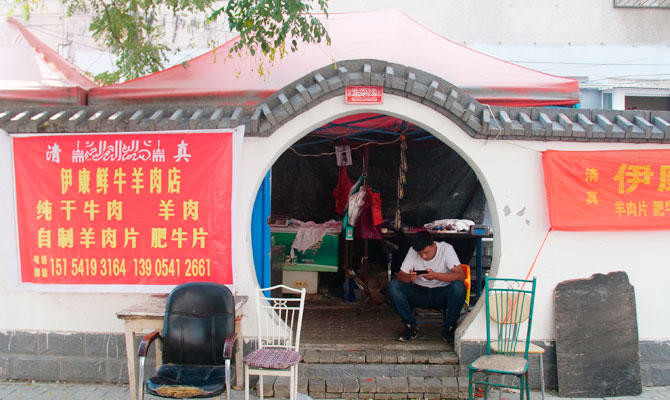
In Beijing, Arabic signs mark Hui bakeries, teahouses, halal restaurants and a thousand-year old mosque bustling with activity in the historically Islamic neighborhood of Niujie.
Ma Changli, who has run a butcher shop in the enclave for the past five years, said police help provide security for Friday prayers at the mosque.
“Our country has always been pretty supportive to our worship,” the 39-year-old butcher said, standing in front of an Islamic inscription and hanging lamb and beef racks.
While the Hui face prejudice from the Han Chinese majority, they are proud to be Chinese and have a “positive outlook for the future,” said David Stroup, a University of Oklahoma professor who met Hui across China in 2016.
Many saw an opportunity in China’s Belt and Road Initiative, a $1 trillion trade and infrastructure initiative that runs across several Muslim-majority nations in central Asia and Africa, he said. They aspired to become middlemen on a revived Silk Road linking China with Islamic nations.
“It was going to be an opportunity for the Hui to play an important role as ambassadors to the Islamic world,” Stroup said.
It came as a shock, he said, when new regulations targeted the practices of Hui alongside those of other religious groups earlier this year. Stroup said the shift has dampened optimism in a community that saw language and religion as links to trading partners in the Muslim world.
Tension bubbled up in August in Weizhou, a dusty Muslim-majority town in China’s northwestern “Qur’an Belt.”
The town’s pride and joy is a gleaming white mosque with four minarets and nine domes tipped with crescent moons that dwarfs a surrounding warren of brick and concrete homes.
Officials issued a demolition order for the Grand Mosque, alleging it had been “illegally expanded” and adding that 1.07 million yuan ($154,765) from foreign sources had been received by four local mosques — financing that would be illegal under Chinese law.
Hundreds of Hui flocked to the mosque’s courtyard for a rarity in China: a political protest. City authorities detained AP journalists and prevented them from conducting interviews at the mosque.
The protesters’ success was even rarer. The mosque remained unscathed, if draped in a banner reading in Chinese: “Stick to directives of Sinicized religion.”
Weeks later, a top Communist propaganda official in Ningxia blamed the incident on “an oversimplified administrative decision” by local authorities.
“It originally should not have happened,” Bai Shangcheng, director-general of the regional Communist Party department that oversees religious groups, said at a news conference in Beijing.
Dissent simmered quietly in the Hui community after the mosque incident, according to Cui, who circumvented China’s Internet censorship to tweet about the protest and feed video to a Turkish television station.
In late November, the Communist Party-run Global Times reported that Ningxia had signed an anti-terrorism cooperation agreement with Xinjiang during a visit by Ningxia Communist Party head Zhang Yunsheng.
China has set up a vast security apparatus in Xinjiang with pervasive police checkpoints and surveillance cameras. By some estimates, more than 1 million Uighurs and Kazakhs have been detained in internment camps in a crackdown on extremism. Two former camp detainees have told the AP that some Hui have been swept up in the clampdown too.
The order to close the Arabic language school came early this month, the Global Times reported. An unnamed expert in Beijing told the newspaper that teaching Arabic sometimes arouses public concern if it crosses over into preaching religious content.
The article quoted China’s education law: “The State separates education from religion.”
Cui is one of the few Chinese citizens disturbed enough — and brave enough — to criticize the Communist Party openly. For that, he has experienced censorship, detention, and “home visits” by police.
He spoke to The Associated Press at his home in Jinan, a city in eastern China where his family traces its roots back five centuries. Skyscrapers dwarf old mosques and boisterous halal restaurants with gold domes, Arabic script and crescents.
He doesn’t drink alcohol or eat pork, but neither does he pray five times a day. His bedside table is stacked with poetry and novels, not religious books. Hanging in the living room is a framed red embroidery by his mother of the Islamic profession of faith in yellow Arabic stitching.
It was underneath this tapestry that police entered his home earlier this year to demand he stop criticizing the government online. Cui posts attacks on Beijing’s policies related to Muslims in China and abroad, such as the government’s support of Myanmar despite widespread criticism of its treatment of the Rohingya, a Muslim minority.
A few months later, on Nov. 27, police brought him to the local Public Security Bureau for a few hours of questioning. A recent Human Rights Watch report said that China started in November “targeting Twitter users in China as part of a nationwide crackdown on social media.” Cui refused to stop or delete his tweets.
Sixty years ago, Communist Party cadres descended on the historically Hui city of Linxia to excise “superstitions” in the city in a “struggle against the privileges of feudalism and religion,” according to a 2016 book by Matthew Erie, an Oxford University professor of modern China studies.
Red Guards lit bonfires with wood from demolished mosques and tombs, Erie writes in “China and Islam: The Prophet, the Party, and Law.” They forced Muslims to wear signs reading “enemies of the state.”
Cui fears the current crackdown on religion will return China to those days of blood.
At a teahouse in Jinan, as steam from his jasmine tea mixes with the scent from a tray of sweets, he recites from his poem “Letter from Prison:“
“It seems like I can see the bulldozer running wild in the Thousand and One Nights.
The angel upon my shoulder urges me: ‘Tell the truth under the grey sky.’“


