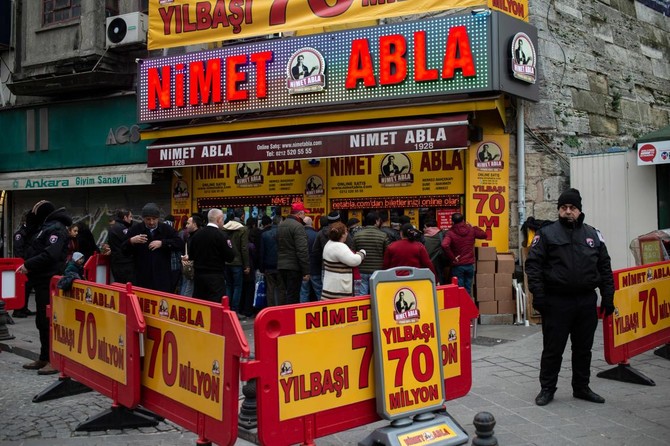
ISTANBUL: Each year in the run-up to the New Year draw, thousands of people flock to the most famous lottery stand in Istanbul, drawn by the promise on display: “Nimet Abla will make you win.”
For 90 years, the lottery booth has drawn large numbers of Turks, filled with hope in these troubled economic times, largely because it has convinced people that it is there that they have the best chance of winning.
And so the people flock to the booth, ignoring what is a growing chorus of the pious who consider gambling a sin.
Excited customers take a selfie in front of the ticket counters in Eminonu district, close to one of the most beautiful Ottoman mosques in Istanbul, Yeni Cami.
A dozen security guards form a cordon around the stall to stop queue-jumpers, redirecting them toward the end of the queue which extends for several hundreds of meters.
With a waiting time of up to three or four hours at the weekend, those wishing to buy tickets have to be patient. Fortunately for Kemal, he has plenty of it.
“I’ve been trying my luck with Nimet Abla for 50 years,” the retired man says. “I have never won... for now!“
Nimet Abla, which means “Big Sister Nimet” in Turkish, owes its name and fortune to founder Melek Nimet Ozden. A formidable businesswoman, she ruled over the lottery world for half a century, after selling her first ticket in 1928.
Following her death in 1978, her nephew, who is today called Nimet Abi (“Big Brother Nimet“), took over the business, and it continues to prosper.
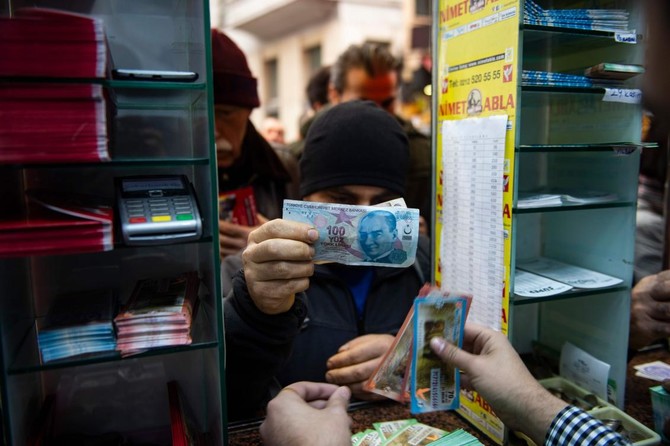
“We sell more and more tickets each year,” Nimet Ozden, 64, tells AFP. He says they sold three million tickets last year, “a tenth of all lottery tickets in Turkey.”
As well as the historic booth in Eminonu, Nimet Abla has two other outlets selling tickets in Istanbul, to which customers flock from all over Turkey.
This year the New Year jackpot is worth 70 million Turkish lira (around 11.5 million euros). One ticket costs 70 lira (11.5 euros), but there is also “a half-ticket” or even a “quarter of a ticket.”
In the last few days before the draw on December 31, the queues begin as early as 6:00 am and last as late as 11:00 pm.
Like seagulls swirling around a trawler returning from a day’s fishing, street vendors try to snatch customers from Nimet Abla with cries of: “No time to wait! We sell the same tickets!“
To stand out from the more than 15,500 authorized national lottery ticket sellers, Nimet Abla relies on its reputation as a lucky charm.
It was something the founder cultivated very early on, investing heavily in advertising.
This has allowed it to stand the test of time, unlike other Turkish lottery legends. “Omer the Long,” “Simon the Dwarf” and “One-armed Cemal” — have all fallen by the wayside.
So even if Nimet Abla has not sold the winning ticket for the end-of-year draw since 2009, its power of attraction remains intact.
“I believe in the good luck of Nimet Abla,” Saniye says while waiting in the queue.
Similarly, Erdemir Koc, an unemployed 45-year-old, was convinced he was more likely to win there.
But not everyone has caught lottery fever. In this majority-Muslim country, there has been a growing expression of religious conservatism in recent years.
Last year, Turkey’s Diyanet religious affairs agency issued its opinion on the lottery, saying that although it was legal, it was “haram” — illicit from an Islamic point of view, like all gambling.
The founder Melek Nimet Ozden took care of her image as a pious woman, undertaking the pilgrimage to Makkah in Saudi Arabia several times and building a mosque in her name. But her legacy is nevertheless now a target.
Not far from the booth, on the other side of the Yeni Cami mosque, a florist, tired of having to give directions to the stall, hung a poster in front of his shop. “Don’t ask me where Nimet Abla is,” it says. “Gambling is a sin.”
“I see the faithful who just after leaving the mosque will go queue at Nimet Abla,” says the shop’s owner, Kadir Sumbul, indignantly
“If it were up to me, I would ban all that,” he tells AFP.
But the games of chance generate a lot of revenue for the Turkish state. Last year, they brought in 1.4 billion lira (230 million euros), according to the Turkish national lottery body (MPI).
Nimet Abi is aware of the criticism, even if he thinks most people don’t share those views.
He himself tries his luck each year in the New Year lottery, he says. But in any case, he adds, as he looks out at the line of impatient customers: “I already feel lucky enough as it is.”


![]()
![]()
![]()
![]()

Turkey’s ‘Big Sister Nimet’ lottery selling hope for 90 years

Turkey’s ‘Big Sister Nimet’ lottery selling hope for 90 years
- This year the New Year jackpot is worth 70 million Turkish lira (around 11.5 million euros)
- Turkey's Diyanet religious affairs agency issued its opinion on the lottery, saying that although it was legal, it was "haram"


Latest updates



© 2026 SAUDI RESEARCH & PUBLISHING COMPANY, All Rights Reserved And subject to Terms of Use Agreement.