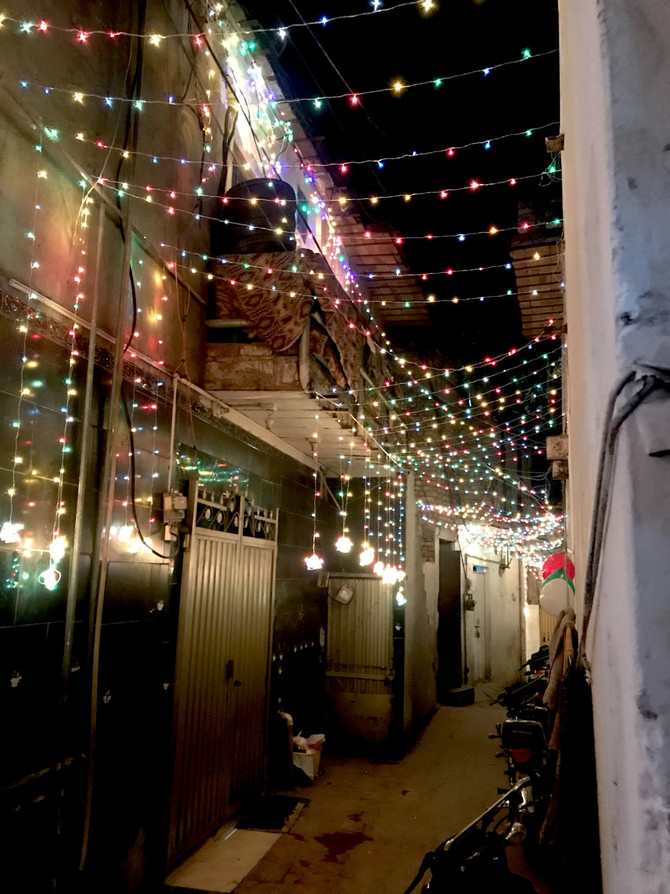
ISLAMABAD: Along Islamabad’s Bhittai Road, in a quaint corner of the F7 sector, lies the French Colony where at this time of the year festive lights adorn the streets and everyone makes a conscious decision to be part of the Christmas cheer.
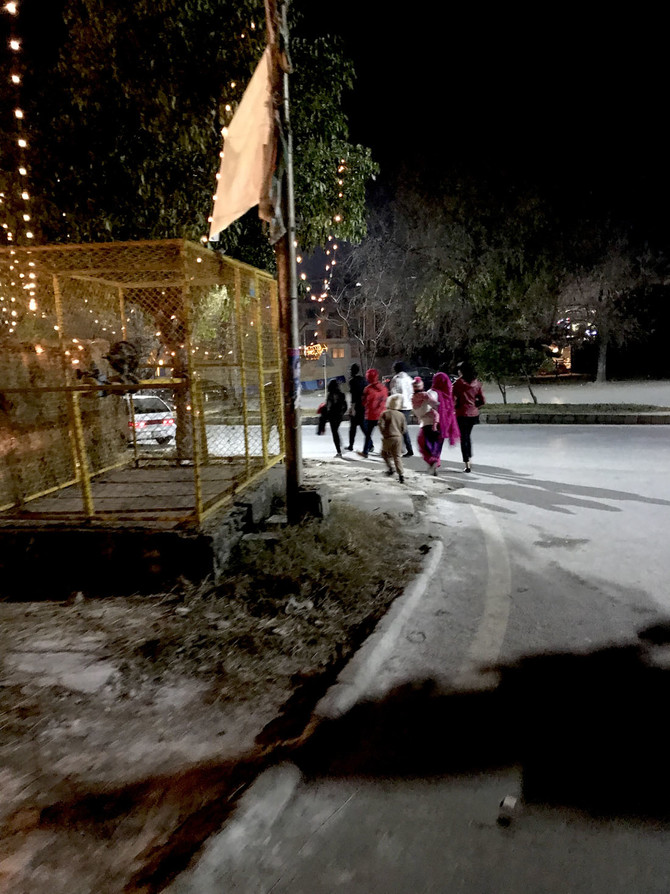
The distant sound of carols breaks through the chatter and laughter of children, teenagers, and families indulging in the festivities as several try to finish last minute errands to celebrate the night before Christmas.
The area which was established decades ago is what a few thousand from Pakistan’s Christian community – or approximately 1.6 percent of the total population — call home.
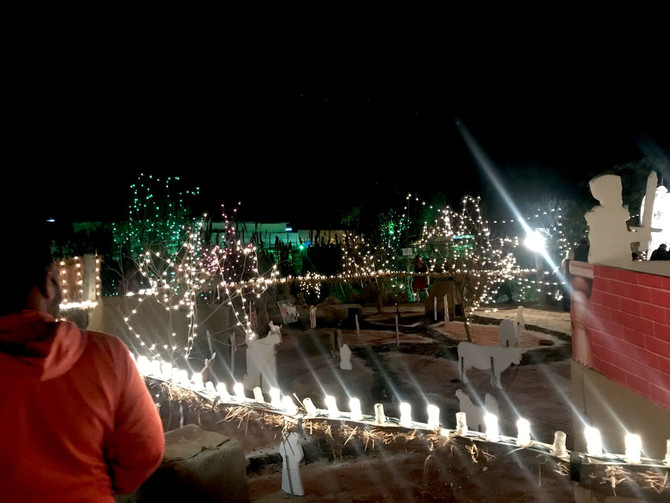
Empty plots surrounding the colony – which were once strewn with walls of hay and open-air tents – take on the avatar of a bride with fairy lights galore and visible from all directions. The lights act as pretty dividers for the many Christmas-themed designs along the pathways.
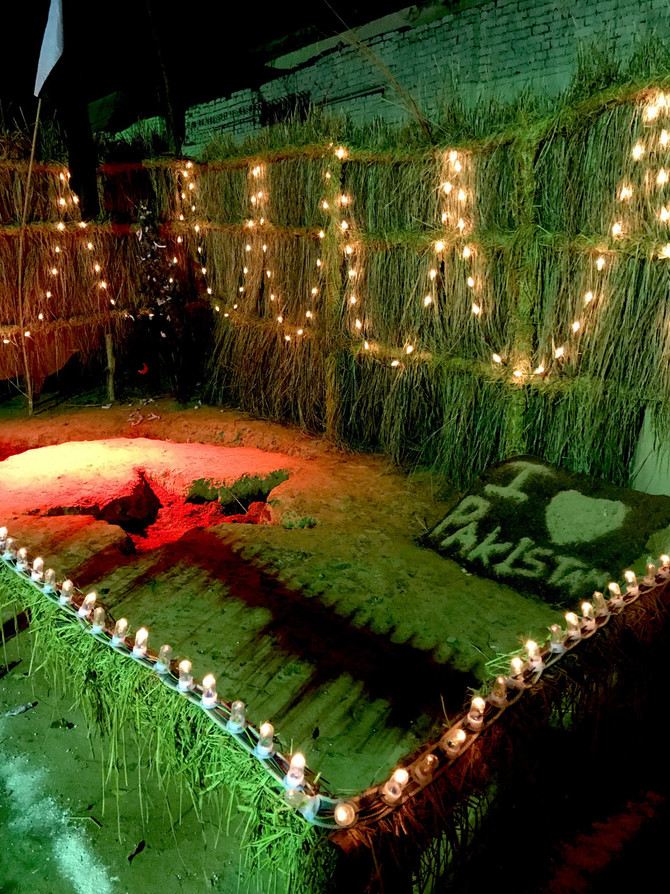
Three different plots have been transformed into winter wonderlands with hues of white, pink, green, blue, and purple lighting up the night sky. Several of them are designed to resemble the Nativity Scene depicting the time when Jesus Christ was born
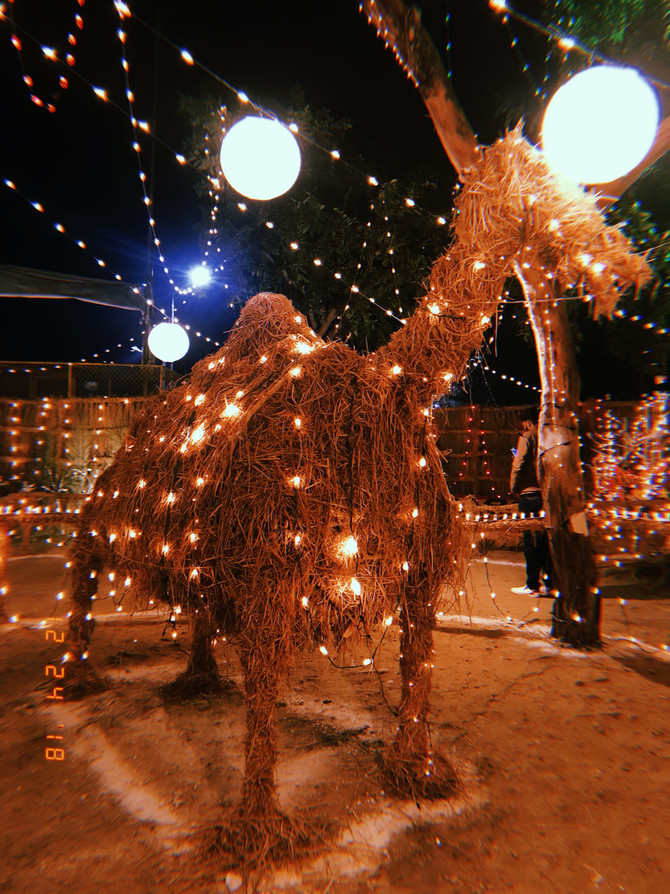
Cutouts of important figures from the Bible and an impressive structure of a camel built from hay is part of one installation. Another had small-scale models of the Jordan River where some believe Jesus had been baptized.
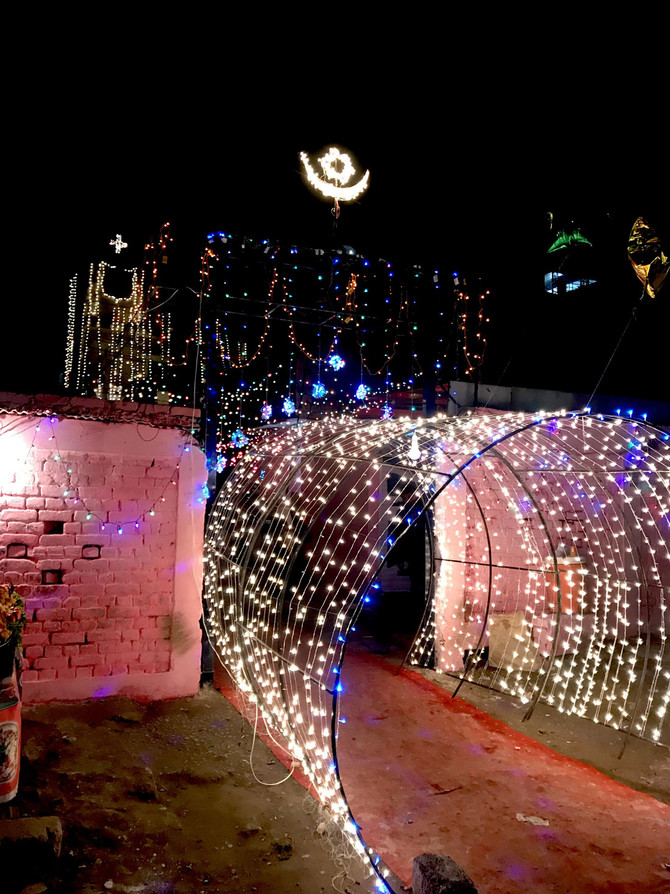
A short distance away lies the Christmas market where a tunnel of lights, on top of which sits a moon and a star with the shining cross of the Salvation Army church standing tall behind it leads you to the entrance.
Here, shop owners with their finger on the consumer’s pulse sell hot cups of chai to beat the chill of a winter’s night in Islamabad. Several rangers stand guards at the entrance of the church to ensure worshippers are safe and secure as they complete their religious obligations.
“It’s always fun to see how it changes every year, what the kids put together,” Sakina, a resident of Islamabad who was accompanied by her husband, said. “The lights are my favorite part,” she said.
“You get to run into friends at times too. We like to come by here and the markets in F6 and F8 before we head to church,” Vicky, her husband, said.
Those walking through the streets to be part of the experience include people from different faiths such as Muslims, Sikhs, and some from Islamabad’s foreign community, all seen with hot cups of tea in their hands and ensuring they “Instagrammed” their night out.
Throughout the colony, churches representing different Christian sects sit side by side within a stone’s throw away from each other.
Along the main street is the Presbyterian church — standing tall with luminous red crosses – with blaring music leading worshippers to its doors.
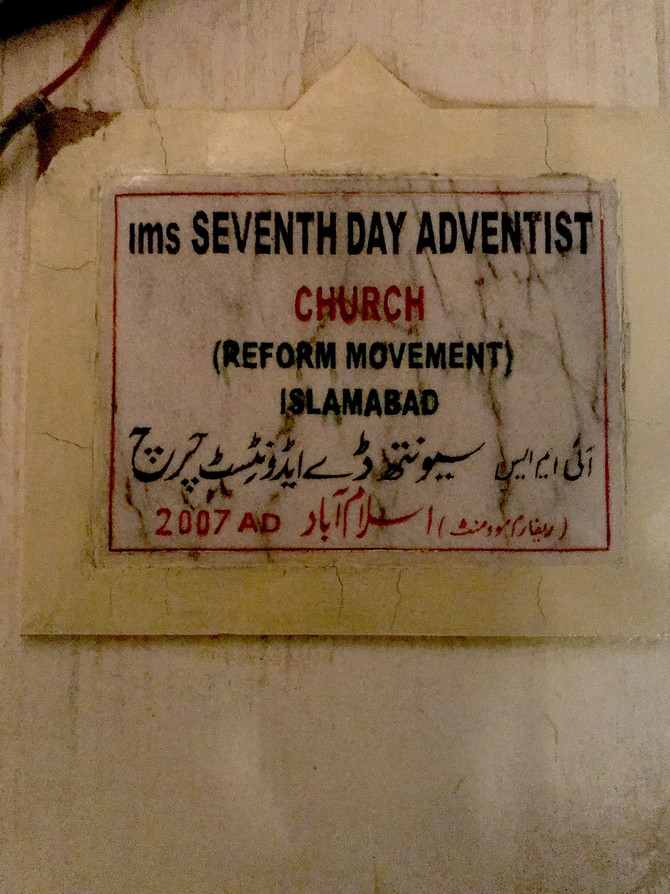
A few turns away from the main road is the Seventh Day Adventist Church established in 2007 by Inayat Daniel Saleebi, a priest who was waiting inside to begin his sermon on Christmas Eve.
“It’s gotten much better over the years,” Saleebi said. “Each year you can feel the change, more acceptance, more open hearts. It will simply take time. Some people they say bad things, but a lot of people…it’s changing,” he added.
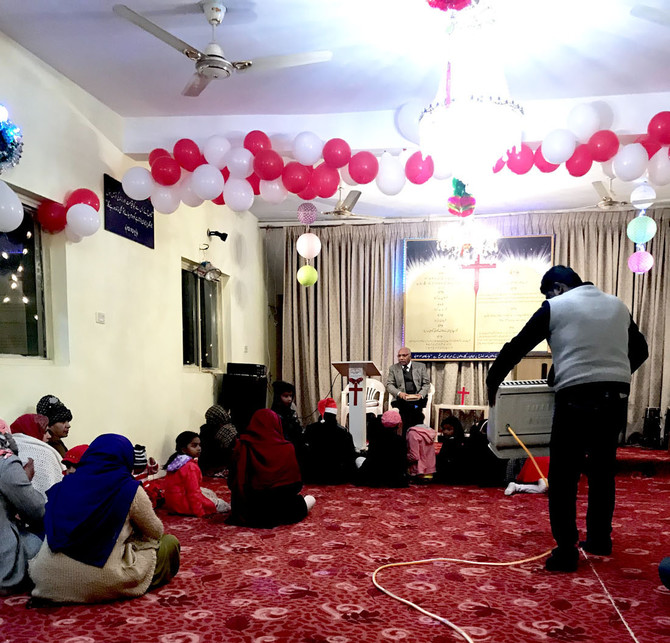
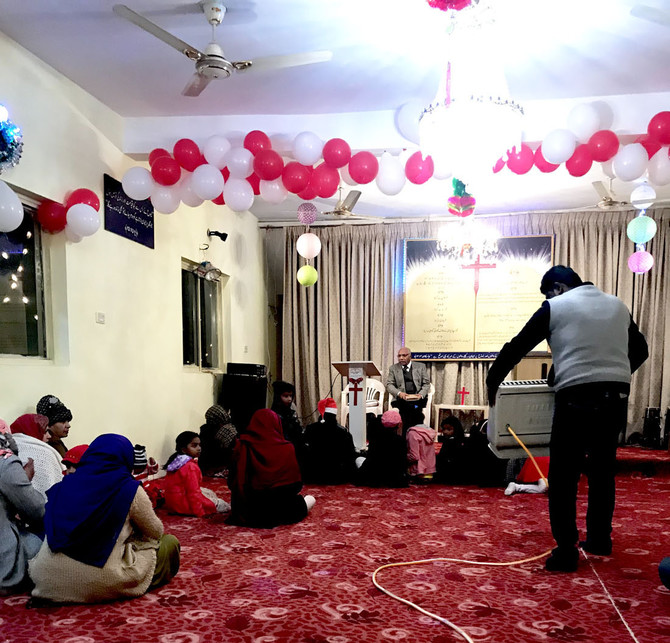
Saleebi, who said the church was always open to everyone, welcomed us to come in and sit through the service. He began by apologizing for the one-hour delay by promising to “keep it short, 20 minutes”, even as laughter filled the room.
Children sit around a heater, acquaintances greet one another before taking their respective seats as the church leader hands out piping hot cups of Kashmiri chai before the service begins.
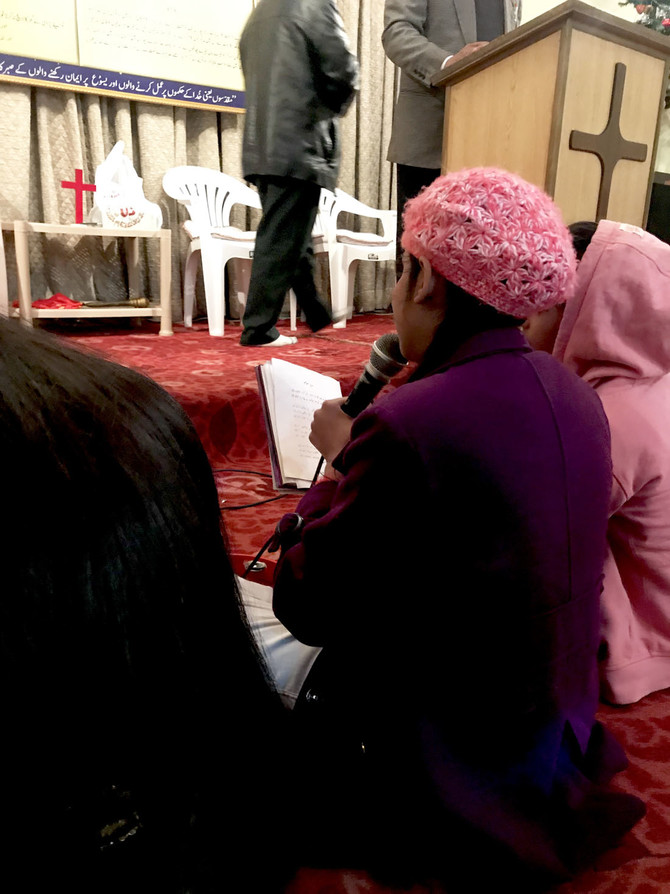
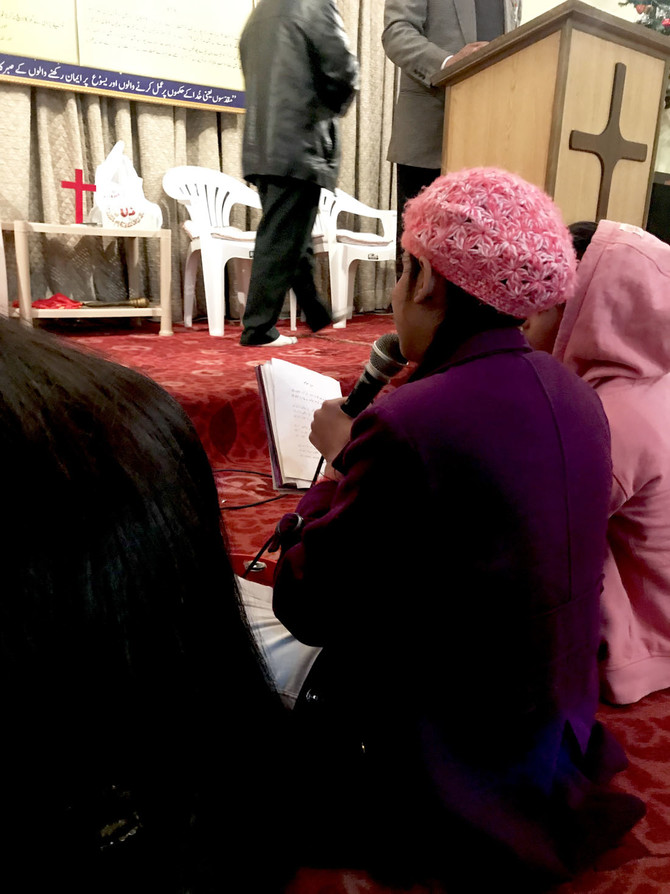
Several sing along as the choir chants hymns from worn-out copies of the Bible, with a unanimous ‘Ameen’ punctuating the prayer.
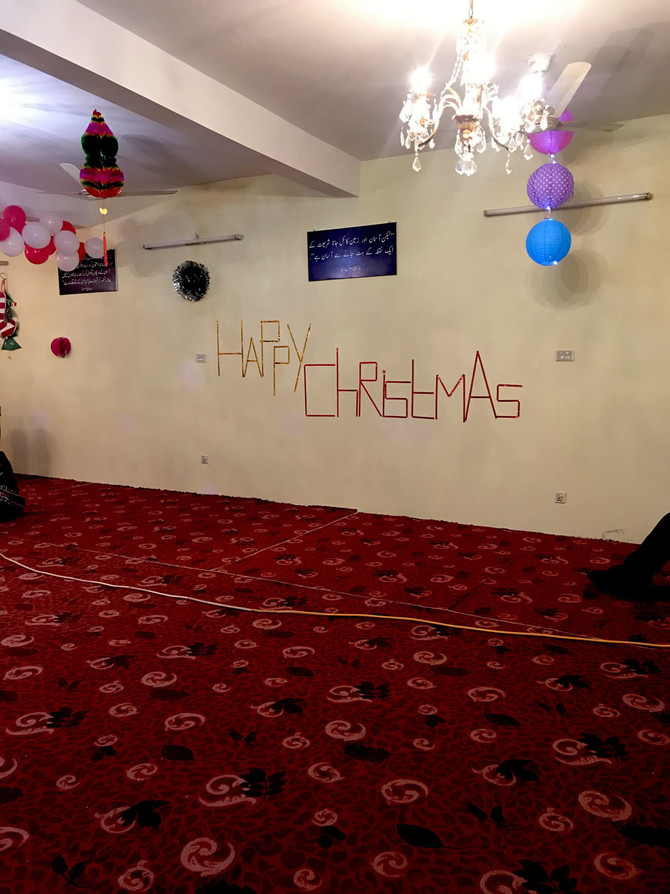
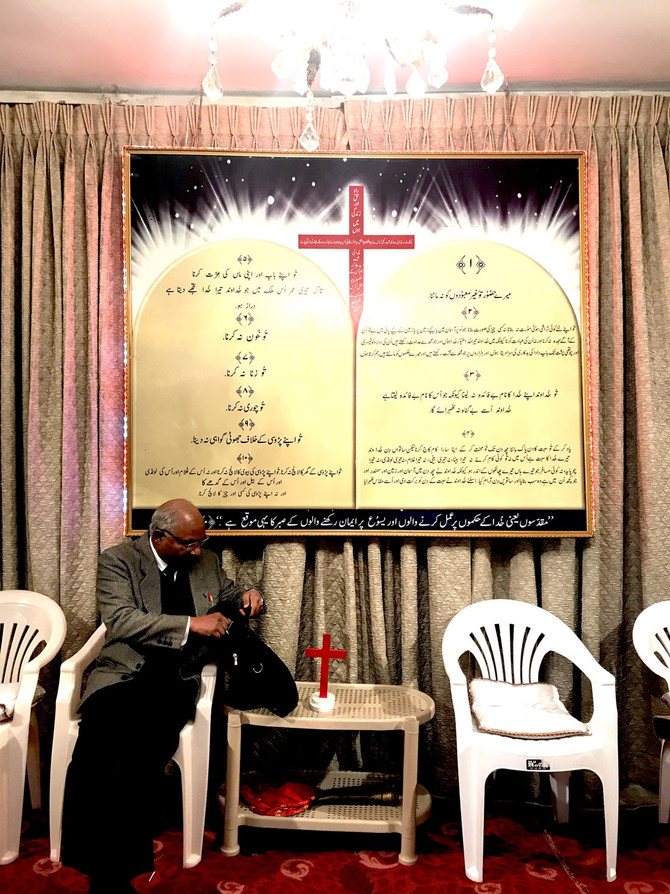
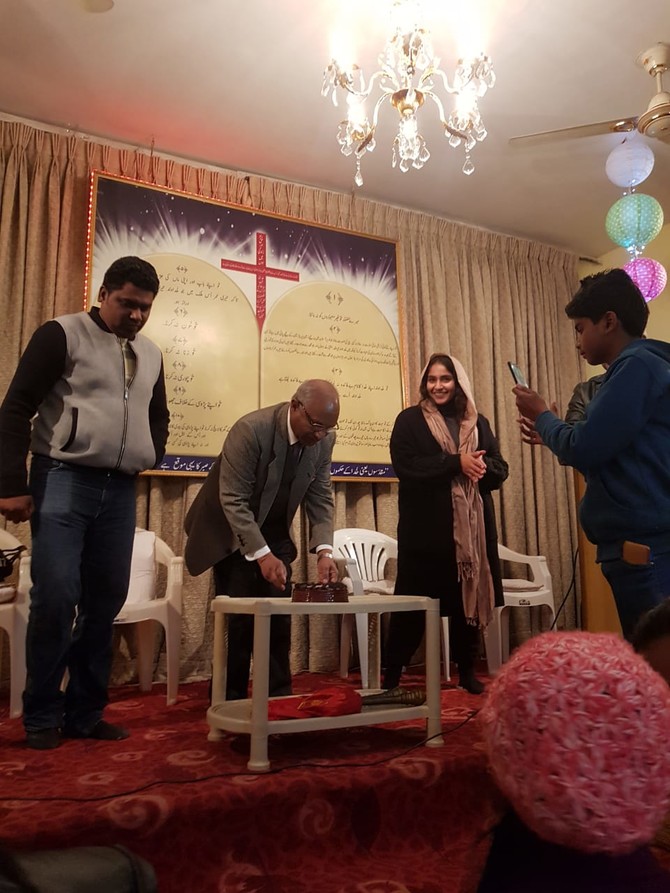
On one side of the single-room church is a ‘Happy Christmas’ sign taped onto the wall using reflective tinsel, while toward the corner of the stage – where worshippers had gathered to sit — stands a Christmas tree. Bright lights line up the perimeter of a wall where a placard — listing the 10 commandments in Urdu – occupies pride of place.
The palpable level of intimacy, invitation, and inclusion is unmistakable.
In a country where the resounding majority of citizens are Muslim, Christians who live in the vicinity are lauded for forging bonds with anyone who visits the neighborhood.
“Everyone, all religions, people of faith are in some way, extremist. We all believe that we are right and that everyone else is wrong, in some way,” Saleeba, another resident, said. “However, being kind and good…that is always the same across all religions.”
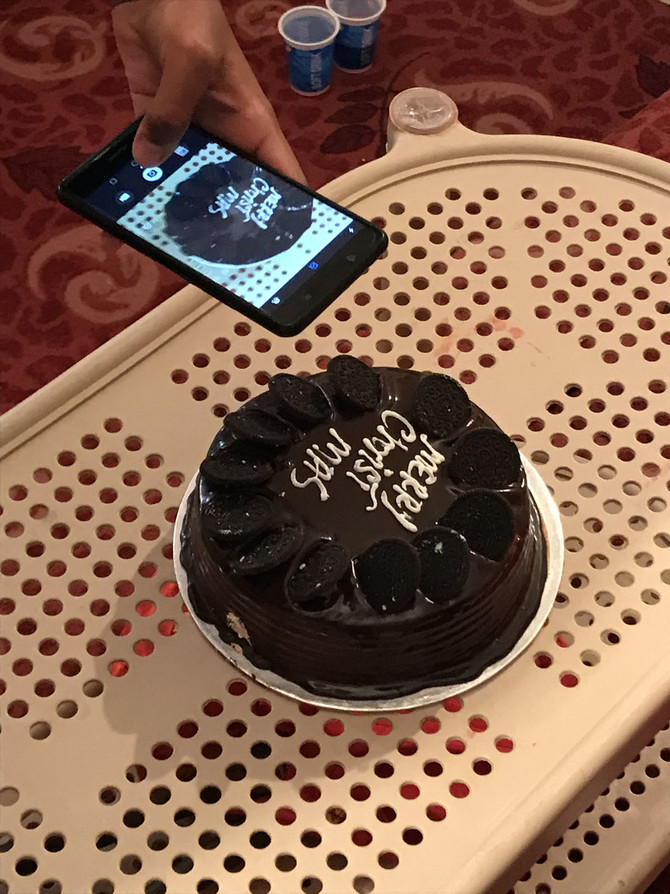
As midnight struck and Christmas Eve transformed into Christmas Day, church leaders brought out a huge cake to cut on stage. What followed were scenes which are very similar to the ones we see outside mosques on Eid day – one where loved ones and acquaintances hug each other with ‘Merry Christmas’ greetings, sharing in the hope for a happy year ahead.
In that every moment, the love and warmth felt inside the church eclipsed the cold weather outside.


“Each year you can see things changing for the better”








“Each year you can see things changing for the better”
- Residents of a Christian-dominated colony share their experiences of celebrating Christmas in the country
- A majority from the 1.6% of the population live in the area in Islamabad

IMF warns against policy slippage amid weak recovery as it clears $1.2 billion for Pakistan
- Pakistan rebuilt reserves, cut its deficit and slowed inflation sharply over the past one year
- Fund says climate shocks, energy debt, stalled reforms threaten stability despite recent gains
ISLAMABAD: Pakistan’s economic recovery remains fragile despite a year of painful stabilization measures that helped pull the country back from the brink of default, the International Monetary Fund (IMF) warned on Thursday, after it approved a fresh $1.2 billion disbursement under its ongoing loan program.
The approval covers the second review of Pakistan’s Extended Fund Facility (EFF) and the first review of its climate-focused Resilience and Sustainability Facility (RSF), bringing total disbursements since last year to about $3.3 billion.
Pakistan entered the IMF program in September 2024 after years of weak revenues, soaring fiscal deficits, import controls, currency depletion and repeated climate shocks left the economy close to external default. A smaller stopgap arrangement earlier that year helped avert immediate default, but the current 37-month program was designed to restore macroeconomic stability through strict monetary tightening, currency adjustments, subsidy rationalization and aggressive revenue measures.
The IMF’s new review shows that Pakistan has delivered significant gains since then. Growth recovered to 3 percent last year after shrinking the year before. Inflation fell from over 23 percent to low single digits before rising again after this year’s floods. The current account posted its first surplus in 14 years, helped by stronger remittances and a sharp reduction in imports. And the government delivered a primary budget surplus of 1.3 percent of GDP, a key program requirement. Foreign exchange reserves, which had dropped dangerously low in 2023, rose from US$9.4 billion to US$14.5 billion by June.
“Pakistan’s reform implementation under the EFF arrangement has helped preserve macroeconomic stability in the face of several recent shocks,” IMF Deputy Managing Director Nigel Clarke said in a statement after the Board meeting.
But he warned that Islamabad must “maintain prudent policies” and accelerate reforms needed for private-sector-led and sustainable growth.
The Fund noted that the 2025 monsoon floods, affecting nearly seven million people, damaging housing, livestock and key crops, and displacing more than four million, have set back the recovery. The IMF now expects GDP growth in FY26 to be slightly lower and forecasts inflation to rise to 8–10 percent in the coming months as food prices adjust.
The review warns Pakistan against relaxing monetary or fiscal discipline prematurely. It urges the State Bank to keep policy “appropriately tight,” allow exchange-rate flexibility and improve communication. Islamabad must also continue raising revenues, broadening the tax base and protecting social spending, the Fund said.
Despite the progress, Pakistan’s structural weaknesses remain severe.
Power-sector circular debt stands at about $5.7 billion, and gas-sector arrears have climbed to $11.3 billion despite tariff adjustments. Reform of state-owned enterprises has slowed, including delays in privatizing loss-making electricity distributors and Pakistan International Airlines. Key governance and anti-corruption reforms have also been pushed back.
The IMF welcomed Pakistan’s expansion of its flagship Benazir Income Support Program, which raises cash transfers for low-income families and expands coverage, saying social protection is essential as climate shocks intensify. But it warned that high public debt, about 72 percent of GDP, thin external buffers and climate exposure leave the country vulnerable if reform momentum weakens.
The Fund said Pakistan’s challenge now is to convert short-term stabilization into sustained recovery after years of economic volatility, with its ability to maintain discipline, rather than the size of external financing alone, determining the durability of its gains.