Pope hopes for peace in Yemen, Syria and other flashpoints

1 / 3
This handout picture released by the Vatican press office on December 25, 2018 at St Peter's square in Vatican shows Pope Francis waving from the balcony of St Peter's basilica during the traditional "Urbi et Orbi" Christmas message to the city and the world. (AFP / Vatican Press Office)
2 / 3
Pope Francis waves after delivering the “Urbi et Orbi” message from the main balcony of Saint Peter’s Basilica at the Vatican, December 25, 2018. (Reuters)
3 / 3
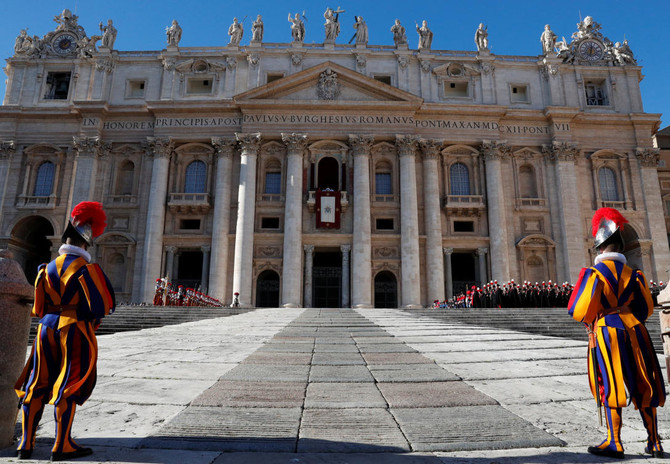
Members of Swiss Guard are seen as Pope Francis delivers the “Urbi et Orbi” message from the main balcony of Saint Peter’s Basilica at the Vatican, December 25, 2018. (Reuters)
Updated 25 December 2018
Follow

Pope hopes for peace in Yemen, Syria and other flashpoints

  • The pontiff said he hoped a truce in Yemen would end the war there
  • He also said he hoped for renewed peace talks between the Israelis and Palestinians

VATICAN CITY: Pope Francis offered a Christmas wish for fraternity among people of different nations, cultures, faiths, races or ideas, describing the world's differences as a richness, not a danger, and championing the rights of religious minorities.
His plea Tuesday for stronger bonds among peoples came as nationalism and a suspicion of migrants are gaining traction across much of the globe.
The long war in Syria, famine amid warfare in Yemen, social strife in Venezuela and Nicaragua, conflicts in Ukraine and tensions on the Korean Peninsula were among the pope's concerns in his Christmas Day message, which he read from the central balcony of St. Peter's Basilica.
Addressing some 50,000 tourists, pilgrims and Romans who flocked to St. Peter's Square on a mild, sunny day, Francis said the universal message of Christmas is that "God is a good Father and we are all brothers and sisters."
"This truth is the basis of the Christian vision of humanity," Francis said in the traditional papal "Urbi et Orbi" ("to the city and the world") message. Without fraternity, he said, "even our best plans and projects risk being soulless and empty." He called for that spirit among individuals of "every nation and culture" as well as among people "with different ideas, yet capable of respecting and listening to one another."
"Our differences, then, are not a detriment or a danger; they are a source of richness," Francis said.
Francis prayed that all minorities have their right to religious freedom respected, noting that some Christians were celebrating Christmas "in difficult, if not hostile, situations."
Communist China is witnessing a systematic suppression of religion, including some restrictions on Christmas celebrations this year. The government's suppression campaign includes re-education camps for Uighur Muslims and a crackdown on Christian churches.

Without specifying religions or countries, Francis prayed for "all those people who experience ideological, cultural and economic forms of colonization and see their freedom and identity compromised."
Francis urged the international community to find a political solution that "can put aside divisions and partisan interests" and end the war in Syria. He said he hoped that an internationally-brokered truce for Yemen would bring relief to that country's people, especially children, "exhausted by war and famine."
He encouraged dialogue among Israelis and Palestinians to end conflict "that for over 70 years has rent the land chosen by the Lord to show his face of love."
In Africa, Francis recalled the millions fleeing warfare or in need of food, and prayed for "a new dawn of fraternity to arise over the entire continent."
Francis urged Venezuelans to "work fraternally for the country's development and to aid the most vulnerable." Millions of Venezuelans are fleeing their country's economic and humanitarian crisis in what has become the largest exodus in modern Latin American history, according to the United Nations.
On Monday night, the 82-year-old pope celebrated Christmas Eve Mass in St. Peter's Basilica.


US and Ukraine ‘a lot closer’ on peace deal, Trump says after meeting with Zelensky

Updated 58 min 14 sec ago
Follow

US and Ukraine ‘a lot closer’ on peace deal, Trump says after meeting with Zelensky

  • Zelensky sees agreement on security guarantees for Ukraine
  • Hurdles to a comprehensive peace deal remain
  • Trump spoke with Putin ahead of meeting on Sunday

PALM BEACH, Florida: US President Donald Trump said on Sunday that he and Ukrainian President Volodymyr Zelensky were “getting a lot closer, maybe very close” to an agreement to end the war in Ukraine, though both leaders acknowledged that ​some of the thorniest details remain unresolved.
The two leaders spoke at a joint press conference late Sunday afternoon after meeting at Trump’s Mar-a-Lago resort in Florida. Trump said it will be clear “in a few weeks” whether negotiations to end the war will succeed.
Zelensky said an agreement on security guarantees for Ukraine has been reached. Trump was slightly more cautious, saying that they were 95 percent of the way to such an agreement, and that he expected European countries to “take over a big part” of that effort with US backing.
Zelensky has said previously that he hopes to soften a US proposal for Ukrainian forces to withdraw completely from the Donbas region of eastern Ukraine, a Russian demand that would mean ceding some territory held by Ukrainian forces.
Both Trump and Zelensky said on Sunday the future of the Donbas had not been settled. “It’s unresolved, but it’s getting a lot ‌closer. That’s a ‌very tough issue,” Trump said.
Just before Zelensky and his delegation arrived at Trump’s Florida residence, Trump ‌and ⁠Russian ​President Vladimir ‌Putin spoke in a call described as “productive” by the US president and “friendly” by Kremlin foreign policy aide Yuri Ushakov.
Ushakov, in Moscow, said Putin told Trump a 60-day ceasefire proposed by the European Union and Ukraine would prolong the war. The Kremlin aide also said Ukraine needs to make a decision regarding the Donbas “without further delay.” And he said the Russian government had agreed to establish working groups to resolve the conflict that will focus on economic and security concerns.


Meeting follows Russian attacks on Kyiv
Zelensky arrived at Mar-a-Lago early Sunday afternoon, as Russian air raids pile pressure on Kyiv. Russia hit the capital and other parts of Ukraine with hundreds of missiles and drones on Saturday, knocking out power and heat in parts of Kyiv. Zelensky has described the weekend attacks ⁠as Russia’s response to the US-brokered peace efforts, but Trump on Sunday said he believes Putin and Zelensky are serious about peace.
The US president said he will call Putin again after meeting with Zelensky. Zelensky ‌had previously told journalists he plans to discuss the fate of the contested Donbas ‍region with Trump, as well as the future of the Zaporizhzhia nuclear ‍power plant and other topics.

Russia claims more battlefield advances 
Putin said on Saturday Moscow would continue waging its war if Kyiv did not seek ‍a quick peace. Russia has steadily advanced on the battlefield in recent months, claiming control over several more settlements on Sunday.
While Kyiv and Washington have agreed on many issues, the issue of what territory, if any, will be ceded to Russia remains unresolved. While Moscow insists on getting all of the Donbas, Kyiv wants the map frozen at current battle lines.
The US, seeking a compromise, has proposed a free economic zone if Ukraine leaves the area, although it remains unclear ​how that zone would function in practical terms.
US negotiators have also proposed shared control over the Zaporizhzhia nuclear plant. Power line repairs have begun there after another local ceasefire brokered by the International Atomic Energy Agency, the agency said on ⁠Sunday.
Russia controls all of Crimea, which it annexed in 2014, and since its invasion of Ukraine nearly four years ago has taken control of about 12 percent of its territory, including about 90 percent of the Donbas, 75 percent of the Zaporizhzhia and Kherson regions, and slivers of the Kharkiv, Sumy, Mykolaiv and Dnipropetrovsk regions, according to Russian estimates.
Putin said on December 19 that a peace deal should be based on conditions he set out in 2024: Ukraine withdrawing from all of the Donbas, Zaporizhzhia and Kherson regions, and Kyiv officially renouncing its aim to join NATO. Zelensky’s past encounters with Trump have not always gone smoothly, but Sunday’s meeting follows weeks of diplomatic efforts. European allies, while at times cut out of the loop, have stepped up efforts to sketch out the contours of a post-war security guarantee for Kyiv that the United States would support.
On Sunday, ahead of the Mar-a-Lago visit, Zelensky said he held a detailed phone call with British Prime Minister Keir Starmer. Trump and Zelensky will hold a phone call with European leaders at some point during the Florida meeting, Trump said. The 20-point plan was spun off from a Russian-led 28-point plan, which emerged from talks between US special envoy Steve Witkoff, Trump’s son-in-law Jared Kushner ‌and Russian special envoy Kirill Dmitriev, and which became public in November.
Subsequent talks between Ukrainian officials and US negotiators have produced the more Kyiv-friendly 20-point plan.