Damascus lights up its biggest Christmas tree

1 / 2
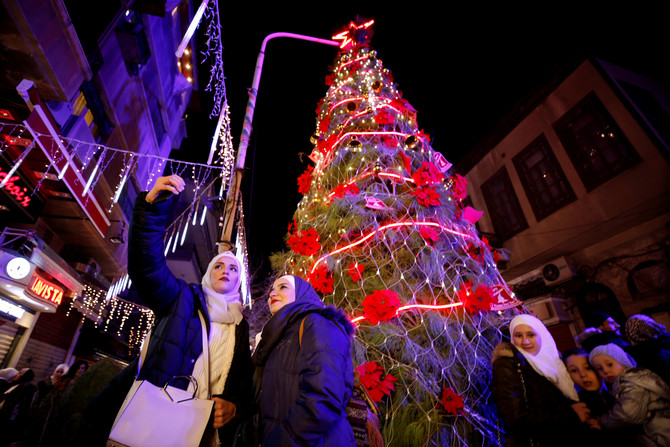
Syrians say the security has begun to gradually return in the country, making it easier for them to mark the Christmas celebrations. (Reuters)
2 / 2
Syrians say the security has begun to gradually return in the country, making it easier for them to mark the Christmas celebrations. (Photo/Supplied)
Updated 25 December 2018
Follow

Damascus lights up its biggest Christmas tree

  • Both Christians and Muslims look forward to celebrating the occasion by decorating trees and taking photos
  • Thousands of people from across Damascus gathered in Abbasid Square to watch the 30-meter-tall Christmas tree being lit up

DAMASCUS: Damascus on Saturday night lit up its tallest Christmas tree in Abbasid Square amid joyous celebrations.

A Christmas scout band paraded through a number of the capital’s neighborhoods, ending in the square, which was repeatedly shelled by Daesh before the Syrian Army seized the terrorist group’s last stronghold in southern Damascus. 

The band played Christmas music, and the accompanying parade gave presents to children and passersby. 

Thousands of people from across Damascus gathered in Abbasid Square to watch the 30-meter-tall Christmas tree being lit up.
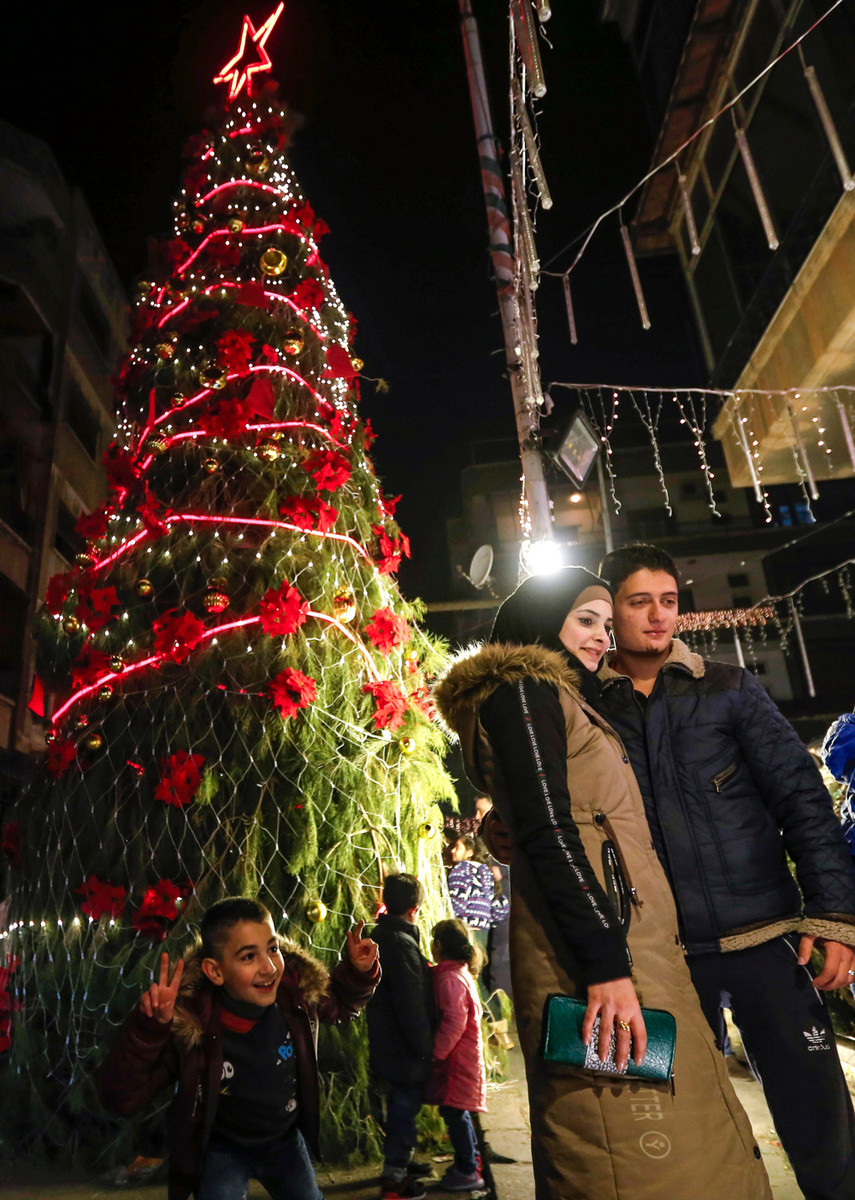


A Syrian couple poses for a picture while gathering around a Christmas tree in the capital Damascus' central neighbourhood of Qassaa. (AFP)

“My daughter was born in 2010 and has never seen Christmas in Damascus before,” Rita Shalhoub, who came with her family from the Jaramana district to witness the event, told Arab News. 

“We continued to celebrate the occasion at home during the past seven years, but our celebrations were overshadowed by the pain of war and the fear of death, in addition to long, depressing power outages,” she added.

“Daesh made sure they shelled Damascus during holidays, and joy was often stolen by the horror and deaths of civilians. The streets would be empty by the end of December as most of us feared leaving our homes during the holidays.”

In early December, streets, squares, shops and homes in the cities of Homs, Aleppo, Damascus, Latakia, Tartus and Hama were decorated with Christmas lights and ornaments in preparation for Syria’s first safe holiday season since 2011. 

Both Christians and Muslims look forward to celebrating the occasion, and many Muslim families decorated trees in their homes, prompting jokes on social media about Christians taking photos next to Muslims’ Christmas trees. 

“Our Muslim neighbors set up better decorations than we did,” said Meray, a Christian school teacher who lives in Al-Muhajirin district in Damascus. 

Electricity supply has improved so unlike previous years, people can now enjoy Christmas lights, she added.

Abu Ahmed, an electrical engineer whose son was killed three years ago in a mortar attack on Abbasid Square, said he did not think he would ever see open-air Christmas celebrations in any part of Damascus, let alone in this square, which was once one of the most dangerous parts of the city. 

Reem Youssef, a Damascus-based architect, said: “What makes this year special is the safety we’re enjoying in Damascus, especially in the neighborhoods known for their Christmas celebrations and decorations before the war. This year’s celebrations remind me of Christmas before the war.” 

She added: “Like Christians, Muslims in Syria anticipate this occasion and its atmosphere, and head to markets in December to shop in preparation to attend Christmas and New Year’s Eve parties in restaurants across the city.” 

She said: “I believe this atmosphere reflects the safety and security that has begun to gradually return to Syria. We hope the country will soon return to its state before the war.”


Syria moves military reinforcements east of Aleppo after telling Kurds to withdraw

Updated 3 sec ago
Follow

Syria moves military reinforcements east of Aleppo after telling Kurds to withdraw

ALEPPO: Syria’s army was moving reinforcements east of Aleppo city on Wednesday, a day after it told Kurdish forces to withdraw from the area following deadly clashes last week.
The deployment comes as Syria’s Islamist-led government seeks to extend its authority across the country, but progress has stalled on integrating the Kurds’ de facto autonomous administration and forces into the central government under a deal reached in March.
The United States, which for years has supported Kurdish fighters but also backs Syria’s new authorities, urged all parties to “avoid actions that could further escalate tensions” in a statement by the US military’s Central Command chief Admiral Brad Cooper.
On Tuesday, Syrian state television published an army statement with a map declaring a large area east of Aleppo city a “closed military zone” and said “all armed groups in this area must withdraw to east of the Euphrates” River.
The area, controlled by Kurdish forces, extends from near Deir Hafer, around 50 kilometers (30 miles) from Aleppo, to the Euphrates about 30 kilometers further east, as well as toward the south.
State news agency SANA published images on Wednesday showing military reinforcements en route from the coastal province of Latakia, while a military source on the ground, requesting anonymity, said reinforcements were arriving from both Latakia and the Damascus region.
Both sides reported limited skirmishes overnight.
An AFP correspondent on the outskirts of Deir Hafer reported hearing intermittent artillery shelling on Wednesday, which the military source said was due to government targeting of positions belonging to the US-backed, Kurdish-led Syrian Democratic Forces.

’Declaration of war’

The SDF controls swathes of the country’s oil-rich north and northeast, much of which it captured during Syria’s civil war and the fight against the Daesh group.
On Monday, Syria accused the SDF of sending reinforcements to Deir Hafer and said it would send its own personnel there in response.
Kurdish forces on Tuesday denied any build-up of their personnel and accused the government of attacking the town, while state television said SDF sniper fire there killed one person.
Cooper urged “a durable diplomatic resolution through dialogue.”
Elham Ahmad, a senior official in the Kurdish administration, said that government forces were “preparing themselves for another attack.”
“The real intention is a full-scale attack” against Kurdish-held areas, she told an online press conference, accusing the government of having made a “declaration of war” and breaking the March agreement on integrating Kurdish forces.
Syria’s government took full control of Aleppo city over the weekend after capturing its Kurdish-majority Sheikh Maqsud and Ashrafiyeh neighborhoods and evacuating fighters there to Kurdish-controlled areas in the northeast.
Both sides traded blame over who started the violence last week that killed dozens of people and displaced tens of thousands.

PKK, Turkiye

On Tuesday in Qamishli, the main Kurdish city in the country’s northeast, thousands of people demonstrated against the Aleppo violence, with some burning pictures of Syrian President Ahmed Al-Sharaa, an AFP correspondent said, while shops were shut in a general strike.
Some protesters carried Kurdish flags and banners in support of the SDF.
“Leave, Jolani!” they shouted, referring to President Sharaa by his former nom de guerre, Abu Mohammed Al-Jolani.
“This government has not honored its commitments toward any Syrians,” said cafe owner Joudi Ali.
Other protesters burned portraits of Turkish Foreign Minister Hakan Fidan, whose country has lauded the Syrian government’s Aleppo operation “against terrorist organizations.”
Turkiye has long been hostile to the SDF, seeing it as an extension of the Kurdistan Workers’ Party (PKK) and a major threat along its southern border.
Last year, the PKK announced an end to its long-running armed struggle against the Turkish state and began destroying its weapons, but Ankara has insisted that the move include armed Kurdish groups in Syria.
On Tuesday, the PKK called the “attack on the Kurdish neighborhoods in Aleppo” an attempt to sabotage peace efforts between it and Ankara.
A day earlier, Ankara’s ruling party levelled the same accusation against Kurdish fighters.
The Britain-based Syrian Observatory for Human Rights reported 45 civilians and 60 soldiers and fighters from both sides killed in the Aleppo violence.
Aleppo civil defense official Faysal Mohammad said Tuesday that 50 bodies had been recovered from the Kurdish-majority neighborhoods after the fighting.