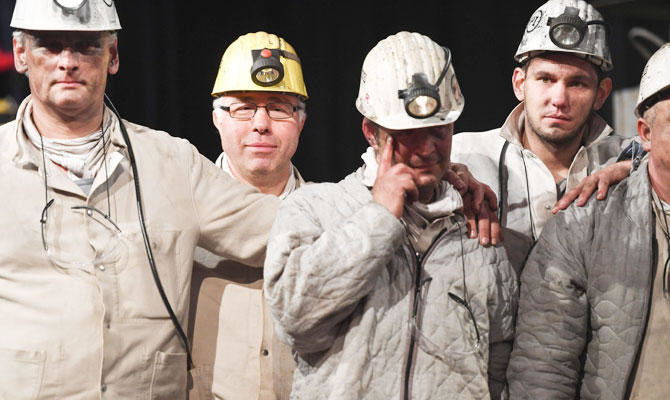
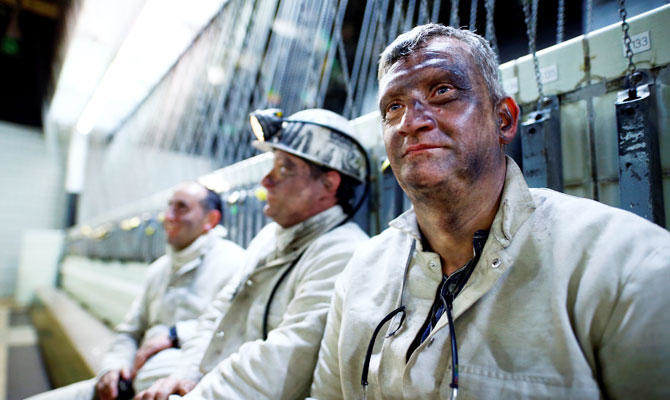
BERLIN: Straining to hold back tears, their once-white helmets and overalls smeared with dust, seven miners in Germany stepped out of a metal cage Friday bearing the last piece of black coal hauled up from 1,000 meters (3,280 feet) below.
The ceremony marked the end of an industry that laid the foundations for Germany’s industrial revolution and its post-war economic recovery.
The men at the Prosper-Haniel mine symbolically handed the football-sized lump of coal to German President Frank-Walter Steinmeier with the words “Glueck Auf.” The ancient miners’ greeting roughly translates as “good luck,” reflecting the uncertainty of a life spent prospecting deep underground.
“A piece of German history is coming to an end here,” Steinmeier told the miners. “Without it, our entire country and its development over the past 200 years would have been unthinkable.”
The Prosper-Haniel mine in the western city of Bottrop and another colliery in Ibbenbueren, 100 kilometers (62 miles) to the north, were the last remnants of an industry that once dominated the region, employing half a million people at its peak in the 1950s. Together, they helped feed the Ruhr valley’s hungry steel mills until imports of cheaper, foreign coal made Germany’s “black gold” lose its sheen.
For decades, the mines survived only thanks to generous subsidies. But in 2007, a political decision was made to phase them out, with a promise of early retirement or retraining for their remaining workers.
According to government figures, Germany’s coal mining industry received more than 40 billion euros ($46 billion) in federal funds since 1998 and is slated to get another 2.7 billion euros through 2022. Some of the money is needed to deal with mine maintenance and environmental cleanup efforts that include preventing parts of the Ruhr region from slowly sinking as myriad tunnels give way over time.
Further vast sums have been spent supporting economic redevelopment in the region, which has seen a growth in universities, research facilities and IT start-ups in recent years.
Steinmeier urged the miners and their loved ones to look to the future, but also to take pride in a culture of hospitality and openness. The Ruhr region became a melting pot with the arrival since the 19th century of successive waves of immigrants, from Poland, Italy and Turkey, in search of well-paid work down the mines.
The end of deep-shaft mining is seen as a test for the planned closure of open-cast lignite, or brown coal, mines that still operate in Germany.
Germany still generates almost two-fifths of its electricity from burning coal, a situation that scientists say can’t continue if Germany wants to reduce its greenhouse gas emissions. Lignite is considered even dirtier than black coal but remains relatively cheap to extract, even in Germany.
More than 400 coal mining regions around the world will face similar pressures to shut down in the coming decades amid international efforts to curb global warming.
Some in Germany fear that other sources of energy — chiefly renewables — may not be sufficient to power an industrial nation, especially as the country also plans to shut down its nuclear plants by 2022.
A government-appointed panel is due to deliver a report in February laying out proposals for the gradual phasing out of lignite mines.
Toward the end of Friday’s ceremony, miners paid their respects to colleagues who lost their lives underground. The dangers were highlighted Monday, when a 29-year-old worker was crushed to death by a metal door in the Ibbenbueren shaft.
And overnight Friday, news emerged of the deaths of 13 miners in an explosion at a colliery in the Czech Republic.


End of an era: Germany closes its last black coal mine


End of an era: Germany closes its last black coal mine
- Germany’s coal mining industry received more than 40 billion euros ($46 billion) in federal funds since 1998 and is slated to get another 2.7 billion euros through 2022


26 Doctors without Borders workers remain unaccounted for in South Sudan a month after attacks
- A hospital in the town of Lankien was bombed by government forces, MSF said
- “We have lost contact with them amid ongoing insecurity”
NAIROBI: More than two dozen Doctors Without Borders workers remain unaccounted for a month after attacks in South Sudan, the medical charity said.
Two facilities belonging to the group, known by French acronym MSF, were attacked on Feb. 3 in Jonglei State, northeast of the capital, Juba, where violence has displaced an estimated 280,000 people since December.
A hospital in the town of Lankien was bombed by government forces, MSF said, while another medical facility in the town of Pieri was raided by “unknown assailants.” Both were located in opposition-held areas.
Staff working at the two facilities fled alongside much of the local population into deeply rural areas where armed clashes and aerial bombardments were ongoing.
MSF said in a statement on Monday that “26 of 291 of our colleagues working in Lankien and Pieri remain unaccounted for.
“We have lost contact with them amid ongoing insecurity,” it said.
The lack of communication with its staff could be linked to the limited network connectivity in much of the state. Staff members who had been contacted described “destruction, violence and extreme hardships.”
Fighting escalated sharply in December, when opposition forces captured a string of government outposts in north central Jonglei. In January, the government responded with a counteroffensive that recaptured most of the area it had lost.
Displaced people in Akobo, an opposition-held town near the Ethiopian border, described horrific violence by government fighters. Many described not being able to find food or water as they walked for days to reach safety.
The attacks on MSF facilities in Lankien and Pieri are part of an uptick in violence on humanitarian staff, supplies and infrastructure, aid groups say. MSF facilities have been attacked 10 times in the last 12 months.
“This violence has taken an unbearable toll not only on health care services, but on the very people who kept them running,” said Yashovardhan, MSF head of mission in South Sudan, who only uses one name.
“Medical workers must never be targets,” he said. “We are deeply concerned about what has happened to our colleagues and the communities we serve.”