More Saudi aid for Syrian kids in Lebanon

1 / 3
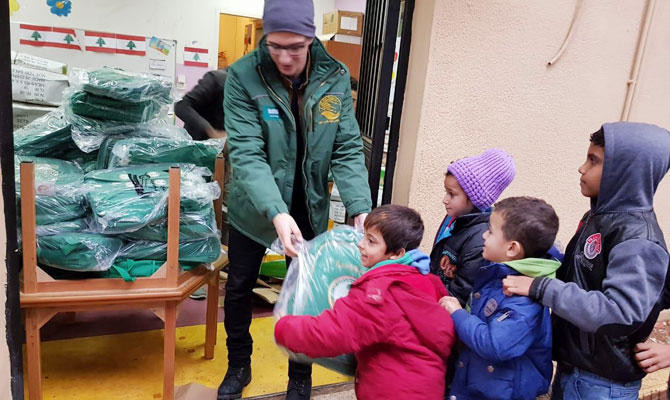
KSRelief has been providing multi-sectoral support to Syrian refugees living in neighboring countries. (SPA)
2 / 3
KSRelief has been providing multi-sectoral support to Syrian refugees living in neighboring countries. (SPA)
3 / 3
KSRelief has been providing multi-sectoral support to Syrian refugees living in neighboring countries. (SPA)
Updated 15 December 2018
Follow

More Saudi aid for Syrian kids in Lebanon

  • The aid was given as part of a joint program with the Lebanese Ministry of Education

JEDDAH: The King Salman Humanitarian Aid and Relief Center (KSRelief) has made a significant donation to Syrian schoolchildren sheltering in Lebanon.
KSRelief distributed 2,360 schoolbags and 1,710 winter kits to young refugees attending schools in the north of the country.
The aid was given as part of a joint program with the Lebanese Ministry of Education.
Students at Nabi Kzayber Official School, Tal Al-Zera’ah Official School and Halba Official School were among those who received bags, stationery and essential school supplies.
KSRelief has been providing multi-sectoral support to Syrian refugees living in neighboring countries, such as Lebanon and Jordan, since the outbreak of the Syrian conflict in 2011.


Air force partnerships are stabilizing force in region, US army lieutenant says

Updated 6 sec ago
Follow

Air force partnerships are stabilizing force in region, US army lieutenant says

  • Lt. Gen. Derek France: The purpose of being here today is to support our friends in the Kingdom of Saudi Arabia
  • France: A great example is the Spears of Victory exercise, where US F-16s and American airmen participated alongside the Royal Saudi Air Force

RIYADH: Saudi Arabia and the US have long enjoyed a strong military relationship, one that continues to grow even as regional and global tensions increase.

US Army Lt. Gen. Derek France, commander of the Ninth Air Force, spoke to Arab News on the sidelines of the World Defense Show in Riyadh about the two nations’ history and future.

“The purpose of being here today is to support our friends in the Kingdom of Saudi Arabia,” he said.

During his visit, the lieutenant met Commander of the Royal Saudi Air Force Lt. Gen. Turki bin Bandar, to discuss the scope of cooperation between the two air forces.

“A great example is the Spears of Victory exercise, where US F-16s and American airmen participated alongside the Royal Saudi Air Force,” France said.

Spears of Victory was a large-scale, multinational air exercise hosted by Saudi Arabia at the King Abdulaziz Air Base in Dhahran from Jan. 18 to Feb. 7.

The exercise, widely regarded as one of the most comprehensive air drills in the Middle East, brought together the RSAF and regional and international partners, including the US, to enhance combat readiness and interoperability.

Beyond providing a platform for strengthening military partnerships and reinforcing collective deterrence and regional stability, Spears of Victory had participating forces conducting complex joint operations, advanced mission planning, and integrated airpower scenarios designed to reflect modern, multi-domain warfare.

“It was a fantastic success and a strong demonstration of partnership,” France said.

According to the commander, the US military’s role in the region is built on partnerships, citing a history of “airmen working with airmen.”

“There is a common language in airpower that transcends cultures and border.”

That cooperation, he said, dates back to Operation Desert Storm through the fight against the Islamic State (Daesh), and beyond.

Operation Desert Storm was the combat phase of the US-led international coalition’s response to Iraq’s invasion of Kuwait in 1990-1991.

Following months of military buildup and diplomacy, the operation combined a sustained air campaign with a brief but decisive ground offensive that liberated Kuwait and significantly degraded Iraq’s military capabilities.

Saudi Arabia played a central role as a host nation and key partner, providing basing, logistical support and regional coordination for coalition forces; laying the foundation for long-standing US-Saudi defense cooperation and a defining moment for modern warfare.

“When air forces are interoperable, understand one another, and train together, it becomes a deterrent and contributes to stability in the region against those who seek to destabilize it.”

The US Embassy Chargee d’Affaires Alison Dilworth in a statement to Arab News added that “the United States is committed to supporting the defense of Saudi Arabia as well as regional security and stability.

“As President Trump said when he designated Saudi Arabia as a major non-NATO ally, ‘A stronger and more capable alliance will advance the interests of both countries, and it will serve the highest interests of peace.’”

The main priority in the US-Saudi military partnership over the next few years is robust integration, France explained.

That includes technical integration through common communications, shared platforms where possible, and strong training and exercise programs to test and improve interoperability.

“There is also a crucial human element. When US and Saudi forces operate side by side, it creates opportunities to learn from each other and understand each other’s cultures.”

France added that many US airmen arrived with preconceived notions of the Middle East that were almost immediately challenged.

However, the US is no stranger to criticism for its military operations worldwide, with recent concern raised over President Trump’s ambitions in Iran, Greenland and Gaza.

Responding to that criticism, France said that a strong military-to-military relationship helped to stabilize regions, often enduring longer than political cycles, and could remain steady even when diplomacy came under pressure.

“I’ve seen this not just here, but elsewhere. These relationships often underpin stability even when political relationships become strained.”

He recalled the time when he flew with the Saudi Air Force in Dhahran in 2004-2005 and formed personal relationships that still exist today.

“One of the general officers who now runs their (Air) Warfare Center is a close friend.

“Those relationships can resurface years later and become enduring bonds between nations, helping sustain broader cooperation even during political challenges.”