Work underway to clear land mines from Jesus baptism site

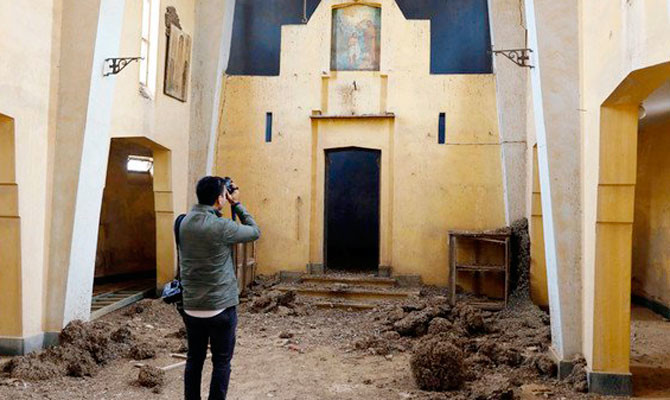
Interior of an Ethiopian church at Qasr Al-Yahud near the Jordan river, which is being opened for the first time in 50 years. (AFP)
Updated 11 December 2018
Follow

Work underway to clear land mines from Jesus baptism site

  • Work at the site just north of the Dead Sea is being overseen by Israel’s Defense Ministry
  • Mines and other ordnance have been cleared from Ethiopian and Greek Orthodox monastery sites, organizers said

QASR AL-YAHUD, Palestinian Territories: Efforts to clear thousands of land mines and other ordnance around the site where many believe Jesus was baptized have reached a milestone and officials allowed a rare glimpse Sunday of abandoned churches there.

The church grounds around the site in the occupied West Bank have sat empty and decaying for around 50 years, though pilgrims have been able to visit a nearby restricted area at the traditional baptismal spot on the banks of the River Jordan.

Work at the site just north of the Dead Sea is being overseen by Israel’s Defense Ministry, de-mining charity Halo Trust and Israeli firm 4CI.

According to the ministry, the project covers around 1 square kilometer (250 acres) as well as some 3,000 mines and other explosive remnants.

It is expected to cost 20 million shekels ($5.3 million, €4.7 million).

The work began in March and would require another eight months to a year to complete, said Moshe Hilman of Israel’s Defense Ministry.

Mines and other ordnance have been cleared from Ethiopian and Greek Orthodox monastery sites as well as a Franciscan chapel, organizers said.

Other grounds belonging to Russian, Syrian, Romanian and Coptic Orthodox churches are yet to be cleared.

The plan once complete is to return the plots to the various church denominations and allow visits. At the crumbling, brick-and-concrete Ethiopian monastery on Sunday, a fading fresco of Jesus being baptized by John the Baptist could still be seen inside.

Signs hung on the walls with notifications that the location had been cleared of explosives.

A collection of pieces of mortars and other explosive remnants sat alongside a nearby roadside as a demonstration of some of what had been found.

“The Halo Trust has reached a pivotal point in our work to clear the baptism site of land mines and other remnants of war,” the charity’s CEO James Cowan said in a statement.

He added that “we have completed clearance of the Ethiopian, Greek and Franciscan churches.”

The majority of the mines were laid by Israeli forces after the country seized control of the West Bank in 1967 from Jordanian troops. Other unexploded ordnance from both Israel and Jordan has remained lodged in the ground, including around the churches, which were evacuated by Israel in the 1970s.

Israel’s control of the West Bank has never been recognized by the international community, which considers the land occupied Palestinian territory.


Russian forces begin pulling out of bases in northeast Syria

Updated 4 sec ago
Follow

Russian forces begin pulling out of bases in northeast Syria

  • Despite having been on opposite sides of the battle lines during the civil war, the new rulers in Damascus have taken a pragmatic approach to relations with Moscow

QAMISHLI, Syria: Russian forces have begun pulling out of positions in northeast Syria in an area still controlled by the Kurdish-led Syrian Democratic Forces after the group lost most of its territory in an offensive by government forces.
Associated Press journalists visited one base next to the Qamishli airport Tuesday and found it guarded by SDF fighters who said the Russians had begun moving their equipment out in recent days.
Inside what had been living quarters for the soldiers was largely empty, with scattered items left behind, including workout equipment, protein powder and some clothing.
Ahmed Ali, an SDF fighter deployed at the facility, said the Russian forces began evacuating their positions around the airport five or six days ago, withdrawing their equipment via a cargo plane.
“We don’t know if its destination was Russia or the Hmeimim air base,” he said, referring to the main Russian base on Syria’s coast. “They still have a presence in Qamishli and have been evacuating bit by bit.”
A UN humanitarian convoy from Damascus reached Qamishli on Tuesday, UN spokesman Stéphane Dujarric said.
“It delivered food, warm clothes and blankets, among other supplies,” he told UN reporters. “More convoys are planned in the coming days.”
Dujarric said the UN is also continuing to distribute food, bread and cash elsewhere including displacement sites.
There has been no official statement from Russia about the withdrawal of its forces from Qamishli.
Russia has built relations with the new central Syrian government in Damascus since former President Bashar Assad was ousted in December 2024 in a rebel offensive led by now-interim President Ahmad Al-Sharaa — despite the fact that Moscow was a close ally of Assad.
Moscow’s scorched-earth intervention in support of Assad a decade ago turned the tide of Syria’s civil war at the time, keeping Assad in his seat. Russia didn’t try to counter the rebel offensive in late 2024 but gave asylum to Assad after he fled the country.
Despite having been on opposite sides of the battle lines during the civil war, the new rulers in Damascus have taken a pragmatic approach to relations with Moscow. Russia has retained a presence at its air and naval bases on the Syrian coast.
Al-Sharaa is expected to visit Moscow on Wednesday and meet with Putin.
Fighting broke out early this month between the SDF and government forces after negotiations over a deal to merge their forces together broke down. A ceasefire is now in place and has been largely holding.
After the expiration of a four-day truce Saturday, the two sides announced the ceasefire had been extended by another 15 days.
Syria’s defense ministry said in a statement that the extension was in support of an operation by US forces to transfer accused Daesh militants who had been held in prisons in northeastern Syria to detention centers in Iraq.