Nissan ex-chairman Ghosn expected to be indicted on Monday

Carlos Ghosn was sacked by Nissan
Updated 07 December 2018
Follow

Nissan ex-chairman Ghosn expected to be indicted on Monday

  • Nissan and the two former executives would likely be indicted over misstatements in five annual reports through the fiscal year that ended in March 2015
  • Ghosn was arrested for allegedly conspiring to understate his income by about half of the actual 10 billion yen ($88.66 million) over five years from 2010

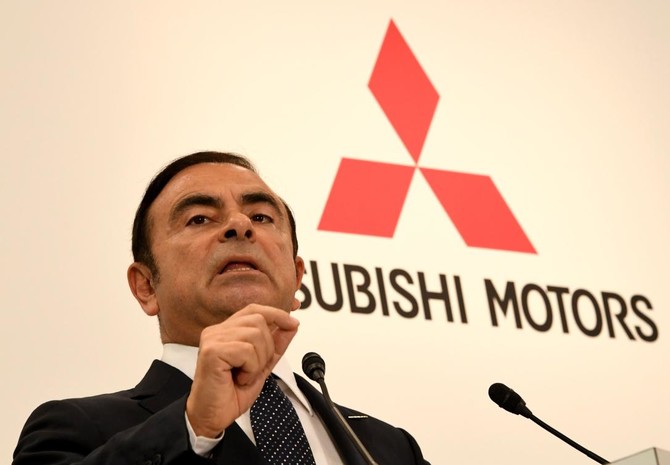
TOKYO: Tokyo prosecutors plan to indict former Nissan Motor Co. Ltd. Chairman Carlos Ghosn on Monday for financial misconduct, the Nikkei business daily reported, ratcheting up their case against the auto tycoon.
Prosecutors also plan to indict on the same day former representative director Greg Kelly as well as the automaker itself, the Nikkei said on Friday, citing unidentified sources.
The Nov. 19 arrest of Ghosn and Kelly shook the foundations of the Renault-Nissan alliance and stunned the auto industry, where Ghosn is renowned for turning around the French and Japanese carmakers. Ghosn remains chairman and chief executive of Renault SA.
Ghosn and Kelly’s detention period runs until Monday, when prosecutors must decide to indict, release, or rearrest them on new claims.
The Nikkei said the two former executives and Nissan would likely be indicted over the alleged underreporting of salaries in five annual reports through the business year that ended in March 2015.
Ghosn and Kelly are also likely to be rearrested on suspicion of making misstatements in reports for the subsequent three business years, the newspaper reported.
The Nikkei said making false statements in an annual report was a crime for which not just the individuals involved but also companies can be held accountable, and prosecutors wanted to charge Nissan for not preventing the alleged crime.
Representatives for the Tokyo District Public Prosecutor’s Office and Nissan declined to comment.
Ghosn was arrested for allegedly conspiring to understate his income by about half of the actual 10 billion yen ($88.66 million) over five years from 2010. Kelly was accused of assisting.
Ghosn and Kelly have not made any statement through their lawyers, but Japanese media reported that they have denied the allegations. 


Saudi ports brace for cargo surge as shipping lines reroute

Updated 09 March 2026
Follow

Saudi ports brace for cargo surge as shipping lines reroute

RIYADH: Preliminary estimates suggest that several global shipping lines could reroute part of their operations to Saudi Arabia’s Red Sea ports, potentially adding 250,000 containers and 70,000 vehicles per month, according to Rayan Qutub, head of the Logistics Council at the Jeddah Chamber of Commerce, in an interview with Al-Eqtisadiah.

“Any disruption in the Strait of Hormuz not only affects maritime traffic in the Arabian Gulf but could also reshape global trade routes,” Qutub said, highlighting the strait’s status as one of the world’s most critical maritime chokepoints for energy and goods transport.

With rising regional tensions, international shipping companies are reassessing their routes, adjusting shipping lines, or exploring alternative sea lanes. This signals that the current challenges extend beyond the Arabian Gulf, impacting the global supply chain as a whole.

Limited impact on US, European shipments

The effects of these developments will not be uniform across trade routes. Qutub noted that goods from China and India, which rely heavily on routes through the Arabian Gulf, are most vulnerable to disruption. In contrast, shipments from Europe and the US typically traverse western maritime routes via the Suez Canal and the Red Sea, making them less susceptible to regional disturbances.

Saudi Arabia’s strategic location, he emphasized, strengthens the resilience of regional trade. The Kingdom operates an integrated network of Red Sea ports — including Jeddah, Rabigh, Yanbu, and Neom — that have benefited from substantial infrastructure upgrades and technological enhancements in recent years, boosting their capacity to absorb increased cargo volumes.

Red Sea bookings

Several major carriers, including MSC, CMA CGM, and Maersk, have already opened bookings to Saudi Red Sea ports, signaling a shift in operational focus to these strategically positioned hubs.

However, Qutub warned that rerouted shipments could increase sailing times. Cargo from Asia, which normally takes 30-45 days, might now require longer voyages via the Cape of Good Hope and the Mediterranean, potentially extending transit to 60-75 days in some cases.

These changes are also reflected in rising shipping costs, driven by longer routes, higher fuel consumption, and increased insurance premiums — a typical response when global trade patterns shift due to geopolitical pressures.

Qutub emphasized that Saudi Arabia’s transport and logistics sector is managing these developments through coordinated government oversight. The Ministry of Transport and Logistics, the Logistics National Committee, and the Logistics Partnership Council recently convened to evaluate the impact on trade and supply chains. Regular weekly meetings have been established to monitor developments and implement solutions to safeguard the stability of supplies and continuity of trade.

He noted that the Kingdom’s logistical readiness is the result of long-term strategic investments, encompassing ports, airports, road networks, rail systems, and logistics zones. Today, Saudi logistics integrates maritime, land, rail, and air transport, enabling a resilient response to global disruptions.

Qutub also highlighted the need for the private sector to continuously review logistics and crisis management strategies, develop alternative plans, and manage strategic stockpiles. Such measures are essential to mitigate temporary fluctuations in global trade and ensure smooth supply chain operations.