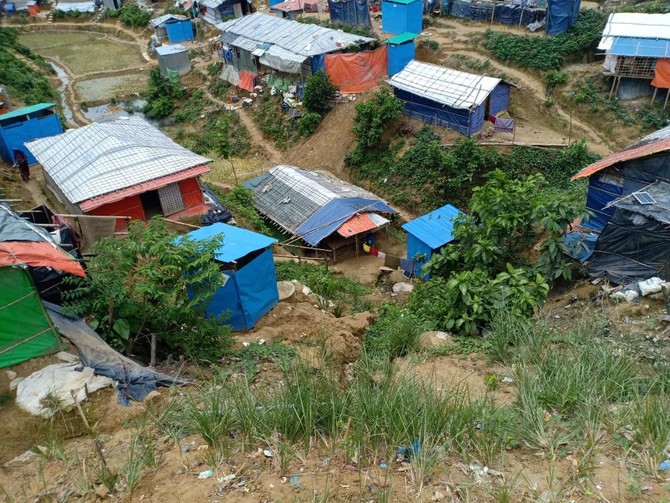
DHAKA: Rohingya refugees have told Arab News they fear going back to Myanmar after a government minister made derogatory remarks about Islam.
Myanmar’s Minister for Religious Affairs and Culture Thura Aung Ko also made comments about the Muslim minority group, which has been subjected to a military crackdown described by the United Nations as a textbook example of ethnic cleansing.
Ko alleged that Rohingya youths in refugee camps across the border in Bangladesh were being brainwashed to “truly march toward Myanmar” and referred to the Rohingya as Bengalis, a term used by Naypyidaw to paint the group as illegal immigrants.
In another video, released by Radio Free Asia, Ko alleged that Myanmar’s Buddhist population was under threat.
“While we Buddhists practice monogamy and have only one or two children, an extreme religion encourages having three or four wives and giving birth to 15 to 20 children. After three, four, five decades in this Buddhist country, the Buddhist community will certainly become the minority,” he said in the video.
The Rohingya have faced severe discrimination in Myanmar and been the target of violence for years, notably in 2017.
Thousands were killed and more than 720,000 fled their homes following a Myanmar military crackdown purportedly aimed at militants, according to rights group.
Myanmar refuses to recognize the Rohingya as a legitimate native ethnic minority and they are denied citizenship and other rights.
“We were living in a highly hostile environment, in many cases that were backed by the state. Now the world witnessed it once again after the religious affairs minister’s comments,” Daud Ali told Arab News, a 47-year-old living in the Kutapalang refugee camp in the southeastern city of Cox’s Bazar.
Another refugee at the same camp, 27-year-old Sayed Alam, said the Rohingya had always been treated as second class citizens.
“Our movements were highly restricted even in Rakhine,” he told Arab News, referring to the western Myanmar state where the majority of the Rohingya live, “so it’s no wonder that a minister of (Aung) Suu Kyi’s government makes derogatory remarks about Muslims.”
Bangladesh protested Ko’s remarks, summoning Myanmar’s Ambassador Lwin Oo to the Foreign Ministry in Dhaka on Wednesday.
Delwar Hossain, from the Foreign Ministry, said Bangladesh had conveyed its displeasure.
“We consider that these types of comments are unacceptable and disgraceful. Bangladesh has strongly objected and made its position clear. In the entire conversation, Myanmar’s envoy did not utter any words in defense of his country and only assured to convey Dhaka’s message to Naypyidaw,” Hossain told Arab News.
Ko, a former Myanmar army general, was appointed in 2016 by Suu Kyi after her party came to power in a general election landslide victory.
“Myanmar does not seem interested in Rohingya [refugees] repatriation,” former Bangladesh Ambassador to the United States Humayun Kabir told Arab News.
Myanmar would not be making negative remarks about Bangladesh if it were genuinely interested in creating a conducive environment for repatriation, he added.
“Actually Bangladesh has no other option to move forward with the repatriation issue except for creating more diplomatic pressure from the international community.”
An attempt to repatriate Rohingya refugees last month failed because of their refusal to go of their own accord.
They had a list of demands before any repatriation including safety and security in Rakhine, citizenship guarantee and freedom of movement.
The UNHCR is helping Bangladesh with the repatriation process to ensure it is voluntary.
One official report from humanitarian agencies said more than 15,000 Rohingyas had entered Bangladesh since January 2018.
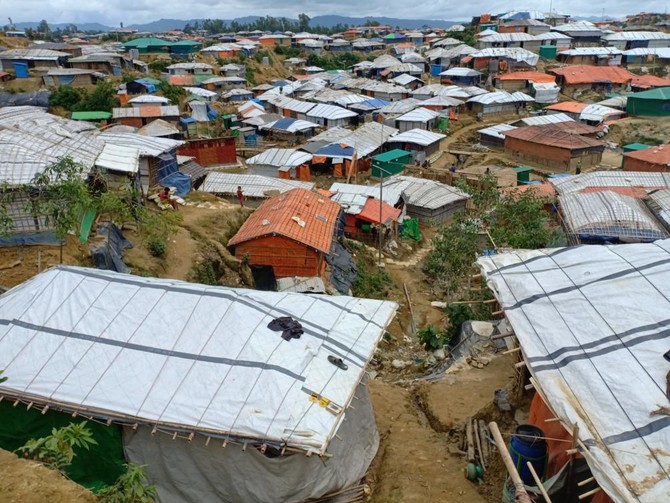
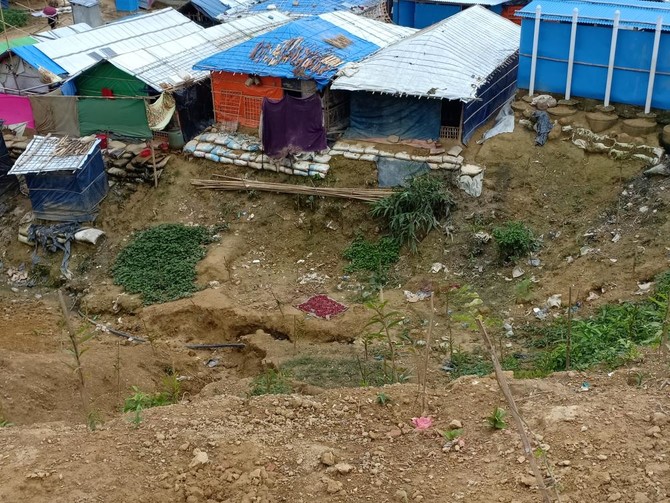
“It is very clear that Myanmar’s government is not willing to repatriate us and that’s why they are constantly spreading negative comments about Rohingyas,” said Mohammad Ashraf, a 38-year refugee from Balukhali camp. “How can we return to Myanmar amid such an unpleasant situation and hatred?”

Rohingya refugees wary after Myanmar minister’s hostile remarks
- Myanmar ambassador summoned by Dhaka
- Crackdown on Rohingya was ‘ethnic cleansing’ said UN
What to know about the Israeli president’s state visit to Australia
- Netanyahu had been outraged by Australia’s decision four months earlier to join France, Britain and Canada in recognizing a Palestinian state
MELBOURNE, Australia: The stated purpose of Israel President Isaac Herzog’s visit to Australia is to support the Jewish community still reeling from an antisemitic attack at Sydney’s Bondi Beach that left 15 dead. But his critics warn his presence undermines rather than repairs social cohesion frayed by the far away war in Gaza.
Protest rallies are expected to follow the president, who performs a largely ceremonial role as head of state, as he travels to Sydney, Melbourne and Canberra over four days starting Monday. Some critics demand he be arrested in Australia on suspicion of inciting genocide in Gaza.
He is the first Israeli head of state to visit Australia since Reuven Rivlin in 2020. Herzog’s father, Chaim Herzog, also visited Australia as Israel’s president in 1986.
Here’s what to know:
The Australian visit comes at a time of extraordinary bilateral tensions
Within hours of two gunmen allegedly inspired by the Daesh group launching their attack in Sydney on Dec. 14 last year, Israeli Prime Minister Benjamin Netanyahu blamed his Australian counterpart Anthony Albanese, posting on social media “your call for a Palestinian state pours fuel on the antisemitic fire.”
Netanyahu had been outraged by Australia’s decision four months earlier to join France, Britain and Canada in recognizing a Palestinian state.
Netanyahu has repeatedly sought to link widespread calls for a Palestinian state, and criticism of Israel’s military offensive in Gaza, to growing incidents of antisemitism worldwide.
Albanese has accused Netanyahu of being “in denial” over the humanitarian consequences of war in Gaza. Netanyahu has branded the Australian a “weak politician who betrayed Israel and abandoned Australia’s Jews.”
Australian Jews have appealed to both leaders to restore “diplomatic norms” to a bilateral relationship that had been friendly for decades.
Albanese has made clear his government’s invitation to Herzog to make that state visit was the idea of Jewish leaders.
“President Herzog is coming particularly to engage with members of the Jewish community who are grieving the loss of 15 innocent lives,” Albanese said.
“People should recognize the solemn nature of the engagement that President Herzog will have with the community of Bondi in particular, and bear that in mind by the way that they respond over coming weeks,” he added.
Jewish leaders welcome Herzog’s visit
Sydney-based Jewish leader Alex Ryvchin, co-CEO of the Executive Council of Australian Jewry, said his community “warmly anticipates” Herzog’s arrival.
“His visit will lift the spirits of a pained community and we hope will lead to a much-needed recalibration of bilateral relations between two historic allies,” Ryvchin said.
“President Herzog is a patriot and a person of dignity and compassion and holds an office that is above party politics. He is a person who has sadly had to comfort families, police and first responders after terrorist attacks many times, and will know how to reassure and fortify our community in its darkest time,” he added.
Ryvchin is one of the Australian Jewish leaders who have accused Albanese’s center-left Labour Party government of not doing enough to curb an increase in antisemitism in Sydney and Melbourne, where 85 percent of Australia’s Jewish population live, since the Israel-Hamas war began in 2023.
Herzog sees opportunity to reset relations
Herzog, a former head of Israel’s centrist Labour Party, now holds a job meant to serve as a unifier and moral compass for all Israelis. A onetime rival of Netanyahu, he has good working relations with the prime minister.
Ahead of his visit, Herzog told The Associated Press that the “primary reason” for the trip was to stand with Australia’s Jewish community as the representative of all Israelis.
“From thousands of miles away in Israel, we feel the deep pain of our Jewish Australian sisters and brothers. I am coming to show them our love and support at this devastating time,” he said.
But Herzog also said the visit is an opportunity “to reinvigorate relations” between Israel and Australia.
“There is a long history of partnership between our two nations and deeply held shared values,” he said, adding that the visit “offers a chance to reignite the longstanding bipartisan support for ties between Israel and Australia.”
“I hope to be able to communicate this message of goodwill and friendship to the Australian people, and dispel many of the lies and misinformation spread about Israel over the last two years,” he said.
Israel’s critics have called for Herzog’s invitation to be withdrawn
“This is one of the most divisive figures in the world. Bringing him to Australia will undermine social cohesion, it will not rebuild it. It will increase division, it will not bring about national unity,” Australian human rights lawyer Chris Sidoti said. Sidoti described the invitation as a ”crazy idea.”
Sidoti was one of three experts appointed by the UN’s Human Rights Council to an inquiry that reported in September last year that Herzog, Netanyahu and former Israeli Defense Minister Yoav Gallant had incited the commission of genocide in Gaza.
The findings carry no legal consequence and Israel has rejected genocide allegations against the country as antisemitic “blood libel.” Sidoti and other lawyers say Australian police could potentially arrest Herzog on suspicion of inciting genocide, which is a crime under Australian law as well as international law. Australian Federal Police have declined to comment.
A lawmaker in Albanese’s government, Ed Husic, said he was “very uncomfortable” with Herzog’s visit. Husic, a Muslim and vocal critic of Israel’s conduct in Gaza, said he was “concerned that a figure like that doesn’t necessarily enhance social cohesion.”
Some state government lawmakers from Albanese’s Labour Party have said they will join a protest in downtown Sydney on Monday planned by the Palestine Action Group activist organization.
“We need to send a clear message to our government and to the world … we are fundamentally opposed to this tour, which is designed to normalize genocide,” protest organizer Josh Lees said.
Police prepare to use enhanced powers of arrest to control protesters in Sydney
In response to the Bondi shooting, the New South Wales state parliament rushed through legislation increasing police powers to arrest protesters in the aftermath of a declared terrorist attack.
New South Wales Premier Chris Minns said a heightened police response in Sydney during Herzog’s visit was necessary to ensure safety.
“We will have thousands of mourners and thousands of protesters as well as a visiting head of state all in the same city at the same time. And we’ve got a responsibility to keep people safe in those circumstances,” Minns said.
“Every international city anywhere in the world would apply exactly the same geographical restrictions so that the two groups don’t meet and as a result there’s not a major confrontation,” Minns added.