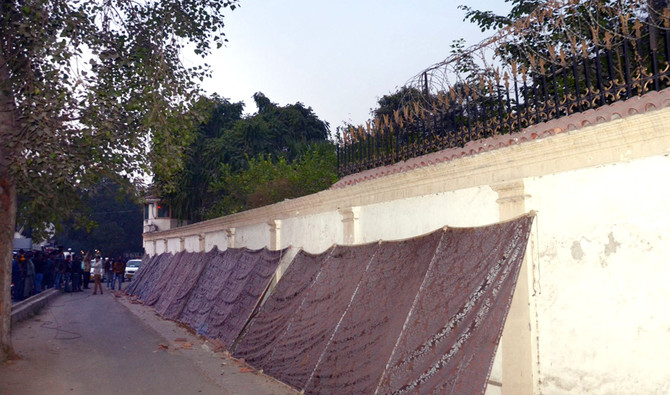
LAHORE: There were mixed reactions in Lahore city to the demolition of the outer boundary wall of the Punjab Governor’s House on Monday. Some people consider it a symbolic breaking of the status quo, while others declared it a violation of heritage law.
The building, which was constructed during the early Mughal era on Mall Road, in heart of Lahore, was the residence of the British lieutenant-governor of the province during colonial rule. After the partition of Pakistan from United India in 1947, the building became the residence of the province’s governors. The building has been criticized by political and religio-political parties as an unnecessary show of wealth in an otherwise impoverished country.
On Saturday, while chairing a meeting of the Punjab cabinet, Prime Minister Imran Khan ordered the boundary walls of the “symbol of the colonial era” to be demolished.
The Punjab government has decided to split the Governor’s House, which is built upon 700 kanals (87.5 acres) of land, into three parts that will each be used for different purposes: the residential and educational part of the house will be separated and not disturbed, while the green lawns, lake and small hill have been turned into into a park that is already open to the public. The third part of the property, which includes the office of the provincial governor, Darbar Hall, will be converted into a museum and art gallery.
“The walls are being erased and the site will be converted into a museum,” Said Fayaz-ul-Hasan Chohan, the Punjab minister for information, on Monday. “It is not a historic place; it is a sign of British grandeur and reflects that the man sitting inside is a VVIP. It is a sign of class difference. By demolishing the walls we want to show everyone that he is also among the masses, from the masses.”
Many, however, have expressed their disappointment in the government’s decision.
“These walls are protected under the law of conservation and cannot be demolished,” said advocate Azhar Siddique. “We will move the court against this decision of the government. A lot of money is involved in the demolition of these walls — they have been erected with iron fences — and that is a waste of the national exchequer, which will create security threats.”
Sabir Bokhari, the president of Sanjok, disagreed.
“In our opinion, the entire building of the Governor’s House should be demolished; it is a symbol of the cruelty the masses have suffered at the hands of the rulers,” he said. “It keeps a common man away from the representatives. All governors’ houses should be demolished.”
Some political pundits suggested that the demolition was a part of the new government’s moves to humiliate previous governments and political institutions. They consider it an insult to the symbols of democracy, which is being used as a tool to divert the attention of the public from more pressing issues.
“Some forces are on an agenda to disgrace the public office and the symbols of democratic institutions,” said senior political analyst Naveed Chaudhary. “The demolition of the walls is part of that agenda.”


![]()
![]()
![]()
![]()
![]()

Mixed opinions as government demolishes boundary wall at Punjab Governor’s House


Mixed opinions as government demolishes boundary wall at Punjab Governor’s House
- Punjab government plans to convert Governor’s office into a museum, says minister
- The building is protected under conservation law and demolishing its walls is unlawful, according to legal expert


Latest updates







© 2026 SAUDI RESEARCH & PUBLISHING COMPANY, All Rights Reserved And subject to Terms of Use Agreement.