96 injured, more than 260 arrested in Paris protests

1 / 8
Demonstrators stand in front of a burning car during a protest of Yellow vests (Gilets jaunes) against rising oil prices and living costs, on December 1, 2018 in Paris. (AFP)
2 / 8
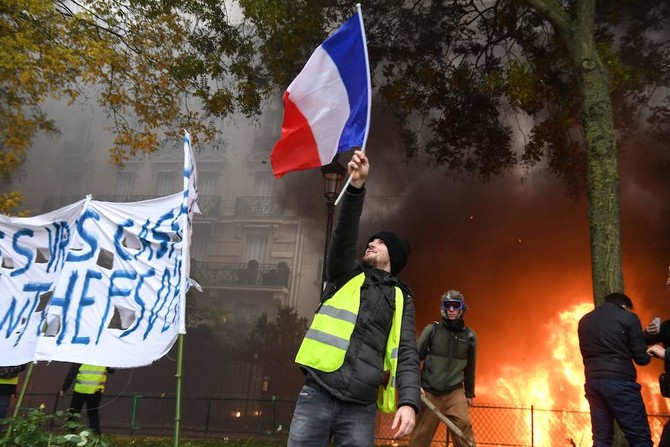
A demonstrator holds a French flag during a protest of Yellow vests (Gilets jaunes) against rising oil prices and living costs, in Paris, on December 1, 2018. (AFP)
3 / 8
Demonstrators gather near a fire burning during a protest of Yellow vests (Gilets jaunes) against rising oil prices and living costs, near the Arc de Triomphe in Paris, on December 1, 2018. (AFP)
4 / 8
Demonstrators gather in front of a burning car during a protest of Yellow vests (Gilets jaunes) against rising oil prices and living costs, on December 1, 2018 in Paris. (AFP)
5 / 8
Riot police officers face demonstrators wearing yellow jackets near the Arc de Triomphe on the Champs-Elysees avenue during a demonstration Saturday, Dec.1, 2018 in Paris. (AP)
6 / 8
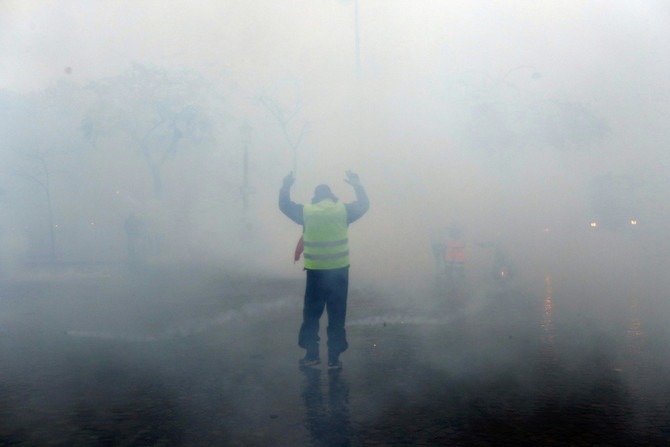
A demonstrator wearing yellow jacket stands among tear gas near the the Champs-Elysees avenue during a demonstration Saturday, Dec.1, 2018 in Paris. (AP)
7 / 8
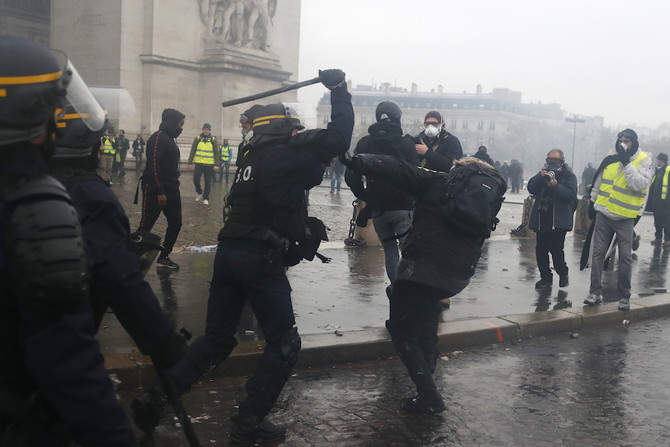
A riot police officer uses his baton on a demonstrator during a demonstration at the Arc de Triomphe Saturday, Dec.1, 2018 in Paris. (AP)
8 / 8
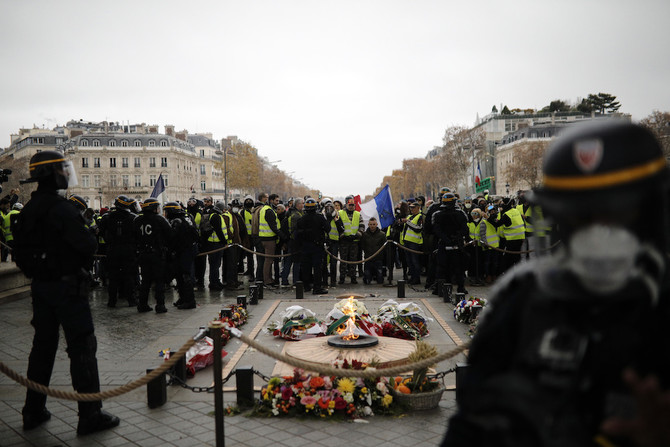
Riot police officers watch demonstrators wearing yellow jackets gathering at the Tomb of the Unknown Soldier under the Arc de Triomphe on the Champs-Elysees avenue during a demonstration Saturday, Dec.1, 2018 in Paris. (AP)
Updated 02 December 2018
Follow

96 injured, more than 260 arrested in Paris protests

  • Hundreds of people gathered at the top of the Champs-Elysees on Saturday morning
  • Police briefly used tear gas to disperse the crowd as some tried to force their way through

PARIS: Paris police say that at least 80 people including 11 police officers have been injured in violent protests in the French capital.

Protesters angry about rising taxes clashed with French police for a third straight weekend and more than 200 were arrested Saturday. Pockets of demonstrators built makeshift barricades in the middle of streets in central Paris, lit fires, sprayed graffiti on the Arc de Triomphe and threw rocks at officers.
Protesters, including some wearing black hoods, piled up large plywood planks and other material in the middle of a street near the Arc de Triomphe, and set the debris ablaze.
Police fired tear gas and used water cannons to try to push back the protesters who gathered around the Arc de Triomphe. Some demonstrators responded by throwing large rocks.
Others removed the barriers protecting the Tomb of the Unknown Soldier from World War I, under the monument, to pose near its eternal flame and sing the national anthem. They were then dispersed by police.
Graffiti sprayed onto the Arc de Triomphe wrote: "yellow jackets will triumph," in reference to the fluorescent vests protesters wear.
French Prime Minister Edouard Philippe said some protesters attacked police forces "with a rarely seen violence," leading to the arrest of more than 100 people.
Speaking at Paris police headquarters, Philippe said over 5,000 protesters were on and around the Champs-Elysees avenue.
Authorities said 5,000 police were deployed in Paris to try to contain the protests.
Several hundreds of peaceful protesters passed through police checkpoints to reach the Champs-Elysees. They marched on the famed avenue behind a big banner writing "Macron, stop taking us for stupid people."
Access to the Champs-Elysees was closed to cars and strictly monitored by police with identity checks and bag inspections.
In addition to rising taxes, demonstrators are furious about President Emmanuel Macron's leadership.
Rabah Mendez, a protester who came from a southern suburb to march peacefully in Paris, said "people say it's difficult to reach the end of the month. People work and pay a lot of taxes and we are fed up."
Paris resident Hedwige Lebrun said "the purchasing power is severely diminishing every day. And then: taxes, taxes and taxes. And the state is asking us to tighten our belts, but they at the contrary live totally above all standard with our money."
All subway stations in and around the famous avenue were closed for security reasons, Paris public transport company RATP said.
The clashes in Paris contrasted Saturday with protests in other French regions, where demonstrations and road blockades were largely peaceful.
The protests, which began with motorists demonstrating against a fuel tax hike, now involve a broad range of demands related to the country's high cost of living.
Last week, French authorities said 8,000 people demonstrated on the Champs-Elysees. Some of the protesters torched barriers and plywood boards. Police fired tear gas and water cannons to push back angry demonstrators.
Since the movement kicked off Nov. 17, two people were killed and hundreds injured in accidents stemming from the protests, and hundreds of protesters and police have been injured.
Meanwhile, hundreds of roads blockades were also held quietly across the country.


Reference to Trump’s impeachments is removed from the display of his Smithsonian photo portrait

Updated 9 sec ago
Follow

Reference to Trump’s impeachments is removed from the display of his Smithsonian photo portrait

  • For now, references to Presidents Andrew Johnson and Bill Clinton being impeached in 1868 and 1998, respectively, remain as part of their portrait labels, as does President Richard Nixon’s 1974 resignation as a result of the Watergate scandal

WASHINGTON: President Donald Trump’s photo portrait display at the Smithsonian’s National Portrait Gallery has had references to his two impeachments removed, the latest apparent change at the collection of museums he has accused of bias as he asserts his influence over how official presentations document US history.
The wall text, which summarized Trump’s first presidency and noted his 2024 comeback victory, was part of the museum’s “American Presidents” exhibition. The description had been placed alongside a photograph of Trump taken during his first term. Now, a different photo appears without any accompanying text block, though the text was available online. Trump was the only president whose display in the gallery, as seen Sunday, did not include any extended text.
The White House did not say whether it sought any changes. Nor did a Smithsonian statement in response to Associated Press questions. But Trump ordered in August that Smithsonian officials review all exhibits before the nation celebrates the 250th anniversary of the Declaration of Independence on July 4. The Republican administration said the effort would “ensure alignment with the president’s directive to celebrate American exceptionalism, remove divisive or partisan narratives, and restore confidence in our shared cultural institutions.”
Trump’s original “portrait label,” as the Smithsonian calls it, notes Trump’s Supreme Court nominations and his administration’s development of COVID-19 vaccines. That section concludes: “Impeached twice, on charges of abuse of power and incitement of insurrection after supporters attacked the US Capitol on January 6, 2021, he was acquitted by the Senate in both trials.”
Then the text continues: “After losing to Joe Biden in 2020, Trump mounted a historic comeback in the 2024 election. He is the only president aside from Grover Cleveland (1837– 1908) to have won a nonconsecutive second term.”
Asked about the display, White House spokesman Davis Ingle celebrated the new photograph, which shows Trump, brow furrowed, leaning over his Oval Office desk. Ingle said it ensures Trump’s “unmatched aura ... will be felt throughout the halls of the National Portrait Gallery.”
The portrait was taken by White House photographer Daniel Torok, who is credited in the display that includes medallions noting Trump is the 45th and 47th president. Similar numerical medallions appear alongside other presidents’ painted portraits that also include the more extended biographical summaries such as what had been part of Trump’s display.
Sitting presidents are represented by photographs until their official paintings are commissioned and completed.
Ingle did not answer questions about whether Trump or a White House aide, on his behalf, asked for anything related to the portrait label.
The gallery said in a statement that it had previously rotated two photographs of Trump from its collection before putting up Torok’s work.
“The museum is beginning its planned update of the America’s Presidents gallery which will undergo a larger refresh this Spring,” the gallery statement said. “For some new exhibitions and displays, the museum has been exploring quotes or tombstone labels, which provide only general information, such as the artist’s name.”
For now, references to Presidents Andrew Johnson and Bill Clinton being impeached in 1868 and 1998, respectively, remain as part of their portrait labels, as does President Richard Nixon’s 1974 resignation as a result of the Watergate scandal.
And, the gallery statement noted, “The history of Presidential impeachments continues to be represented in our museums, including the National Museum of American History.”
Trump has made clear his intentions to shape how the federal government documents US history and culture. He has offered an especially harsh assessment of how the Smithsonian and other museums have featured chattel slavery as a seminal variable in the nation’s development but also taken steps to reshape how he and his contemporary rivals are depicted.
In the months before his order for a Smithsonian review, he fired the head archivist of the National Archives and said he was firing the National Portrait Gallery’s director, Kim Sajet, as part of his overhaul. Sajet maintained the backing of the Smithsonian’s governing board, but she ultimately resigned.
At the White House, Trump has designed a notably partisan and subjective “Presidential Walk of Fame” featuring gilded photographs of himself and his predecessors — with the exception of Biden, who is represented by an autopen — along with plaques describing their presidencies.
The White House said at the time that Trump himself was a primary author of the plaques. Notably, Trump’s two plaques praise the 45th and 47th president as a historically successful figure while those under Biden’s autopen stand-in describe the 46th executive as “by far, the worst President in American History” who “brought our Nation to the brink of destruction.”