A history of Saudi royals' official visits to Egypt

2016 Saudi King Salman, left, and Egypt’s President Abdel Fattah El-Sisi, right. (Reuters)
Updated 26 November 2018
Follow

A history of Saudi royals' official visits to Egypt

  • The prosperous Saudi-Egyptian relationship was etched in stone on Jan. 10, 1946, during the first official visit to Egypt by King Abdul Aziz
  • King Salman’s official visit in 2016 consolidated the two nations’ historical ties

JEDDAH: When Crown Prince Mohammed bin Salman arrives in Cairo on Monday, he will be continuing a tradition of deep-rooted historical relations that span several decades, dating back to the days of Saudi Arabia’s founder, King Abdul Aziz.

The prosperous relationship was etched in stone on Jan. 10, 1946, which marked the first official visit to Egypt by King Abdul Aziz. 

The only other time he left the Arabian Peninsula was to visit US President Franklin D. Roosevelt aboard the USS Quincy in the Suez Canal.

Egypt’s King Farouk sent his royal yacht, El-Mahroosa, to pick up King Abdul Aziz in Jeddah. 
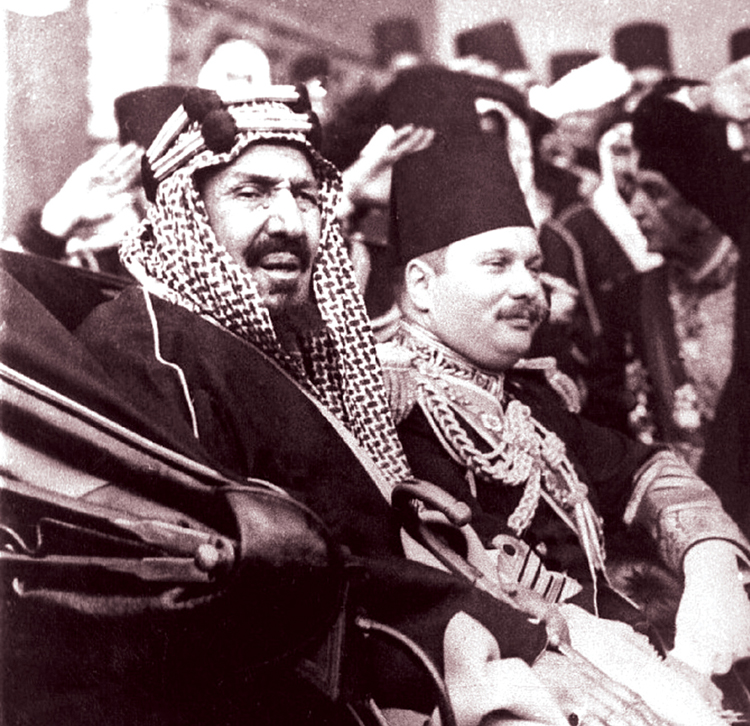


1946 Saudi Arabia’s King Abdul Aziz, left, and Egypt’s King Farouk, right. (Supplied)

After welcoming him in Suez, they boarded a royal train toward Cairo, where they held talks in Abdeen Palace.

Over the years, the ties between Saudi Arabia and Egypt were defined by the times.

Saudi King Faisal’s rule was one of tenacity and craft. He was a prime supporter of Egypt and its people, and visited the country seven times during his rule, starting with his first official visit on Sept. 8, 1965. 

Egypt supported King Faisal’s oil embargo in protest against Western support for Israel during the 1973 Arab-Israeli War. 
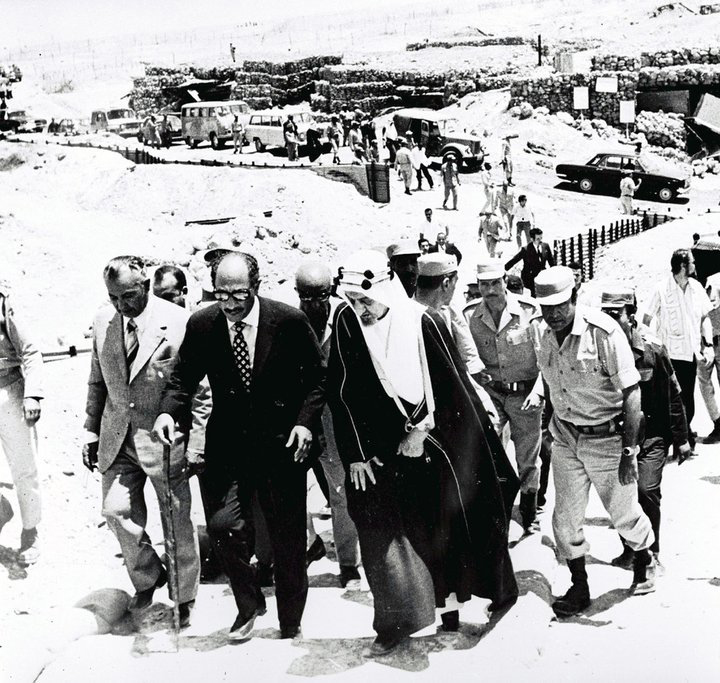


1974 Saudi King Faisal, center right, and Egyptian President Anwar Sadat, center left. (Supplied)

The resulting oil crisis helped undeveloped oil-rich states flourish and boosted their social development plans.

King Faisal’s eight-day visit to Cairo in 1974 cemented future Saudi-Egyptian relations. He toured several cities, with thousands of Egyptians coming out to greet him.

Saudi King Fahd made three trips to Egypt during his rule, the most important one on Aug. 9, 1990, after Iraq’s invasion of Kuwait. 

The emergency Arab League Summit was crucial as it determined the unified commitment to free Kuwait from Iraqi occupation.
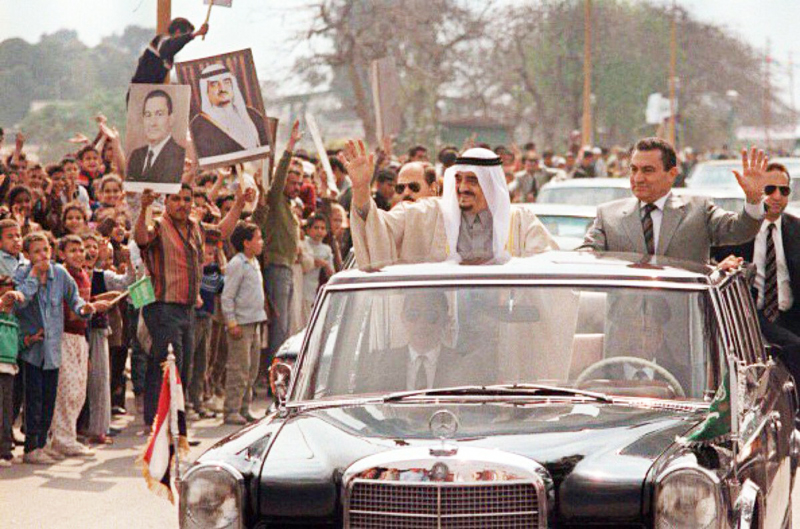


1989 Saudi King Fahd, left, and Egyptian President Hosni Mubarak, right. (Supplied)

King Abdullah continued Saudi Arabia’s strong relationship with Egypt. His first visit as king was to Sharm El-Sheikh in 2008, during which he focused on regional issues, including the conflict in Iraq and the threat from Iran’s nuclear program. 

His second visit, in 2014, although short, was vital in showing Saudi support for the Egyptian government of President Abdel Fattah El-Sisi following the overthrow of his predecessor Mohamed Morsi in 2013.

King Salman’s official visit in 2016 consolidated the two nations’ historical ties. He was named the “Great Guest of Egypt in Cairo,” and was granted the Collar of the Nile, the country’s highest state honor. 

The five-day visit resulted in the signing of 17 agreements, many of them aimed at boosting commerce and trade. 

They included cooperation on peaceful nuclear energy, the development of King Salman University in Egypt’s Sinai Peninsula, and the building of a bridge connecting the two countries. Nothing could be more representative of the bilateral relationship than that.


Ramadan brings local communities together to engage in volunteering activities

Updated 10 March 2026
Follow

Ramadan brings local communities together to engage in volunteering activities

  • For the Jeddah Volunteer group, local volunteers head out to lower-income neighborhoods to distribute meals
  • Supervisor Ahmed Al-Hamdan told Arab News that the iftar project is among the group’s most significant Ramadan initiatives

JEDDAH: Since the start of Ramadan, charities, mosques, restaurants, generous individuals and young volunteers across Saudi Arabia are coming together to make a tangible difference to the lives of those in need.

Volunteering activities usually peak in the weeks preceding Ramadan, with several initiatives taking place across the country.

“Every Ramadan, we are proud to see citizens and residents step up as volunteers across the Kingdom of Saudi Arabia, in Riyadh, Jeddah, Damam, Tabuk, Hail, Najran, Qassim and the rest of cities, embodying the spirit of giving and solidarity during this holy month. The people’s dedication and compassion have been a true reflection of Saudi Arabia’s values,” Sheikh Mansour Al-Shareef, imam of Al-Tawheed Mosque in Jeddah, told Arab News.

Al-Shareef underscored the spiritual essence of volunteerism, saying: “Volunteerism in Ramadan is not only about helping the needy but also about showing unity within communities.”

He noted the remarkable rise in community engagement in recent years. “Volunteering is on the rise with individuals from all walks of life contributing their time and resources to foster social solidarity, particularly during Ramadan.”

For the Jeddah Volunteer group, local volunteers head out to lower-income neighborhoods to distribute meals.

Supervisor Ahmed Al-Hamdan told Arab News that the iftar project is among the group’s most significant Ramadan initiatives.

He noted that the program aims to strengthen social solidarity and ease the burden on needy families, adding that every day during Ramadan, more than 100 volunteers arrive at the various iftar sites by the afternoon Asr prayer.

They work together to prepare special meals which include water, dates and rice, and later they distribute meals by hand. For many, the reward of helping those in need is what drives them to participate in volunteer campaigns.

It is becoming an act of duty for volunteer Noura Abdulaziz, who has been involved in such initiatives for the last two years.

She said: “I dedicate myself to this cause because it is the month of giving and it is our duty to give a hand in this special month. I really enjoy every minute of it.”

She pointed out that she sacrificed her time spent with her family to hand out meals to those who are in need.

“The number of iftars I have with my family is minimal, but they have no complaints as they understand the greater purpose,” she said.

Under the slogan “Ramadan Kareem,” fulfilling its annual commitment to community service, Kayani Event Management launched its annual “Iftar for the Fasting” campaign in the heart of Al-Balad district (historic Jeddah) for the fifth consecutive year, creating a scene of social solidarity within the ancient city.

The aim was to deliver Iftar meals to needy families and charitable organizations in the area, reinforcing the spirit of compassion embodied by the holy month.

Rana Bajouda, CEO of Kayani, told Arab News: “Our continuation for the fifth year is a confirmation of our commitment to our neighbors and our people in Jeddah, and our belief that giving is the true engine of success for any organization.”

From individual acts to organized government efforts, the General Directorate of Education in the Makkah Region launched a broad community initiative to provide Iftar meals for fasting visitors to the Holy Mosque, aiming to distribute 5,000 meals daily throughout the holy month of Ramadan.

Behind this initiative stands a team of 500 volunteers from the education sector, who work side by side, in a scene of faith that embodies the spirit of cohesion and clearly reflects the leading community role of the education sector in serving those who visit the Grand Mosque.