
BEIRUT: Lebanon’s Hezbollah is applying lessons from its last war with Israel as it braces for a possible full-scale Israeli invasion and protracted conflict, returning to its roots in guerrilla warfare in south Lebanon, four Lebanese sources said.
Operating in small units, fighters from the Iran-backed group are avoiding the use of communication devices that could be at risk of Israeli tapping, and are rationing the use of key anti-tank rockets as they engage Israeli troops, said the sources, who are familiar with Hezbollah military activities.
Some 15 months since Israel pounded Hezbollah in their last war, the group sparked a new Israeli offensive last week by opening fire to avenge the killing of Supreme Leader Ayatollah Ali Khamenei at the start of the US-Israeli war on Iran.
Heavily criticized in Lebanon for dragging the country into a war that has displaced 700,000 people, Hezbollah has described its actions as “existential defense,” framing it as a response to Israeli attacks that have continued since a 2024 ceasefire.
While Israel plans for the likely continuation of its Lebanon offensive after the Iran war, the four sources said Hezbollah’s calculations are based on Iran’s clerical leadership surviving the war, leading to a regional ceasefire of which it would be part.
FIGHTING FOCUSED AT INTERSECTION OF SYRIAN, ISRAELI BORDERS
The sources who are familiar with Hezbollah thinking declined to be named due to the sensitivity of the matter. The details of how Hezbollah is operating in the field have not previously been reported.
Hezbollah’s media office didn’t immediately respond to a request for comment.
Hezbollah, a Shiite Muslim group founded by Iran’s Revolutionary Guards in 1982, was the only Lebanese group to keep its weapons at the end of the 1975-90 civil war to fight Israeli troops who occupied the south until withdrawing in 2000.
Hezbollah’s role in driving them out has underpinned its popularity among many Shiites, though its decision to enter the Iran war has drawn criticism from within the Shiite community.
This war has come at a critical juncture for Hezbollah.
Greatly weakened during the 2024 war, Hezbollah has faced pressure from the Lebanese state to disarm. The Beirut government last week banned Hezbollah’s military activities.
Adding to the pressures on Hezbollah since the 2024 war, its Syrian ally President Bashar Assad was toppled in December of that year, severing the main supply route from Iran.
The sources said much of Hezbollah’s fighting on the ground had been focused so far near the town of Khiyam, near the intersection of Lebanon’s border with Israel and Syria.
This is one area where Hezbollah believes any Israeli land invasion could begin.
Reuters reported last week that Hezbollah’s elite Radwan fighters, who withdrew from the south following the 2024 ceasefire, had returned to the area.
ISRAELI SOURCE: HEZBOLLAH STABILIZING RANKS DESPITE BLOWS
An Israeli security source said there was no sign that Hezbollah was looking to de-escalate — quite the opposite. While Israel had eliminated a few of Hezbollah’s very senior commanders, it seemed that the group was managing to stabilize its ranks and make and execute decisions.
Two of the Lebanese sources said four deputies had been appointed for every Hezbollah commander, to ensure continued operations.
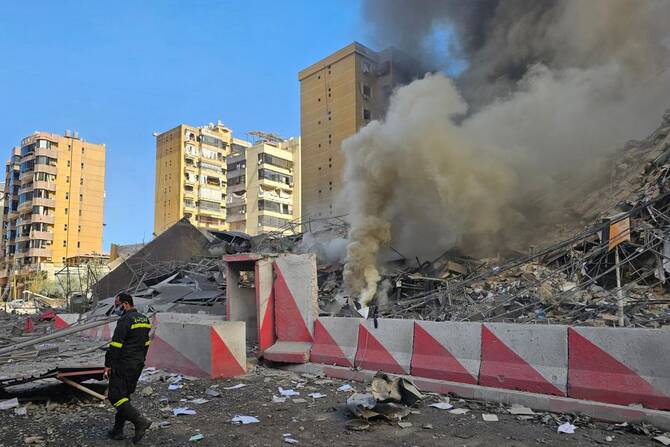
The Israeli military says it has struck hundreds of Hezbollah targets since March 2, launching airstrikes in the south, Beirut’s Hezbollah-controlled southern suburbs, and the eastern Bekaa Valley.
The Israeli military has also sent more soldiers into south Lebanon, where some of its troops had remained since 2024, establishing what it has called forward defensive positions to guard against the risk of Hezbollah attacks on northern Israel.
Two Israeli soldiers have been killed in Lebanon.
Hezbollah has launched daily drone and rocket attacks at Israel.
In 2024, not only did Israel booby-trap hundreds of pagers used by Hezbollah, but it also penetrated the group’s private phone network, according to Lebanese officials familiar with Hezbollah’s post-war investigation into breaches.
The sources said Hezbollah was avoiding any devices that could be susceptible to eavesdropping.