

Saudi Arabia’s KSRelief continues humanitarian efforts in Yemen, Syria

1 / 4
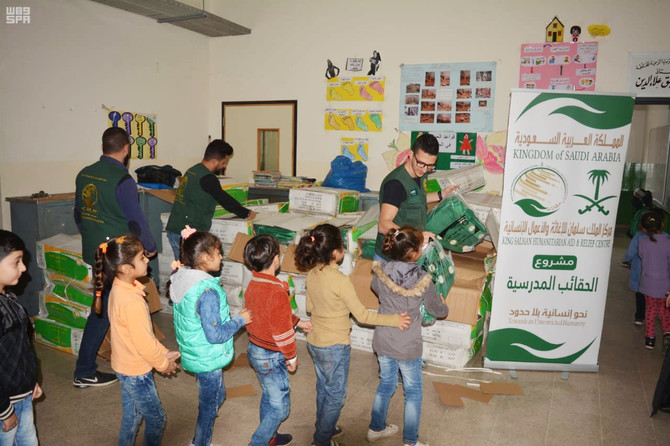
Syrian refugee school children in Lebanon collect their share of school supplies from the KSRelief office in Lebenon/ ((SPA
2 / 4
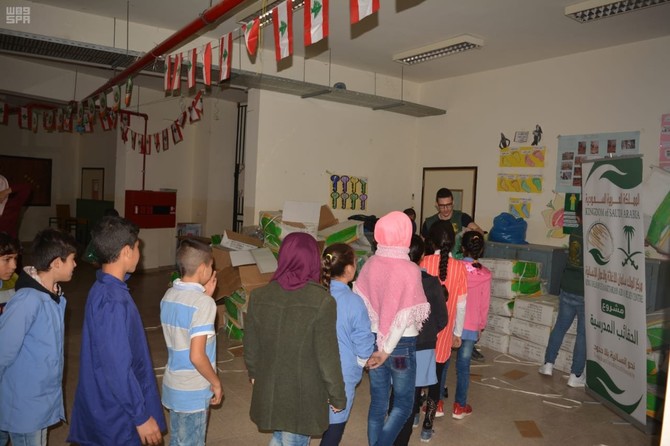
Syrian refugee school children in Lebanon collect their share of school supplies from the KSRelief office in Lebenon/ ((SPA
3 / 4
Syrian refugee school children in Lebanon collect their share of school supplies from the KSRelief office in Lebenon/ ((SPA
4 / 4
A KSRelief worker signs documents with officials of a livelihood project in Marib, Yemen. (SPA)
Updated 25 November 2018
Follow

Saudi Arabia’s KSRelief continues humanitarian efforts in Yemen, Syria

  • KSRelief has launched labor-intensive projects not only to improve infrastructure but also to provide employment opportunities
  • In Syria, part of the KSRelief's humanitarian effort, including the provision of Dutch cattle to farmers

JEDDAH: The King Salman Humanitarian Aid and Relief Center (KSRelief) has stepped up its humanitarian work in Yemen and Syria.

In Yemen's Talh district, Shabwa governorate, KSRelief launched labor-intensive projects not only to improve infrastructure but also to provide employment opportunities.

This started with the implementing a major projects to pave the Sinhur road, which would benefit seven villages in Talh, with a population of more than 3,500, and provide jobs for 160 people directly and 800 people indirectly.

The coordinator of the sector of labor-intensive projects, Jihad Baltif, explained that the sector implemented 14 projects, targeting five Yemeni governorates, including Hadramout, Al-Jouf, Shabwa, Aden and Lahj, benefiting 1,600 people from direct employment.

In Syria, KSRelief is carrying out various humanitarian projects in different parts of the war-torn country. 

Field trips to Hama governorate are also part of the aid agency's efforts to rehabilitate the civilian population. 

The field trips are aimed at providing veterinary care and vaccinations for livestock provided by the center for the needy families. KSRelief has undertaken several initiatives to support the agricultural sector in Syria to ensure food security.  The center provided 390 Dutch cows to poor Syrian families, along with free feed, veterinary care and vaccinations for six months.


KSRelief also distributed 2,320 schoolbags to Syrian students in a number of schools in Mount Lebanon. This initiative was taken in cooperation with the Ministry of Education and Higher Education in Lebanon.


KSRelief distributes more than 87,000 bread loaves daily among Syrians displaced by war in the country. The center has also launched a project to rehabilitate public utilities in the northern countryside of Aleppo.


Experimental farm in Al-Lith looks into future of Saudi Arabian agriculture

Updated 02 February 2026
Follow

Experimental farm in Al-Lith looks into future of Saudi Arabian agriculture

  • Research initiative reflects strategic transformation

JEDDAH: An experimental farm in Saudi Arabia’s Al-Lith Governorate is one of the research initiatives reflecting the strategic transformation taking place in the Kingdom’s agricultural sector.

The farm uses highly efficient, sustainable production models that combine scientific research with commercial application, contributing to strengthening the country’s food security system and the sustainability of water resources.

Located in the Ghumaiqa Center on an area of about 10 hectares, the cutting-edge farm is a testing platform for modern agricultural technologies that tackle the challenge of water scarcity.

The farm includes developed open fields and modern greenhouses, supported by smart irrigation encompassing drip and sprinkler irrigation alongside surface and subsurface technologies.

All the systems operate via smart controls that enable the monitoring of water consumption and ensure improved efficiency, thereby achieving a balance between agricultural production and water conservation.

The farm also uses treated and diluted low-salinity seawater.

It aims to diversify agricultural water sources, reduce reliance on freshwater, and open new horizons for agriculture in coastal and semi-arid environments.

A view of the experimental farm in Al-Lith. (SPA)

The project represents a promising investment opportunity in the field of smart agriculture, enabling the development of commercially scalable production models, particularly for high-value vegetables and fruits, while reducing operational costs associated with water and energy, enhancing the economic feasibility of future agricultural projects.

In addition, the project contributes to transferring and localizing agricultural expertise, supporting local food supply chains, and creating an attractive environment for agricultural investment.

This aligns with Sustainable Development Goals and enhances the efficiency of the private sector in adopting innovative agricultural solutions.

Yahya bin Abdulrahman Al-Mahabi, the director of the Ministry of Environment, Water and Agriculture office in Al-Lith Governorate, told the Saudi Press Agency that the project represented the future of agriculture in the Kingdom.

He explained that the vision was based on investing in technology, enhancing the return on water per unit, and integrating scientific research with investment opportunities.

Al-Mahabi spoke of the experimental farm as a modern, scalable and replicable model applicable in several regions of the Kingdom, particularly in coastal environments.

Al-Mahabi highlighted the Ministry of Environment, Water and Agriculture’s commitment to supporting distinctive projects that contributed to achieving food security while developing rural areas and enhancing agricultural production efficiency, in line with the objectives of the Kingdom’s Vision 2030.