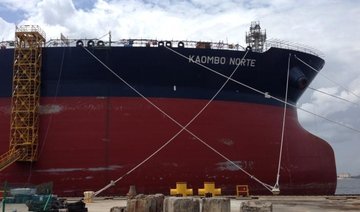
LUANDA: On Saturday, nearly two decades after securing the initial rights, Total’s CEO, Patrick Pouyanne, was in Luanda to snip the ribbon on a $16 billion oil project. It is not clear when he, or his peers, will be celebrating in Angola again.
Without another mega-project like Total’s Kaombo on the horizon and fields getting old, Africa’s second-largest crude producer is facing a steep decline unless it can revive exploration in what was once one of the world’s most exciting offshore prospects.
Sonangol, the state oil company, is negotiating contracts for new blocks with oil majors and Angola plans to hold an auction next year, the first tender for exploration rights since 2011.
It is a race against time for a country where oil accounts for 95 percent of exports and around 70 percent of government revenues. Luck will also play a part, as it always does in exploration where finding oil can never be guaranteed.
But without new projects, output could fall to 1 million barrels per day by 2023, according to the oil ministry. That is down from 1.5 million today and nearly half of what Angola was producing a decade ago. The country risks having its OPEC quota cut and is struggling to ensure the long-term feed for its $10 billion liquid natural gas plant.
President Joao Lourenco won an August 2017 election promising an “economic miracle” in Angola, which despite its oil wealth struggles to provide basic services to a mostly impoverished population that is growing at 3 percent a year. But falling oil production means a third consecutive contraction is expected in 2018, even while annual inflation runs at 18 percent.
To turn things around, Angola has asked international oil companies to the table, offering better fiscal terms and more collaboration.
With the time from exploration to first oil on new areas anything from five to 10 years, Angola is also offering tax breaks to encourage companies to link existing marginal discoveries to operating production platforms.
There are signs the measures are working, though some oil experts wonder at what cost for the southwest African country.
“The level of exploration activity in Angola is beginning to change,” Sonangol’s chairman, Carlos Saturnino, said at Saturday’s inauguration.
He expects between five and 10 new concessions to be signed next year.
Exxon, he said, had shown interest in some blocks in southern Angola’s unexplored Namib basin, while advanced discussions are being held with BP, Equinor and ENI for the rights to the ultra-deep offshore blocks 46 and 47.
BP and ENI declined to comment. Equinor and Exxon did not immediately respond to a request for comment.
Total, which operates 40 percent of Angola’s production, plans to drill its first exploration well in four years. Beneath 3,630m of water on block 48, it will be one of the world’s deepest.
“We hope it will be a play-opener for the ultra-deep in Angola,” said Andre Goffart, senior vice president for development. “We are seeing a new wave of exploration in Angola.”
These signs of fresh exploration come after a period of near-paralysis due to a lack of drilling success, a slump in oil prices and a deteriorating relationship between Sonangol and the oil majors.
Angola’s offshore reserves are expensive to explore and develop, making it a hard sell for shareholders when oil is at $40. The number of rigs operating off Angola’s shores dropped from 18 in early 2014 to just two in 2017, according to oil services company Baker Hughes.
The steep drop in prices from 2014 came just as companies were smarting from the failure to discover Brazil-like oil
reservoirs beneath a layer of salt on the African side of the Atlantic. The search for the “Angolan pre-salt” resulted in some of the most expensive dry wells ever drilled and sapped exploration appetite.
Critics say the situation was exacerbated by Isabel dos Santos, the former president’s daughter and previous chair of Sonangol, under whose leadership new projects ground to a halt. Dos Santos denies allegations of mismanagement, saying she helped turn around an almost bankrupt company.
“There are few places in the world right now where the oil majors are in as good a negotiating position as here,” said one international oil executive in Luanda on condition of anonymity.
Some local experts fear the deals Angola is striking are too beneficial for the companies, although details remain private.
“If Angola gives away too much it could create problems further down the line,” said Jose Oliveira, an oil specialist at the Catholic University in Luanda.
But the country has little choice given its imminent production decline and a lack of money or expertise to lead the drilling campaigns itself.