Grappling with taboos, Iraqi women join wrestling squad

1 / 5
Coach Nhaaia dhahir Mohsen, 50, sits surrounded by female wrestlers from the Iraq's first women's wrestling squad, in Diwaniya, Iraq November 10, 2018. (Reuters)
2 / 5
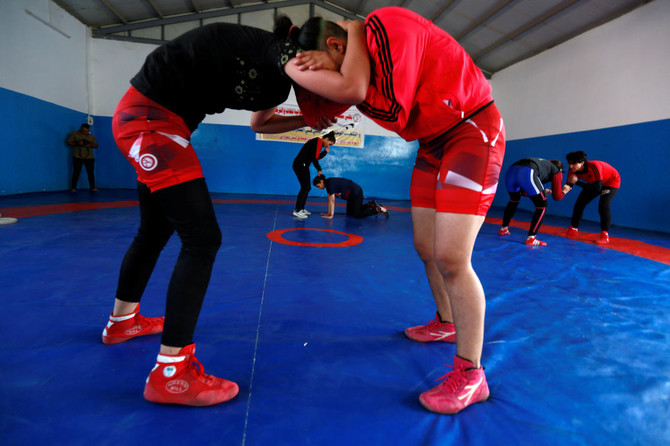
Iraqi women, part of the country's first women's wrestling squad, face each other during practice at the sports club in Diwaniya, Iraq November 10, 2018. (Reuters)
3 / 5
Women leave the gym after their exercise, as part of the country's first women's wrestling squad, in Diwaniya, Iraq November 10, 2018. (Reuters)
4 / 5
Iraqi women wrestle during practice at the sports club, as part of the country's first women's wrestling squad in Diwaniya, Iraq November 10, 2018. (Reuters)
5 / 5
Iraqi women, part of the country's first women's wrestling squad, sit on the bus as they leave the gym after exercises in Diwaniya, Iraq November 10, 2018. (Reuters)
Updated 15 November 2018
Follow

Grappling with taboos, Iraqi women join wrestling squad

DIWANIYA, Iraq: The toughest fight that Iraqi freestyle wrestler Alia Hussein ever faced was convincing her family that women should be allowed to grapple.
The 26-year-old student was a keen cyclist and basketball player but when she told her family last year that she wanted to try her hand at the physical world of wrestling she was met with abuse.
"I was humiliated and even beaten by my family, but I defied them all," Hussein told Reuters.
"I feel that I can express myself through this sport. I wanted to prove to society that wrestling is not confined to men only and that Iraqi women can be wrestlers and can win and fight."
On the blue mats of the Al-Rafideen Club in the conservative city of Diwaniya, some 180 km (110 miles) south of Baghdad, Hussein trains three times a week with 30 other female wrestlers, some still wearing headscarves. When a big competition comes up, they train every day.
In September, Hussein won a silver medal in the 75 kg (165 lb) freestyle category at a regional event in Lebanon and gold at a local tournament in Baghdad.
"I faced opposition from my family at the beginning, but after my participation in Baghdad and Beirut tournaments they started to encourage me, thank God," Hussein said.
This is the second attempt by the Iraqi Wrestling Federation (IWF) to grow women's wrestling, this time prompted by the threat of a ban by the sport's global body if they didn't.
The first ended when the club in Diwaniya was disbanded in 2012 after complaints from the local community that the sport was in defiance of local traditions and culture.
The IWF has managed to recruit 70 female wrestlers who train at 15 clubs across the country, a spokesman for the body said. Each is entitled to a payment of 100,000 Iraqi dinars ($84) a month, but the money has stopped for the last three months as the IWF invests in a new wrestling hall in Baghdad.
Despite the financial offer, recruitment is tough.
Nihaya Dhaher Hussein, a 50-year-old school teacher, is the driving force behind the burgeoning team in Diwaniya which started in 2016.
She drives the squad to practice, trains them and undertakes the dangerous task of convincing families to let their daughters, sisters or wives wrestle.
"A woman wrestling is alien to our conservative tribal society," she said. "The idea is hard to accept. It was so difficult to attract girls and convince their families.
"I was threatened myself by a brother of a player who verbally abused me and tried to hit me. It is so difficult to bring them to training and return them to their houses."


Arts festival’s decision to exclude Palestinian author spurs boycott

Randa Abdel Fattah. (Photo/Wikipedia)
Updated 12 January 2026
Follow

Arts festival’s decision to exclude Palestinian author spurs boycott

  • A Macquarie University academic who researches Islamophobia and Palestine, Abdel-Fattah responded saying it was “a blatant and shameless act of anti-Palestinian racism and censorship,” with her lawyers issuing a letter to the festival

SYDENY: A top Australian arts festival has seen ​the withdrawal of dozens of writers in a backlash against its decision to bar an Australian Palestinian author after the Bondi Beach mass shooting, as moves to curb antisemitism spur free speech concerns.
The shooting which killed 15 people at a Jewish Hanukkah celebration at Sydney’s Bondi Beach on Dec. 14 sparked nationwide calls to tackle antisemitism. Police say the alleged gunmen were inspired by Daesh.
The Adelaide Festival board said last Thursday it would disinvite Randa ‌Abdel-Fattah from February’s ‌Writers Week in the state of South Australia because “it ‌would not ​be ‌culturally sensitive to continue to program her at this unprecedented time so soon after Bondi.”

FASTFACTS

• Abdel-Fattah responded, saying it was ‘a blatant and shameless act of anti-Palestinian racism and censorship.’

• Around 50 authors have since withdrawn from the festival in protest, leaving it in doubt, local media reported.

A Macquarie University academic who researches Islamophobia and Palestine, Abdel-Fattah responded saying it was “a blatant and shameless act of anti-Palestinian racism and censorship,” with her lawyers issuing a letter to the festival.
Around 50 authors have since withdrawn from the festival in protest, leaving it in doubt, local media reported.
Among the boycotting authors, Kathy Lette wrote on social media the decision to bar Abdel-Fattah “sends a divisive and plainly discriminatory message that platforming Australian Palestinians is ‘culturally insensitive.'”
The Adelaide Festival ‌said in a statement on Monday that three board ‍members and the chairperson had resigned. The ‍festival’s executive director, Julian Hobba, said the arts body was “navigating a complex moment.”

 a complex and ‍unprecedented moment” after the “significant community response” to the board decision.
In the days after the Bondi Beach attack, Jewish community groups and the Israeli government criticized Prime Minister Anthony Albanese for failing to act on a rise in antisemitic attacks and criticized protest marches against Israel’s war in ​Gaza held since 2023.
Albanese said last week a Royal Commission will consider the events of the shooting as well as antisemitism and ⁠social cohesion in Australia. Albanese said on Monday he would recall parliament next week to pass tougher hate speech laws.
On Monday, New South Wales state premier Chris Minns announced new rules that would allow local councils to cut off power and water to illegally operating prayer halls.
Minns said the new rules were prompted by the difficulty in closing a prayer hall in Sydney linked to a cleric found by a court to have made statements intimidating Jewish Australians.
The mayor of the western Sydney suburb of Fairfield said the rules were ill-considered and councils should not be responsible for determining hate speech.
“Freedom ‌of speech is something that should always be allowed, as long as it is done in a peaceful way,” Mayor Frank Carbone told Reuters.