ANKARA: The European Court of Auditors (ECA), a Luxembourg-based financial watchdog, emphasized in a report published on Tuesday the difficulties in properly tracking the EU funds provided to Turkey to address the needs of refugees while living outside camps.
The Facility for Refugees in Turkey is the main mechanism to financially support about 4 million Syrian refugees living in Turkey, and it is endowed with €6 billion ($6.78 billion) that will be disbursed in two installments for financing various projects addressing the urgent needs of refugees and their host communities.
The ECA criticized the transparency level of two cash-assistance humanitarian programs — valued at about €1.1 billion — where it was not possible to properly track the flow of money going to the beneficiaries from registration until payment.
Ankara reportedly declined to disclose the beneficiaries’ names, and instead gave anonymous banking details.
One of these two EU-funded programs addresses Syrian children’s school-related needs, and is also supported through grants from the US and Norway. The other program, the Emergency Social Safety Network, is intended to provide assistance for food and rent.
In an exclusive interview with Arab News, Bettina Jakobsen, a member of the ECA and chief auditor of the report, said the Turkish authorities referred to their national legislation on data protection as a basis for not granting access to the UN partner or ECA access to beneficiary data.
“We consider that this lack of access to final beneficiaries’ data de facto limited the scope of our audit and the related level of assurance we can provide,” she said.
“At the time of the audit, no issue of fraud or corruption has been reported. We have not experienced any other difficulties when carrying out our audit procedures and the cooperation with the Turkish authorities was good.”
In the context of the second tranche, the ECA recommends that the European Commission insist that the Turkish authorities grant full access to the beneficiaries’ data.
“The commission should also scale up monitoring and reporting on the facility. In addition, the ECA is also carrying out legality and regularity audits, and considering the scale of these projects, an audit of the legality and regularity of the related payments may take place in the coming years,” Jakobsen told Arab News.
During a press conference in Brussels on Tuesday, Jakobsen said the lack of access to such key information was unprecedented in her career and this was the first time the institution had faced such a refusal, leading to some “doubts.”
However, Ayselin Yildiz, UNESCO Chair on International Migration at Yasar University in Izmir, said she was surprised that the European authorities are pushing Turkey not to respect data protection rights.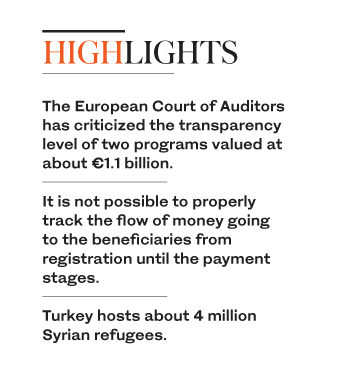
“Of course, the procedures of allocation and spending of the funds have to be transparent and accountable, but it does not require sharing the details of individual data with third parties,” she told Arab News.
Yildiz, who has coordinated and worked on several EU-funded projects on refugees, also noted that the two cash-assistance programs in question are shuffled through UN agencies, the World Food Programme and implementing partners.
“They must have their own internal control and monitoring mechanisms. These issues had to be set well in the beginning in grant agreements and I question why this has occurred as an obstacle for cooperation two years after the launch of the program,” she added.
“Beyond the trust and accountability problem between the EU and Turkish authorities, we should question if the consent of Syrian refugees has been taken on the conditions of benefiting from these funds and whether they had agreed to share their personal data, which is very sensitive for their future migration journey,” Yildiz underlined.
It was not the only challenge the auditors encountered in monitoring Turkey’s management of European taxpayer money going to Syrian refugees. The report also found that the interest generated on the money in the bank did not reach the refugees or return to the EU taxpayer, but was kept by the implementing partners.
However, the report also welcomed the fact that “all the humanitarian projects audited provided helpful support to the refugees, mainly through cash-based assistance, and most of them achieved their intended outputs.”
The commission will consider the recommendations of the audit report while implementing the next tranche of the assistance between the end of 2018 and 2019, which will amount to €3 billion, to prevent any risk of the funds being misused.
Laura Batalla, the secretary-general of the European Parliament Turkey Forum, said the EU funding for refugees has delivered tangible and measurable results in record time, which has had a positive impact on the livelihood of Syrians living in Turkey.
“Therefore, it should be hailed as a success. The EU and Turkey should, however, take into account the recommendations made by the Court of Auditors to achieve the maximum potential of the facility. Improving transparency is essential in this regard,” she said.
The Turkish government has not yet issued any public statement about the EU audit report.


![]()

Ankara’s handling of EU programs for Syrian refugees under scrutiny
Ankara’s handling of EU programs for Syrian refugees under scrutiny
- One of these two EU-funded programs addresses Syrian children’s school-related needs, and is also supported through grants from the US and Norway


Latest updates


© 2026 SAUDI RESEARCH & PUBLISHING COMPANY, All Rights Reserved And subject to Terms of Use Agreement.