JEDDAH: Kuwait’s Minster of Public Works Hussam Al-Roumi resigned on Friday after flooding across the country.
Al-Roumi expressed his “deep regret” over the severe damage to private property caused by the latest heavy rains.
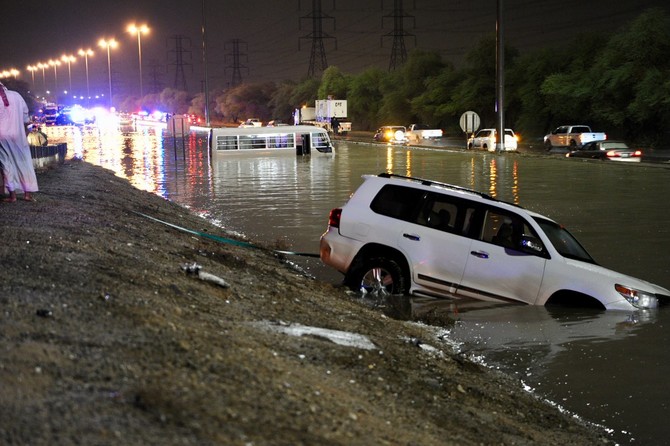
Rain lashed Kuwait on Thursday and Friday. Footage posted on social media from across Kuwait showed torrents sweeping away cars as sewage systems failed to drain the heavy downpour.
“Based on my moral responsibility and in support of the approach taken by His Highness the Prime Minister to bear the consequences of the government’s heavy responsibility, I submitted my resignation to the National Assembly Speaker,” he added.
The army and national guard were mobilized to help clear water from critical facilities and roadways and the Kuwait Oil Company announced a state of emergency, state news agency KUNA reported.
The national guard announced on Friday that it was upgrading the weather conditions to “extreme” due to bad weather and ordered units to be on a heightened state of alert.
The meteorological department of Kuwait’s Directorate General of Civil Aviation reported that the country has received almost 30 millimeters since Thursday evening, a significantly high amount for Kuwait in a 24-hour span. It forecast unstable weather conditions and moderate to heavy scattered thunderous rains, expected to run until Saturday morning.
Meanwhile, Kuwait University announced it will close its campus and cancel exams scheduled for Saturday.
Following instructions from the Dean of the University Dr. Hussein Al-Ansari, and Minister of Education and Higher Education Dr. Hamed Al-Azmi, the campus will be closed due to weather conditions engulfing the country, the university’s spokesman Dr. Muthana Al-Refaie said in a press statement.
Exams scheduled on Saturday were canceled and will be held later on after the weather conditions improve, he added.
The Ministry of Interior urged both citizens and expatriates to be extra cautious over the next couple of days.
The national guard announced earlier on Friday the formation of six technical emergency teams to follow up efforts to support the relevant government agencies to address the effects of rainfall and water floods to ensure smooth traffic on the roads and to respond to any emergencies in accordance with the objectives of the country’s 2020 strategic vision, which stresses security first.
The prime minister confirmed that the government is following the situation closely in all regions and all ministers have been asked to take the necessary measures in order to maintain safety and minimize damage. He also stressed that those who fail to perform their duties will be held accountable.
Kuwait, along with several other countries in the region, has experienced unstable weather conditions with several areas flooded due to the heavy rainfall over the last week.


![]()
![]()
![]()

Kuwait’s public works minister resigns amid severe flooding

Kuwait’s public works minister resigns amid severe flooding



Latest updates


© 2026 SAUDI RESEARCH & PUBLISHING COMPANY, All Rights Reserved And subject to Terms of Use Agreement.