

Bad weather shuts schools and government in Kuwait

1 / 5
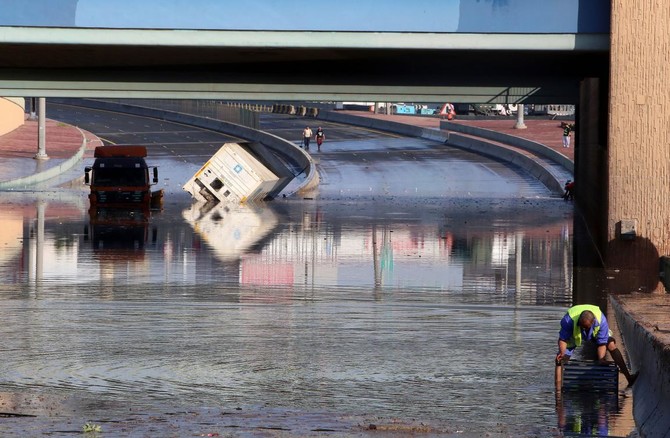
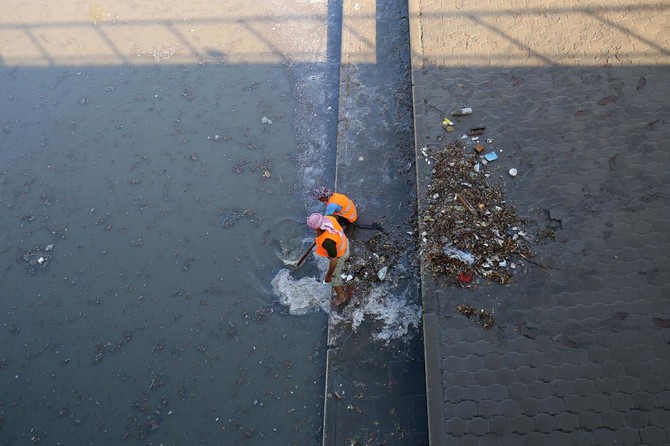
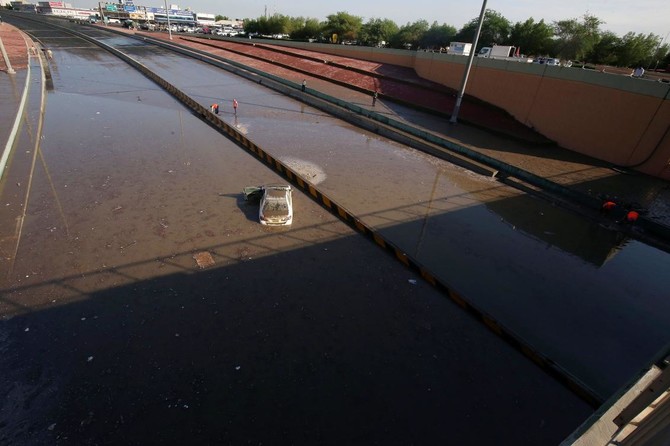
Municipality workers try to drain a flooded underpass in Kuwait City on November 6, 2018, as a result of the accumulation of rainwater. (AFP)
2 / 5
Municipality workers try to drain a flooded underpass in Kuwait City on November 6, 2018, as a result of the accumulation of rainwater. (AFP)
3 / 5
Municipality workers try to drain a flooded underpass in Kuwait City on November 6, 2018, as a result of the accumulation of rainwater. (AFP)
4 / 5
Municipality workers try to drain a flooded underpass in Kuwait City on November 6, 2018, as a result of the accumulation of rainwater. (AFP)
5 / 5
Municipality workers try to drain a flooded underpass in Kuwait City on November 6, 2018, as a result of the accumulation of rainwater. (AFP)
Updated 06 November 2018
Follow

Bad weather shuts schools and government in Kuwait

  • The country closed its main stock exchange as well as government, ministerial offices and schools due to the bad weather.
  • The heavy rain, that started on Monday night and continued into the early hours of the morning, caused transport chaos

KUWAIT: Schools and government departments in Kuwait were forced to shutdown on Tuesday as floods lashed the Gulf state. 

The country closed its main stock exchange as well as government, ministerial offices and schools due to the bad weather. The heavy rain, that started on Monday night and continued into the early hours of the morning, caused transport chaos.

The deputy prime minister Sheikh Sabah Khaled Al-Ahmad Al-Sabah responded by firing the roads and transport head Ahmad Al-Hassan after the bad weather brought parts of the country to a standstill. 


The Kuwait News Agency (KUNA) said the forecast remained unsteady with dust and winds along with thundershowers. 

A meteorologist quoted by KUNA said the unstable weather was due to a low pressure system bringing winds and air full of humidity.  

Kuwait Airways said that no flights had been canceled at Kuwait’s main international airport as a result of the weather.


MSF will keep operating in Gaza ‘as long as we can’: mission head

Updated 58 min 40 sec ago
Follow

MSF will keep operating in Gaza ‘as long as we can’: mission head

  • The head of Doctors Without Borders in the Palestinian territories told AFP the charity would continue working in Gaza for as long as possible

AMMAN:The head of Doctors Without Borders in the Palestinian territories told AFP the charity would continue working in Gaza for as long as possible, following an Israeli decision to end its activities there.
In early February, Israel announced it was terminating all the activities in Gaza by the medical charity, known by its French acronym MSF, after it failed to provide a list of its Palestinian staff.
MSF has slammed the move, which takes effect on March 1, as a “pretext” to obstruct aid.
“For the time being, we are still working in Gaza, and we plan to keep running our operations as long as we can,” Filipe Ribeiro told AFP in Amman, but said operations were already facing challenges.
“Since the beginning of January, we are not anymore in the capacity to get international staff inside Gaza. The Israeli authorities actually denied any entry to Gaza, but also to the West Bank,” he said.
Ribeiro added that MSF’s ability to bring medical supplies into Gaza had also been impacted.
“They’re not allowed for now, but we have some stocks in our pharmacies that will allow us to keep running operations for time being,” he said.
“We do have teams in Gaza that are still working, both national and international, and we have stocks.”
In December, Israel announced it would prevent 37 aid organizations, including MSF, from working in Gaza from March 1 for failing to submit detailed information about their Palestinian employees, drawing widespread condemnation from NGOs and the United Nations.
It had alleged that two MSF employees had links with Palestinian militant groups Hamas and Islamic Jihad, which the medical charity has repeatedly and vehemently denied.
MSF says it did not provide the names of its Palestinian staff because Israeli authorities offered no assurances regarding their safety.
Ribeiro warned of the massive impact the termination of MSF’s operations would have for health care in war-shattered Gaza.
“MSF is one of the biggest actors when it comes to the health provision in Gaza and the West Bank, and if we are obliged to leave, then we will create a huge void in Gaza,” he said.
The charity says it currently provides at least 20 percent of hospital beds in the territory and operates around 20 health centers.
In 2025 alone, it carried out more than 800,000 medical consultations, treated more than 100,000 trauma cases and assisted more than 10,000 infant deliveries.