

Iran rejects law banning terrorist financing

1 / 3
Iran's Revolutionary Guard commander Mohammad Ali Jafari speaks during a rally in front of the former US Embassy in Tehran on Nov. 4, 2018, marking the 39th anniversary of the seizure of the embassy by militant Iranian students. (AP Photo/Vahid Salemi)
2 / 3
Iranian people burn the American flag as they mark the anniversary of the seizure of the US Embassy in Tehran Nov 4, 2018. (Tasnim News Agency /Handout via REUTERS)
3 / 3
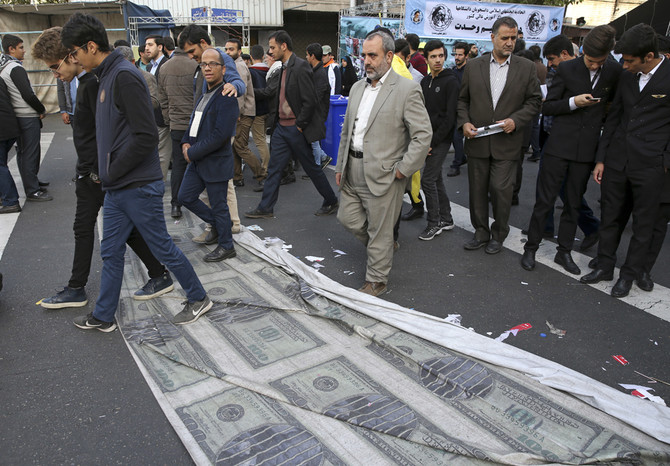
Demonstrators walk on a banner showing altered images of US banknotes with a picture of President Donald Trump on the ground during a rally in front of the former US Embassy in Tehran on Nov. 4, 2018. (AP Photo/Vahid Salemi)
Updated 05 November 2018
Follow

Iran rejects law banning terrorist financing

  • As US sanctions begin, Tehran chooses to fund Hezbollah, Hamas
  • Previous legislation on money-laundering and organized crime has also been delayed by higher authorities, including the Guardian Council, after being approved by Parliament

JEDDAH: Iran’s powerful Guardian Council on Sunday rejected legislation to join the UN convention against terrorist financing, just a few hours before the reintroduction of tough US sanctions on Tehran’s oil trade and banking sector.

Joining the convention is crucial to Iran’s hopes of obtaining European support in evading the sanctions, which came into effect at midnight on Sunday. But conservative hawks on the council fear it would prevent them from funding groups such as Hezbollah in Lebanon and Hamas in Gaza, by forcing greater financial transparency.

The council said aspects of the bill were against Islamic law and the constitution and sent it back to Parliament for revision. The legislation “has flaws and ambiguities,” spokesman Abbas Ali Kadkhodaie said.

The bill, narrowly passed by Parliament last month, is one of four proposed by President Hassan Rouhani’s government to meet demands set by the international Financial Action Task Force (FATF), which monitors countries’ efforts to tackle money-laundering and terrorist financing.

Rouhani’s government says the law is vital after US President Donald Trump withdrew from the 2015 nuclear deal and reimposed sanctions. The other parties to the deal — Britain, France, Germany, China and Russia — have demanded that Iran accede to the FATF if it wants to maintain trade.

“Neither I nor the president can guarantee that all problems will go away if we join the UN convention, but I guarantee that not joining will provide the US with more excuses to increase our problems,” Iran’s Foreign Minister Mohammad Javad Zarif said during the parliamentary debate last month.

Previous legislation on money-laundering and organized crime has also been delayed by higher authorities, including the Guardian Council, after being approved by Parliament.

The council is made up of six clerics appointed by supreme leader Ayatollah Ali Khamenei and six lawyers appointed by the judiciary.

Iran’s failure to pass the FATF “is only symptomatic of the larger issue of Iran’s support for extremist and terrorist groups and organizations,” the security analyst Dr. Ted Karasik told Arab News.

“The legislation is good for domestic consumption by particular groups of officials, but the whole process is of course a sham.

“Its funding for terrorist militias and its acts of espionage make Iran, and specifically the Quds Force, simply unqualified for FATF status.”


Morocco deploys army to help evacuate thousands after floods

Updated 6 sec ago
Follow

Morocco deploys army to help evacuate thousands after floods

  • More than 20,000 people had been moved ⁠to shelter and camps by Saturday
  • Authorities set up sandbags and temporary barriers in flood-prone districts as waters began to recede

RABAT: Morocco has deployed army rescue units to help with the evacuation of thousands of people after floods triggered by torrential rains and rising river levels hit parts of the country’s northwest, state TV reported on Saturday.
Weeks of heavy rainfall, combined with water releases from a nearly full dam nearby, increased water levels in the ⁠Loukous River and flooded several neighborhoods in the city of Ksar Kbir, about 190 km (118 miles) north of the capital Rabat, a national flood follow-up committee said.
More than 20,000 people had been moved ⁠to shelter and camps by Saturday, official media reported.
Authorities set up sandbags and temporary barriers in flood-prone districts as waters began to recede.
Schools in Ksar Kbir have been ordered to remain closed until February 7 as a precaution.
In the nearby province of Sidi Kacem, the Sebou River’s rising levels prompted evacuations ⁠from several villages as authorities raised vigilance levels.
The abundant rainfall ended a seven-year drought that drove the country to invest heavily in desalination plants.
The average dam-filling rate has risen to 60 percent, with several major reservoirs reaching full capacity, according to official data.
Last month, 37 people were killed in flash floods in the Atlantic coastal city of Safi, south of Rabat.