ISLAMABAD: Following the Supreme Court’s landmark decision to overturn a verdict in the case of Aasia Bibi, who had been imprisoned for eight years on blasphemy charges, Pakistan’s social media platforms continued to express polarized views on the judgment, even as the country’s major cities witnessed massive protests on Wednesday.
Many hailed the historical ruling as a monumental victory, with Senator Sherry Rehman tweeting, “Landmark judgment by Supreme Court to acquit #AasiaBibi today. False accusers took half her life away. Now the state must protect all those who stand for the rule of law and justice. We have all been witness to the havoc mobs have wreaked to
red lines before. That line must be held.”
Fearing the consequences of the verdict, analyst Raza Rumi also paid homage to former Punjab Governor Salman Taseer who had been killed by his own bodyguard for speaking in favor of Bibi. “While hoping & praying for the safety of #AasiaBibi, her family and the judges, one just cannot stop thinking of #SalmanTaseer & #ShahbazBhatti — precious lives lost while standing up for the weak,” Rumi said.
While many lauded the three judges who acquitted Bibi in the case, some users voiced their disapproval, tweeting under the top-trending hashtag AasiaBibi: “Judge Sir, just as you cannot tolerate contempt of court, I cannot tolerate blasphemy #AasiaBibi”.
Additionally, right-wingers in Pakistan demanded that the ruling be ignored, with some going as far as to tweet pictures of Mumtaz Qadri, the bodyguard who murdered governor Taseer.
Ahead of the verdict, Khadim Hussain Rizvi, a hard-liner cleric and chief of far-right Tehreek-e-Labbaik (TLP) party urged thousands of followers to protest against Bibi’s release. Despite authorities deploying additional security across the country, hundreds of TLP supporters blocked the main roads of all major metros.
Speaking to Arab News, a TLP supporter, protesting outside the Punjab Assembly in Lahore, said: “This is not the Faizabad protest where we demonstrated peacefully by blocking the roads until we were forced to fight. We will assume an offensive position and agitate till the very end.”
TLP General Secretary Allama Waheed Noor and the party’s spokesperson told Arab News that the protesters would take to the streets and paralyze life in all major cities unless the Supreme Court reverses its verdict.
In Karachi, the country’s largest city, TLP workers blocked all the main arteries of the city including, Numaish Chowarngi at M.A. Jinnah Road, I.I. Chundrigar Road near State Bank of Pakistan, Star gate near Jinnah international airport, Azam Chowk at Orangi town, Sohrab Goth and the Hub River Road.
“We have been directions from the center to keep the protest completely peaceful,” Muhammad Ali, a TLP spokesperson in Karachi told Arab News. “We will, however, bring the city to standstill by blocking roads.”
The Supreme Court, after reserving the verdict, had restrained both electronic and print media from discussing or commenting on the matter. However, journalists and media persons present on the scene of the protests reported being manhandled by TLP activists in Karachi, while Lahore’s traffic police confirmed to Arab News that the protests had paralyzed 23 main points in the city, crippling traffic, after TLP workers had gathered outside the Punjab Assembly in Lahore to protest Bibi’s release.
Bibi’s life continued to remain in jeopardy despite the court stating in its verdict that she was falsely accused. Admitting they were unaware of her whereabouts, TLP’s Noor said: “She was in Multan jail but has now been shifted to an unknown location.”


![]()
![]()
![]()
![]()

Protests engulf Pakistan’s major cities after landmark ruling

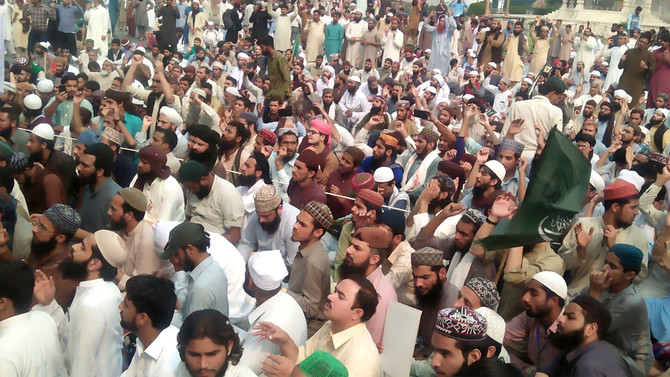

Protests engulf Pakistan’s major cities after landmark ruling
- Social media divided over top court’s decision to acquit Christian woman on death row
- Aasia Bibi had been convicted in 2010 on charges of blasphemy


Latest updates


© 2026 SAUDI RESEARCH & PUBLISHING COMPANY, All Rights Reserved And subject to Terms of Use Agreement.