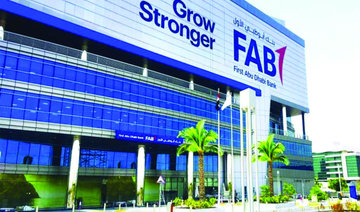
DUBAI: First Abu Dhabi Bank (FAB), the largest lender in the UAE by assets, said on Monday it will launch commercial banking operations in Saudi Arabia by the end of this year.
The bank, which was granted a commercial banking license in Saudi Arabia earlier this year, has been expanding its staff in the kingdom as it seeks to benefit from the government’s drive to move the economy beyond oil revenues.
It appointed Abdullah Abubakr as head of private banking in Saudi Arabia as of this month, according to his LinkedIn page.
FAB did not respond to a request for comment on his appointment.
FAB is the latest foreign bank attracted by openings in Saudi Arabia. The bank said it had already completed its first debt capital markets transaction in the kingdom through its investment banking business. In February, it was granted a license to conduct arranging and advising activities in the securities business. The bank also on Monday reported a 16 percent rise in third quarter net profit as net interest income and fees and commissions edged higher.
FAB made a net profit of 3.02 billion dirhams ($822 million) in the three months ending Sept. 30, up from 2.61 billion dirhams in the prior-year period, it said in a statement. SICO Bahrain had forecast FAB’s quarterly profit at 2.87 billion dirhams.
FAB’s performance was helped by lower net impairment charges during the quarter, with impairments falling 23 percent to 435 million dirhams. Loans and advances rose to 354 billion dirhams as of Sept. 30, up 8 percent from the same period of last year. Deposits totaled 455 billion dirhams, up 20 percent from a year earlier.

First Abu Dhabi Bank to start commercial banking in Saudi Arabia this year
- FAB is the latest foreign bank attracted by openings in Saudi Arabia
- It had already completed its first debt capital markets transaction in the kingdom through its investment banking business
Saudi Arabia’s debt capital market to hit $600bn by end-2026, up 15% Fitch says
RIYADH: Saudi Arabia’s debt capital market is expected to reach $600 billion in outstanding issuance by the end of 2026, cementing its position as the largest US dollar debt and sukuk issuer among emerging markets.
In a report published this week, Fitch Ratings said outstanding Saudi debt surpassed $520 billion in 2025, an annual increase of 21 percent, with sukuk — Shariah-compliant financial instruments — accounting for roughly 62 percent of the total.
The steady momentum in Saudi Arabia’s sukuk market highlights the broader expansion of the Kingdom’s debt markets, as domestic and international investors seek diversification and stable returns.
Bashar Al-Natoor, global head of Islamic finance at Fitch Ratings, said: “Driven by cross-sector financing needs, fiscal deficits, regulatory initiatives, and expected lower oil prices and interest rates, Saudi Arabia’s DCM is likely to reach $600 billion outstanding in 2026.”
He added: “Almost all Fitch-rated Saudi sukuk are investment grade, with issuers on Stable Outlooks and no defaults. Following reforms, foreign investors now contribute more than 10 percent of the government’s outstanding direct domestic issuance in primary local markets at end-2025.”
In 2025, the Kingdom’s dollar debt issuance surged by 49 percent to around $100 billion, with sukuk growth outpacing bonds.
In emerging markets excluding China, Saudi Arabia was both the largest dollar-debt issuer in 2025, with an 18 percent share, and the largest environmental, social and governance dollar-debt issuer, with more than a 26 percent share.
“Subordinated sukuk issuances by banks are rising. Access to the Saudi riyal and dollar markets is bringing benefits amid tighter riyal liquidity. This is supported by no additional currency risk, and established access to foreign investors,” said Fitch.
It added that Saudi Arabia’s annual borrowing plan, approved by the National Debt Management Center, aims to source up to 50 percent of sovereign funding needs from private markets, 25 percent to 30 percent from international debt capital markets, and 20 percent to 30 percent from domestic debt capital markets.
The report further noted that private funding channels, syndicated financing and certificates of deposit for banks are expected to remain among the prominent alternative funding sources in Saudi Arabia.
Fitch, however, cautioned that Saudi Arabia’s DCM is exposed to oil price sensitivity, interest rate volatility, evolving Shariah requirements for sukuk, and geopolitical risks, which could affect fiscal balances, funding costs and investor sentiment.
Earlier this month, a separate report by Fitch Ratings revealed that global sukuk issuances reached $300 billion in 2025, representing a 25 percent increase compared to the previous year, driven by steady offerings in Gulf Cooperation Council countries.
The report added that this growth momentum is likely to continue in 2026, supported by funding diversification efforts, upcoming maturities and refinancing activity across sovereigns, banks and corporates.


