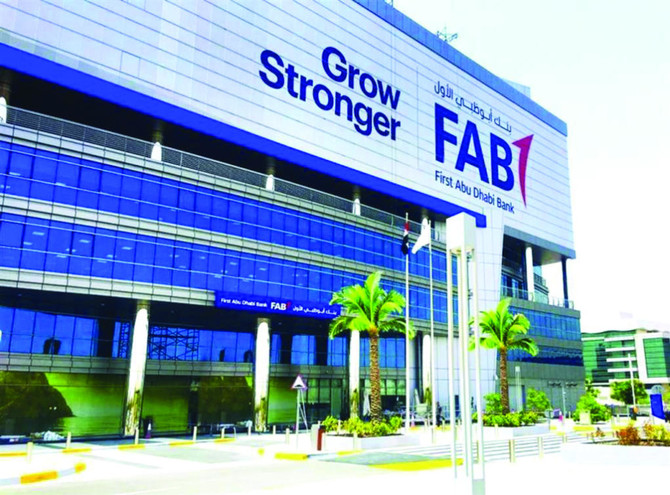
LONDON: First Abu Dhabi Bank (FAB), the UAE’s largest lender, is poised to establish a commercial banking business in the Kingdom after being granted a license by the Saudi Arabia Monetary Authority (SAMA).
FAB will be able to open up to three branches as part of its expansion strategy that recently saw Riyadh’s Capital Market Authority (CMA) give it permission to establish an investment banking subsidiary.
The Abu Dhabi bank joins Western financial institutions that have shown an interest in operating in KSA as the economy opens in line with the Vision 2030 modernization and reform program.
Citibank, for example, started up in Jeddah in April 2017 after a gap of 13 years, making it the first American bank to put down roots in the Kingdom in more than a decade. Citi won a license to take part in mergers and acquisitions, initial public offerings, privatizations, and other capital markets business.
Goldman Sachs, which has been operating in the Kingdom since 2009 as an agent and underwriter last June won CMA approval for a license to trade equities.
Commenting on the FAB license, Tahnoon Bin Zayed Al-Nahyan, chairman of FAB, said: “In light of the recent securities license approval secured earlier this year, FAB is moving forward with the next phase of our growth plan for the KSA market.
“By providing new opportunities for customers in the region to grow stronger, this new addition to the banking landscape will be another catalyst for the continued advancement of the KSA economic agenda, and will further reinforce the UAE and Saudi Arabia’s solid relationship.”
CEO Abdulhamid Saeed said: “These developments give us the platform to tap into the region’s largest economy with the full strength and capabilities of the FAB offering, and build on the strong potential of the KSA market. We are confident that our expansion into Saudi Arabia will enhance our regional presence and will provide an important contribution to our international network.”
Headquartered in Abu Dhabi’s Khalifa Business Park, FAB’s international network spans over 19 countries outside the UAE.
Based on audited financial information as at December-end 2017, FAB had total assets of $182 billion.
Recent reports by Bloomberg have suggested that Citi, Goldman Sachs, Morgan Stanley and HSBC have been appointed to advise on Saudi Arabia’s global borrowing program. This involves the refinancing and extension of the $10 billion loan from two years ago, and a new bond which could rival the record-breaking $17.5 billion issue of 2017.
The Saudi stock exchange opened itself to direct investment by foreign institutions in mid-2015 and last year eased restrictions on foreign ownership in its stock market to improve the investment environment.
International firms such as BlackRock, Citigroup, HSBC and Ashmore Group have since been among those to join the list of institutional investors that can directly trade the market.

UAE bank to open branches in Saudi Arabia
Arab food and beverage sector draws $22bn in foreign investment over 2 decades: Dhaman
JEDDAH: Foreign investors committed about $22 billion to the Arab region’s food and beverage sector over the past two decades, backing 516 projects that generated roughly 93,000 jobs, according to a new sectoral report.
In its third food and beverage industry study for 2025, the Arab Investment and Export Credit Guarantee Corp., known as Dhaman, said the bulk of investment flowed to a handful of markets. Egypt, Saudi Arabia, the UAE, Morocco and Qatar attracted 421 projects — about 82 percent of the total — with capital expenditure exceeding $17 billion, or nearly four-fifths of overall investment.
Projects in those five countries accounted for around 71,000 jobs, representing 76 percent of total employment created by foreign direct investment in the sector over the 2003–2024 period, the report said, according to figures carried by the Kuwait News Agency.
“The US has been the region's top food and beverage investor over the past 22 years with 74 projects or 14 projects of the total, and Capex of approximately $4 billion or 18 percent of the total, creating more than 14,000 jobs,” KUNA reported.
Investment was also concentrated among a small group of multinational players. The sector’s top 10 foreign investors accounted for roughly 15 percent of projects, 32 percent of capital expenditure and 29 percent of newly created jobs.
Swiss food group Nestlé led in project count with 14 initiatives, while Ukrainian agribusiness firm NIBULON topped capital spending and job creation, investing $2 billion and generating around 6,000 jobs.
At the inter-Arab investment level, the report noted that 12 Arab countries invested in 108 projects, accounting for about 21 percent of total FDI projects in the sector over the past 22 years. These initiatives, carried out by 65 companies, involved $6.5 billion in capital expenditure, representing 30 percent of total FDI, and generated nearly 28,000 jobs.
The UAE led inter-Arab investments, accounting for 45 percent of total projects and 58 percent of total capital expenditure, the report added, according to KUNA.
The report also noted that the UAE, Saudi Arabia, Egypt, and Qatar topped the Arab ranking as the most attractive countries for investment in the sector in 2024, followed by Oman, Bahrain, Algeria, Morocco, and Kuwait.
Looking ahead, Dhaman expects consumer demand to continue rising. Food and non-alcoholic beverage sales across 16 Arab countries are projected to increase 8.6 percent to more than $430 billion by the end of 2025, equivalent to 4.2 percent of global sales, before exceeding $560 billion by 2029.
Sales are expected to remain highly concentrated geographically, with Egypt, Saudi Arabia, Algeria, the UAE and Iraq accounting for about 77 percent of the regional total. By product category, meat and poultry are forecast to lead with sales of about $106 billion, followed by cereals, pasta and baked goods at roughly $63 billion.
Average annual per capita spending on food and non-alcoholic beverages in the region is projected to rise 7.2 percent to more than $1,845 by the end of 2025, approaching the global average, and to reach about $2,255 by 2029. Household spending on these products is expected to represent 25.8 percent of total expenditure in 13 Arab countries, above the global average of 24.2 percent.
Arab external trade in food and beverages grew more than 15 percent in 2024 to $195 billion, with exports rising 18 percent to $56 billion and imports increasing 14 percent to $139 billion. Brazil was the largest foreign supplier to the region, exporting $16.5 billion worth of products, while Saudi Arabia ranked as the top Arab exporter at $6.6 billion.