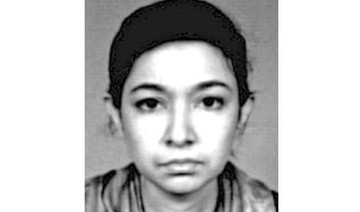
ISLAMABAD: The government of Pakistan is exploring legal options to secure the release and repatriation of neuroscientist Dr. Aafia Siddiqui, currently in jail in the United States, as well as raising the issue at appropriate international meetings and using diplomatic channels, Andleeb Abbas, Parliamentary Secretary for Ministry of Foreign Affairs, told Arab News on Friday.
“We are using laws, contracts, and conventions (for the repatriation of Siddiqui),” Abbas said, but admitted no plan has yet been finalized. “In principle we have agreed that we are going to raise this issue,” she added.
Siddiqui was indicted by a New York federal district court in September 2008 on charges of attempted murder and assault stemming from an incident in an interview with the US authorities in Afghanistan. She, however, denies the charges.
After 18 months in detention, she was tried and convicted in early 2010 and sentenced to 86 years in prison. She is currently serving her jail term in the US.
Siddiqui’s imprisonment sparked protests in Pakistan where supporters claim the charges against her were invented. Successive governments in Pakistan also announced they would take measures to ensure the extradition of Siddiqui, but so far any such measures, if taken, have been unsuccessful.
During July’s election campaign, Pakistan Tehreek-e-Insaf (PTI) — now the ruling party in Pakistan — promised to provide consular and legal services to all Pakistanis jailed abroad, saying, “We (will) make our best efforts to bring prisoners like Dr. Aafia Siddiqui and others back to Pakistan.”
A ruling party lawmaker in the Punjab Assembly, Seemabia Tahir, also submitted a resolution in the provincial assembly on Friday urging Prime Minister Imran Khan to take all necessary measures to bring Siddiqui back to Pakistan.
“Dr. Aafia Siddiqui is a daughter of Pakistan,” Tahir told Arab News. “I’ll soon call on the prime minister too to request him to take all possible diplomatic and legal measures to ensure her repatriation.”
Pakistan Foreign Minister Shah Mahmood Qureshi’s recent interview with Fox News about the possible release of Dr. Shakeel Afridi also sparked a debate about a prisoner swap.
Afridi helped the US track down Osama bin Laden in Pakistan by running a fake vaccination program to collect DNA but has since been in jail in Pakistan.
“He is viewed in a particular light in Pakistan. He is viewed as a traitor in Pakistan, but he is viewed as a friend in the US. So we have to bridge this gap,” Qureshi told Fox News.
The parliamentary secretary told Arab News that a deal to exchange Afridi for Siddiqui “is not under discussion.”
“The US has not discussed this issue with our government,” she added.
Dr. Fauzia Siddiqui, sister of Dr. Aafia, blamed successive Pakistani governments for “non-cooperation” and failure to take effective diplomatic steps with the US authorities.
“We are hopeful that Aafia will be released one day,” she told Arab News. “But our governments just make statements that they have taken up the issue at the highest level, but practically have done nothing.”
Fauzia said that they were pursuing matters in the US courts, and working with human rights activists in the US to get her sister released and returned to Pakistan.
Barrister Masroor Shah said that Pakistan does not have an extradition treaty with the US, therefore the government cannot press the US authorities for repatriation of Dr. Aafia.
“Dr. Aafia can be brought back to Pakistan through a bilateral arrangement with the US,” he told Arab News, “her release may be secured by utilizing diplomatic channels instead of the legal ones.”


![]()

Pakistan exploring legal options over repatriation of Aafia Siddiqui
Pakistan exploring legal options over repatriation of Aafia Siddiqui
- Swap of Dr. Shakeel Afridi for Dr. Aafia Siddiqui not under discussion, says Parliamentary Secretary for Ministry of Foreign Affairs
- Siddiqui’s sister says Pakistani government has done “nothing“

Latest updates


© 2026 SAUDI RESEARCH & PUBLISHING COMPANY, All Rights Reserved And subject to Terms of Use Agreement.