Half-wooden house undamaged in Indonesia’s powerful quakes

A survivor sits in a tent on a field of a mosque where she took refuge in Palu on Monday, after an earthquake and tsunami hit the area on Friday. (AFP)
Updated 02 October 2018
Follow

Half-wooden house undamaged in Indonesia’s powerful quakes

JAKARTA: When all his neighbors built theirs permanent with concrete walls, Boby’s family kept their house in Palu, the provincial capital of Central Sulawesi, semi-permanent with only half of its walls made from concrete.
This structure withstood at least two powerful earthquakes, including a 7.4-magnitude one that struck the province on Friday.
“Half of the walls in my family’s house are made of teak wood. Our house remains intact, while other houses in the neighborhood are damaged,” Boby told Arab News.
Moreover, all his family members are safe and back in their house. He had tried to reach his family by phone since the quakes started, and was finally able to talk to one of his younger brothers on Monday.
“I was especially worried about my father since he’d had a stroke and was hospitalized. He returned home three days before the quake hit,” he said. Four days after the twin disaster struck Palu and Donggala, the death toll has soared to 844. Most of the dead — 821 — are from Palu, and 744 bodies have been identified, while the remaining casualties were in Donggala and Parigi Moutong districts, where 11 and 12 people died respectively.
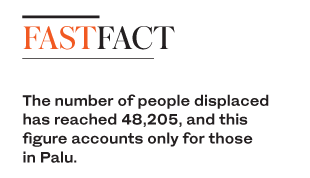
Sutopo Purwo Nugroho, the spokesman for National Disaster Mitigation Agency, said 90 people (including eight foreigners from South Korea, Belgium and France) are still missing, while 632 people had been badly injured. The number of people displaced has reached 48,205, and this figure accounts only for those in Palu.
However, the official figures that the agency presented only scratched the surface as it is feared that hundreds of others are still unaccounted for, while commmunication networks are still down and rescue missions to other affected areas outside Palu are being hampered by damaged roads, landslides and broken bridges.
“We still don’t know the number of victims in Balaroa and Patobo housing complex. The soil in Balaroa was actually moving up and down, with houses rising up two meters and roads going down five meters down since they were built near the Palu-Koro fault and the quake triggered liquefaction,” Nugroho said.
“Hundreds of houses in Patobo have been swept away by the mud from the liquefaction,” he added. There were 1,747 houses in Balaroa and 744 in Patobo, which have now been reduced to debris. A rescuer told news broadcaster TV One that the number of survivors responding to calls from rescuers from beneath the ruins of the eight-story Roa-Roa Hotel in Palu, now almost flattened to the ground, became fewer and fewer every day. Efforts to take them out of the rubble have been hindered by the lack of heavy machinery to lift the broken concrete walls, but Nugroho said equipment had been moved in from cities in the region such as Mamuju, Gorontalo, Poso and Balikpapan. The Indonesian government said on Monday that it “welcomes” offers from various countries to assist in the relief efforts.
Nugroho said it was President Joko Widodo’s call to decide whether Indonesia would accept international aid after he visited the areas devastated in the disasters and assessed the situation there on Sunday.
Indonesia welcomes things required most now for relief efforts in Palu: aircraft that can land on a 2,000-meter runway, water and sanitation, tents, power generators, a field hospital and medical assistance, and fogging equipment.
“We need fogging to prevent diseases from decaying corpses which are still not found,” Nugroho said, adding that the government has prepared 1,000 body bags and started burying victims on Monday.


Maduro’s fall tests Venezuela’s ruling ‘club’

Updated 5 sec ago
Follow

Maduro’s fall tests Venezuela’s ruling ‘club’

  • The ousting of Nicolas Maduro as Venezuela’s president puts to the test his “Chavista” factions that have governed the oil-rich nation for 27 years
CARACAS: The ousting of Nicolas Maduro as Venezuela’s president puts to the test his “Chavista” factions that have governed the oil-rich nation for 27 years.
What happens to the so-called “club of five” powerful leftist figures, now that two of its most important members — Maduro and his wife Cilia Flores — have been captured and sent to the United States to face trial?

’Club of five’
Anointed by his mentor Hugo Chavez before the latter’s death in 2013, Maduro kept a tight grip on power until his capture by US forces on Saturday.
Maduro ruled alongside Flores and three other powerful figures: former vice president Delcy Rodriguez — now Venezuela’s interim leader — her brother Jorge, and their rival: hard-line Interior Minister Diosdado Cabello.
“It’s like a club of five,” a diplomatic source in Caracas told AFP under the condition of anonymity.
“They can speak, they have a voice in the government, but Maduro was the one who kept the balance. Now that he’s gone, who knows?“
Maduro and ‘Super Cilita’
The image of Maduro handcuffed and blindfolded as US forces transported him to New York to face trial made headlines around the world.
During months in the crosshairs of US President Donald Trump, who accused him of being a drug trafficker, the 63-year-old former bus driver deflected pressure by dancing to techno music at near-daily rallies, always broadcast live, as he chanted the mantra “No war, yes peace!” — in English.
Frequently underestimated, Maduro managed to eliminate internal resistance and keep the opposition at bay.
Murals, songs and films celebrated him, as did the animated cartoon “Super Moustache,” in which he appeared as a superhero, fighting imperialism alongside “Super Cilita,” who is based on Flores.
Toy figurines of both characters were also produced.
The military swore absolute loyalty to him, led by Defense Minister Vladimir Padrino Lopez.
Though defiant at first and calling for Maduro’s return, Venezuela’s interim leader Rodriguez called for a “balanced and respectful relationship” between the South American country and the United States on Sunday.
“The top level of government has survival as its absolute priority,” Antulio Rosales, political scientist and professor at York University in Canada, told AFP.
The Rodriguez siblings
Rodriguez controlled the economy and the oil industry as vice president while her brother Jorge is the speaker of parliament.
They are known for their incendiary rhetoric, often mixing belligerence, irony and insults against the “enemies of the fatherland.”
But behind the scenes, they are skilled political operators.
Jorge Rodriguez was the chief negotiator with the opposition and the United States, and his sister represented Maduro in various international forums.
Experts also attribute purges within government to them, such as one that sent Tareck El Aissami, a powerful oil minister until 2023, to prison.
Rodriguez took over his post shortly afterwards.
The feared policeman
Diosdado Cabello meanwhile is widely feared in Venezuela. Under his ministry, some 2,400 people were detained during protests that followed Maduro’s disputed re-election in 2024, in a move that cowed the opposition.
Cabello is seen as representing the most radical wing of “Chavismo,” and some see him at odds with the pragmatism of the Rodriguez pair, though both sides have denied this.
Cabello acted as president for a few hours when Chavez was overthrown for two days in 2002.
He accompanied Chavez in a failed coup attempt in 1992. Today he is number two in the Socialist Party behind Maduro.
The US courts have now named Cabello among those wanted for trial alongside Maduro.
They have offered $25 million for his capture.
Having kept a low profile in the hours after Maduro’s capture, he appeared by Rodriguez’s side at her first cabinet meeting as acting president on Sunday.