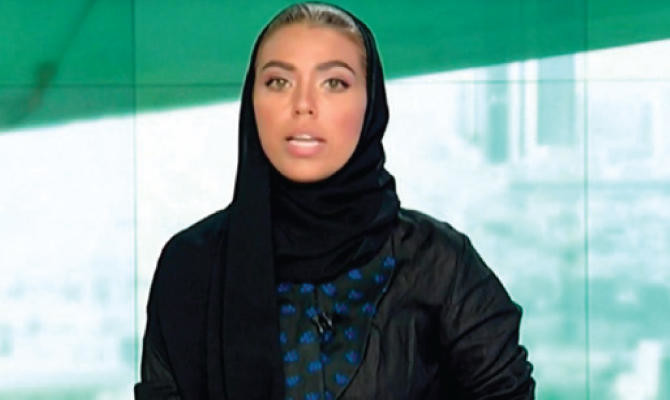
Up close and personal with Weam Al-Dakheel, the first woman to anchor the main news bulletin in Saudi Arabia

1 / 5
Weam Al-Dhakeel
2 / 5
Al-Dhakeel with some young fans. (Supplied)
3 / 5
Al-Dhakeel interviews the actor Wagner Moura. (Supplied)
4 / 5
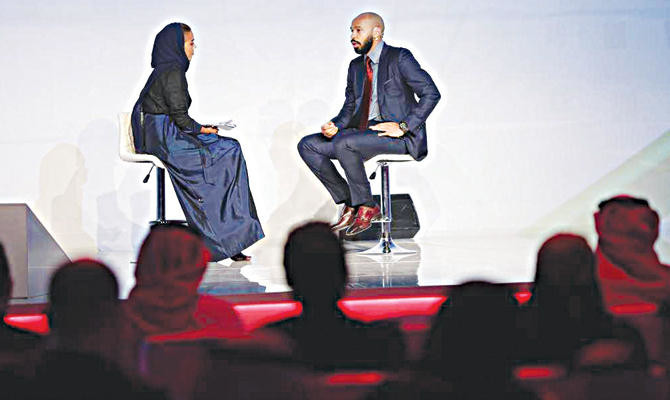
Al-Dhakeel interviews the footballer Thierry Henry. (Supplied)
5 / 5
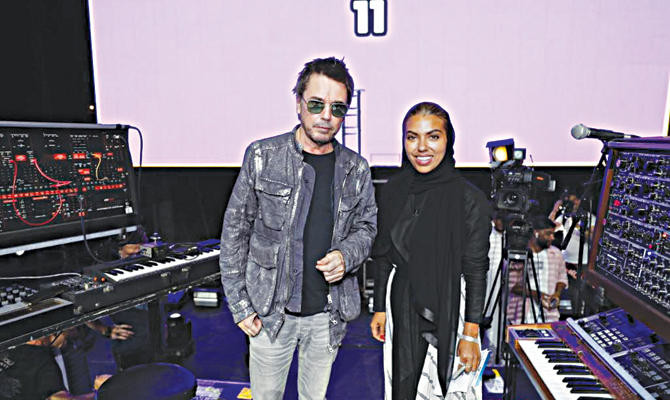
Al-Dhakeel interviews the musician Jean-Michel Jarre (Supplied)
Updated 02 October 2018
Follow

Up close and personal with Weam Al-Dakheel, the first woman to anchor the main news bulletin in Saudi Arabia

  • Al-Dakheel is not only a high-flier on screen, but off is as well as she is also an operations manager at Saudi television.
  • As a journalist, she aims to document the changes currently occurring in her country.

RIYADH: At the age of 8, Weam Al-Dakheel used to rush downstairs every morning to read the newspapers that her father had delivered to their home. “I would challenge myself and read them upside down,” she recalls.
So when it became time to choose a career, it was clear which direction she was heading in.
Born in Morocco, raised in Jeddah, and having studied in Lebanon, Al-Dakheel now lives in Riyadh and is the first woman to anchor the main evening news on Saudi TV. Al-Dakheel has an interesting and varied background, and one that she’s proud of. “It helped shape me,” she said.
Al-Dakheel is not only a high-flyer in front of the cameras; few people know that she’s also the operations manager at Saudi TV.
“I work from the heart,” she said. “The ‘title’ of being the first can either break you or make you. It can also be a fresh start or beginning. It’s a big responsibility. I’m aware of my passion, and with awareness comes responsibility.” Al-Dakheel said she doesn’t feel pressure, but is more focused on how she manages her time.
Before reaching the heights at Saudi TV, Al-Dakheel transitioned through many stages of journalism to find her passion. She was editor-in-chief of a student publication at the American University in Beirut, which she fondly recalls as having shaped her as a journalist.

When there was no “news” to publish, they went out and found it. The student journalists went out found people with interesting stories and let them talk about their experiences. “I listened when they spoke and poured their hearts out,” Al-Dakheel said.
She recalls the story of a homeless man that she saw every day on the streets. What struck her most about him was his intellect and use of sophisticated words, which suggested there was more to him than met the eye. “We found out later he was a doctor and we wanted to interview him, but the next day he was gone. That experience taught me to never to judge people based on their appearance.”
After cutting her professional teeth as an intern at Al-Hayat, the pan-Arab daily newspaper, Al-Dakheel worked as a news presenter at Al-Arab News Channel in Bahrain. She was also a TV reporter for CNBC Arabia from September 2012 to November 2013, which was when she found her calling. “I realized that I preferred TV to written journalism,” she said.
Al-Dakheel grew up in an intellectual household, with parents who loved to read and were avid followers of what was going on in the world. Family gatherings consisted of discussions about regional and international issues, debating their areas of interest, and exchanging opinions.
Al-Dakheel began her university studies in Lebanon in 2006, but when Israel invaded, her parents feared for her safety and urged her to return home to Saudi Arabia. She persevered, and finally convinced them that she should stay and continue her studies.

“Studying and living in Lebanon shaped me in a lot of ways,” she said. “I grew up, I matured, I learned, I failed, I succeeded, I was challenged … and all this just to continue my studies there.
“My parents raised us to be responsible and independent, but at the same time to take their advice. To be a responsible person makes you a strong person who can face challenges. My parents raised us and encouraged us to be this way. After a while, things calmed down and they reopened university registration, and my parents agreed with me. So I returned.”
Al-Dakheel graduated in 2011 with a BA in journalism, and she is proudly a journalist to this day. “I consider myself a journalist before being a TV news anchor, and any TV broadcaster that doesn’t consider themselves a journalist, then they are a conveyor and not a newsmaker. At every stage of my life, I made sure I presented myself a journalist, because that’s the core of being a broadcaster.”

One of Al-Dakheel’s jobs is to document the transformation currently under way in her homeland. “Change is happening,” she said, “and for a female to present the evening news on the Saudi national TV proves that change is taking place.
“Change happens at the core, through education, social reforms and even accepting others, whether you agree with their opinion or not. That gives a wider perception of how you see yourself and others who are different from you.”
Al-Dakheel operates in a male-dominated workplace, but does not shy away from giving her opinion. A strong-willed perfectionist by nature, she makes sure that the workflow is impeccable. She is not intimidated by her surroundings — in fact, her main supporters are her male colleagues. “I work in silence, I let my success make the noise,” she said.
Being a broadcaster is her calling, but philanthropy is close to her heart too. In 2016, Al-Dakheel travelled to Jordan and volunteered in the Gaza camp for refugees at Jerash. While she has also worked at a philanthropic organization, it is her job as a journalist that pushes her to do more.
“I just want to take the camera and shed light on people’s stories,” she said.
“I believe that when you share this experience with viewers and make them feel that the screen is made for them, people will watch and that is what success is. It’s not only about being the first female anchor, that’s just the beginning.”
A matter of trust: Media leaders look to rebuild credibility in age of AI

Updated 08 December 2025
Follow

A matter of trust: Media leaders look to rebuild credibility in age of AI

  • ‘Don’t do what pleases platforms, do what is right,’ journalism professor says
  • ‘General journalism is going to be very difficult,’ media boss says

ABU DHABI: Media organizations are facing unprecedented disruption to their industry, as traditional business models come under strain from rapid technological shifts, the rise of independent creators and a growing public distrust in news.

This fragmented landscape has transformed the essence of journalism and content creation in the 21st century.

Amid the upset, journalists, creators and industry executives were in Abu Dhabi on Monday for the opening day of the inaugural Bridge Media summit, where they hoped to map a path forward in a rapidly evolving industry.

Jeff Zucker, CEO and operating partner at RedBird IMI and RedBird Capital Partners, said that while storytelling remained at the core of the media, artificial intelligence was fundamentally reshaping how stories were created, delivered and consumed.

“General journalism, by and large, is going to be very difficult in a world of AI,” he told the conference.

Having been at the helm of some of the biggest media businesses in the world, including CNN and NBC Universal, Zucker emphasized the value of deep, niche journalism, arguing that the viability of future news models will hinge on offering something readers cannot get elsewhere.

“Economic models may broaden, so I think that niche journalism that goes deep and gives the consumer an edge and a reason to subscribe to that journalistic outlet — that’s what will work and that’s what will succeed.”

It is an idea that featured across the first day of the summit, with media practitioners from all disciplines pushing colleagues to focus on elevating the quality and originality of their content, rather than being dismayed at the fall in advertising revenue and chokehold of algorithms.

Moataz Fattah, a journalism professor and presenter at Al-Mashhad TV, decried media organizations’ constant focus on algorithms, saying they would be better served by honing their craft.

“Don’t do what pleases platforms, do what is right and go to where the audience is,” he said.

“How to be authentic is to be true to what you believe in.”

Fattah argued that while it was true that younger generations gravitated toward short form content, it was still possible to engage them to take deeper dives on subjects.

What mattered most, he said, was ensuring that the right format was used for the subject matter, applying creativity and flair to keep audiences challenged and informed so that they might get the full context.

This idea of challenging audiences, rather than caving to what may seem trendy was echoed by Branko Brkic, leader at Project Kontinuum, an initiative that aims to reaffirm news media’s positive role in the global community.

“If we are giving readers and audiences (only) what they want, why do we exist? Why do they need us?” he said.

“We have to be half a step ahead, we need to satisfy the needs that they know they have but also fill the needs they didn’t know they wanted.”

Sulemana Braimah, executive director at the Media Foundation for West Africa, said transparency, credibility and, ultimately, the impact on society were what should drive storytelling, rather than just views and likes.

“In the newsroom, we always have to ask why we are doing this story, what is the story in the story, who is it for?” she said, urging media outlets to choose depth over superficial recognition of content.

“Stories that get views don’t necessarily mean they hold value. We need to keep asking why, what’s the value, what are we helping by making this story.”

Individuals over institutions 

Another theme that dominated discussions at the conference was the idea that trust was increasingly being driven by individuals rather than brands and institutions. The argument, put forward by Zucker, is that unlike in the past, when legacy outlets conferred trust upon journalists, audiences now place their trust in individual voices within a media institution, making personal reputation a critical currency in modern journalism.

“People are looking much more to individuals in this new creator economy, this new AI world,” he said.

Jim Bankoff, co-founder and CEO of Vox Media, echoed that sentiment and predicted that more news content would be led by trustworthy and notable personalities.

Speaking on the strategy of his own media company, he said the future would likely see lower headcounts within institutions, due to AI and automation, but more emphasis on talented individuals.

“Work on something that makes you essential to your core audience,” he said.

Consolidation, AI and finances in flux

One of the big talking points of the opening day was Netflix’s attempt to acquire Warner Bros., a move seen by some as evidence of a rapidly consolidating industry challenged by shrinking profit margins.

AI seemingly only seeks to further challenge these margins. With many more people using AI summaries and overviews to get news and information, chatbots are becoming the new face of the internet, reducing traffic flow to news websites and destroying the ad-based revenue model.

Pooja Bagga, chief information officer at Guardian Media Group, said audiences defined the rules of the internet and delivery of news content and that the onus lay with media companies to reinvent themselves.

“It’s all about what our audience want, what they want to see, how they want to see it, which formats they want to interact with and when they want to consume the news,” she said.

Many media outlets have signed licensing deals with AI companies to include the use of their content as reference points for user queries in tools like ChatGPT while ensuring attribution back to their websites.

These agreements also allow tech firms to access publishers’ content — including material held behind paywalls — to train large language models and power AI-driven services in exchange for media organizations’ use of the tech to build their own products or for revenue sharing.

In October last year, the Financial Times, Reuters, Axel Springer, Hearst and USA Today Network signed an agreement with Microsoft allowing it to republish their content in exchange for a share of the advertising revenue.

Bagga said that such agreements were essential to safeguarding news content and ensuring tech companies upheld their responsibility to handle journalistic material with integrity and accountability.

She also stressed the need for greater transparency from tech companies in how they use journalistic content to train large language models, emphasizing the importance of ensuring accuracy in AI-generated overviews.

An alternative route, she said, was collaborating with other publishing companies under rules and regulations that ensure intellectual property was protected.

In newsrooms, amid the fast-evolving world of tech and artificial intelligence, there must be a trusted supervisory body to safeguard editorial integrity, she said.

Elizabeth Linder, founder and chief diplomatic officer at Brooch Associates, stressed the need for transparency and broad understanding on how decisions are made by media and tech companies to ensure “a productive social contract.”

She called for conversations between governments, tech platforms and individuals, citing Australia's Communications Minister Anika Wells, who introduced a bill to ban social media use for children under the age of 16.

“Especially with the development of AI technology coming in, we need to take a really big step back and reframe this entire conversation.”