

Saudi Arabia, Pakistan discuss oil refinery project

Saudi adviser on energy Ahmad Hamed Al-Ghamdi, center, holds talks with Pakistan’s Minister of Power Omar Ayub Khan, right, in Islamabad. (Photo courtesy: PID)
Updated 02 October 2018
Follow

Saudi Arabia, Pakistan discuss oil refinery project

  • During the meeting with the Finance Minister Asad Umar, both sides discussed areas of mutual cooperation
  • Saudi Arabia has always supported Pakistan in the most difficult times, says Asad Umar

JEDDAH: The high-level Saudi delegation on a five-day visit to Islamabad held talks with Pakistani authorities on Monday in a cordial atmosphere as both sides discussed areas for potential investment, Pakistan’s Commerce Minister Abdul Razak Dawood told Arab News.
A multibillion-dollar oil refinery which Saudi Arabia has offered to set up in Pakistan’s port city of Gwadar was one of the items discussed.
“Today (Monday) meetings with the Saudi delegation started on a very positive note. Both sides reviewed the areas of mutual interest,” Dawood said.
The Saudi delegation, which arrived in Pakistan on Sunday — shortly after Pakistan’s newly elected Premier Imran Khan’s visit to the Kingdom — remained busy on Monday, meeting individually with Commerce Minister Abdul Razak Dawood, Minister of Petroleum Ghulam Sarwar Khan, Minister of Power Omar Ayub Khan, and Finance Minister Asad Umar. During the meeting with the finance minister, both sides discussed areas of mutual cooperation. “Saudi Arabia has always supported Pakistan in the most difficult times,” Umar said. “The Saudi delegation has expressed interest in an oil refinery, the power sector, setting up a desalination plant, wind projects, and solar power projects,” Dawood added. The visiting delegation is expected to sign memoranda of understanding in projects of mutual interest at the end of the five-day visit.
“The delegation is going to visit Gwadar on Tuesday to review the setting up of the oil refinery,” Dawood said. Saudi Arabia has also expressed interest in acquiring stakes in liquefied natural gas power plants in Punjab province. During the meeting with Federal Minister for Power Omar Ayub Khan, the visiting delegation, led by adviser on energy Ahmad Hamed Al-Ghamdi, discussed prospects of increasing cooperation in the power sector.
Ayub briefed the delegation about investment opportunities in the power sector and assured full security to the investors. “Pakistan is the best destination for foreign investment,” Khan told the delegation.
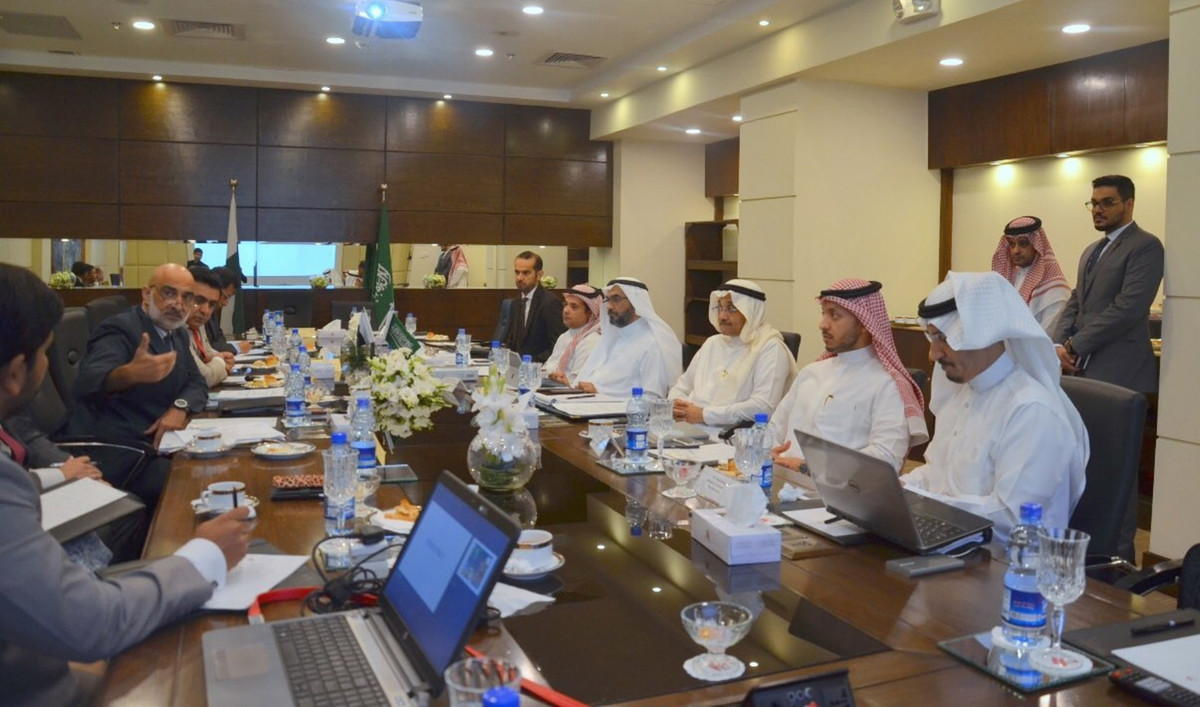


Pakistani officials are briefing visiting delegation of Saudi Arabia on the prospects of mutual investment. (AN photo)

Both sides also discussed the current volume of bilateral trade and explored ways to enhance trade volume from the current $3.4 billion, which is largely in favor of Saudi Arabia.
Pakistan imported $3.1 billion worth from the Kingdom while exporting only $316.7 million worth of goods during the 2017-18 fiscal year, the State Bank of Pakistan’s data shows.
During the meeting, Pakistan also formally sought the import of crude oil from the Kingdom on deferred payment for at least 90 days.
Last week, Pakistan’s Information Minister Fawad Chaudhry said that Pakistan and Saudi Arabia had signed three agreements to bring major investment into the country after the formal invitation of Pakistan to Saudi Arabia as a third partner in the China Pakistan Economic Corridor (CPEC) projects.
During his visit to the Kingdom in September, Umar had said that Prime Minister Khan discussed with the Saudi leadership measures for trade enhancement and investment. “These are measures which will help fill the external financing gap,” Umar noted.
He said Pakistan was constantly in touch with international commercial markets and banks for financing.
Rebuilding lives: Saudi initiative gives fresh hope to amputees

Updated 08 December 2025
Follow

Rebuilding lives: Saudi initiative gives fresh hope to amputees

  • Baitureh Health Association has provided life-changing support to more than 1,000 people
  • Prosthetic limbs can cost up to $76,000

MAKKAH: The Baitureh Health Association for the Care of Amputees has quickly become one of Saudi Arabia’s most impactful humanitarian initiatives, transforming support for people with lost limbs.

Established in 2020, the association deals with people’s physical, psychological and social needs and fills a long-standing gap in the national health system.

CEO Badr bin Alyan told Arab News that the initiative was created in response to a growing need, driven by amputations linked to accidents, blood disorders, occupational injuries and other causes.

Its operations were “based on service integration rather than fragmentation, enabling beneficiaries to return to their lives with confidence, ability and independence,” he said.

This holistic process covers everything from initial evaluations to psychological and physical rehabilitation, family support, prosthetic fitting and ongoing maintenance.

Its psychological support programs include group sessions led by certified mentors who have undergone similar experiences, as well as field visits to support patients before and after amputation.

More than 1,000 people across the Kingdom have so far benefitted from the association’s work, about 10 percent of them children, whom Alyan said were “the most sensitive and the most in need of intensive psychological and family support.”

Its specialist programs for children — My First Step and Therapeutic Entertainment — help young people adapt to prosthetics, overcome trauma and build confidence in a safe and supportive setting.

The association has completed more than 300 prosthetic fittings, including silicone cosmetic limbs, mechanical, hydraulic, electronic and 3D-printed models. 

Alyan said the type of prosthetic selected depended on a number of factors, such as age, lifestyle, type of amputation, activity level and psychological readiness.

Children also have to undergo frequent adjustments to their new limbs to account for their growth.

Each prosthetic cost between SR20,000 ($5,300) and SR285,000, Alyan said.

The association funds its work through sponsorships, community contributions and strategic partnerships.

Despite its success, Alyan said there were still challenges to be faced, including the lack of a consolidated base for the provision of psychological support and therapy services and prosthetics development and maintenance.

There was also a shortage of local experts, he said.

In response, the association set up a rehabilitation center, which Alyan said would help to localize prosthetics manufacturing, reduce costs and accelerate fitting processes and create opportunities for local experts to develop their knowledge and experience.

But providing prosthetics was only part of the association’s work, he said.

“Rebuilding a human life is the deeper goal.”