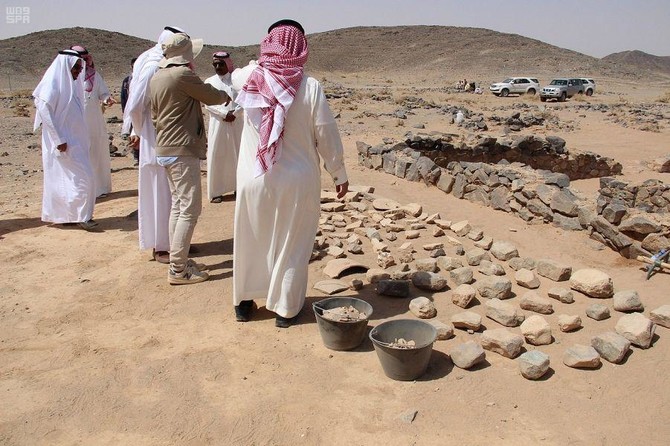
JEDDAH: Saudi Arabia has concluded the past Hijri (Islamic calendar) year with unprecedented archaeological findings, as well as achievements in archaeological protection, rehabilitation of sites and restoration of national antiquities.
The recent discovery of the 85,000-year-old remains of an ancient man in the Nefud Desert on the outskirts of Tabuk was considered among the most important discoveries announced by the Saudi Commission for Tourism and Heritage (SCTH) this year. This astonishing and very rare discovery of a fossilized finger bone is the oldest human fossil on record unearthed outside of Africa and the Levant.
It may shed light on the route early humans took out of Africa as part of early migrations.
The commission also recently announced that it has discovered in Ukhdud, Najran province, a pottery jar filled with more than a thousand coins, metallic stamps, and engraved stones that date back to the first century AD. This modern archaeological discovery is of great scientific value as it indicates the cultural, social and political prosperity of the site.
Other discoveries were made in Saudi Arabia’s Al-Ablaa, a site of archaeological treasures in Asir province. The foundations of a mosque dating back to the first Islamic era had been found with an area estimated at 616 m².
The commission’s team of archaeologists have also found a number of interconnected architectural units in the area that contain many archaeological phenomena. The most important of which are walls, circular basins and water reservoirs, as well as a large pottery tractor used to store grains and agricultural crops produced by the residents of Al-Ablaa.
Also, the discovery of a 2,000 year-old carved drawing of a number of camels in a mountain in Al-Jouf region, has garnered great interest in international archaeological arenas.
According to a collaboration between the French National Center for Scientific Research and SCTH reported earlier this year in the Cambridge journal of Antiquity , the so called “Camel Site” has life-size carved camels into rocks that date back to more than 2,000 years ago but were somewhat eroded because of the weather.
Moreover, archaeological finds at the site of Halit, in the province of Dawadmi in Riyadh, have discovered the foundations of a mosque that was built with in the style as mosques in the first Islamic era.
At the mining settlement of Asham, in Al-Baha region, foundations of another mosque were discovered, dating back 1,000 years ago. This mosque is considered one of the earliest in the south of the Arabian Peninsula, as it includes a foundation stone that indicates that it was founded during 1023 AD.
The commission also announced earlier the discovery of 15 archaeological sites in several locations across the Kingdom during 32 joint Saudi-international expeditions.
Among the discoveries was an elephant’s carpal bone in Tayma, one of the oldest settlements in the Kingdom, during the 15th century.
Those important findings indicate the prominent historical status of Saudi Arabia and the Kingdom being a cradle for human civilizations.
Prince Sultan bin Salman, head of the commission, previously said in a press conference that Saudi Arabia has become one of the most advanced countries in the field of research and archaeological discoveries in recent years.

A year of unprecedented archaeological findings in Saudi Arabia
Tech executives highlight Saudi Arabia’s growing AI ambitions
- Oracle AI World Tour Riyadh brought together senior Saudi government officials, business leaders, technology decision-makers, developers and innovators
- One-day conference highlighted advances in AI-powered cloud infrastructure, databases and enterprise applications, positioning AI as a key driver of digital transformation and economic growth
RIYADH: Leaders in Saudi Arabia’s technology industry highlighted the Kingdom’s growing ambitions in artificial intelligence during an event in Riyadh on Tuesday.
The Oracle AI World Tour Riyadh brought together senior Saudi government officials, business leaders, technology decision-makers, developers and innovators to explore how AI is transforming industries, accelerating economic diversification and enabling organizations to innovate securely and at scale.
The one-day conference highlighted advances in AI-powered cloud infrastructure, databases and enterprise applications, positioning AI as a key driver of digital transformation and economic growth in line with Saudi Arabia’s Vision 2030.
Saud Al-Sheraihi, vice president of digital solutions at stc, spoke to Arab News at the event about the strong demand for digital solutions across Saudi Arabia, noting the rapid growth of the Kingdom’s digital economy.
“Saudi Arabia is among the highest globally in digital growth. The digital economy now contributes more than 16 percent of GDP, and the ambition is to position the Kingdom as a global hub for digital and AI innovation,” he said.
Richard Smith, executive vice president of technology for Oracle in Europe, the Middle East and Africa, added that the event reflected Oracle’s long-standing commitment to the Kingdom and its expanding role in the regional AI ecosystem.
“Oracle has been working in Saudi Arabia for many years, and we are absolutely delighted with our partnerships here,” Smith said. “We have made significant financial investments in the region, more than $14 billion, as part of our long-term growth strategy.”
Smith said AI had moved beyond experimentation and was now focused on delivering measurable business outcomes. “Organizations are no longer asking whether AI works. They are looking for real return on investment, and that is where cloud, data and AI come together.”
He added that AI adoption in Saudi Arabia was accelerating across government, telecommunications and enterprise sectors, driven by demand for secure, compliant and locally hosted cloud solutions.
“Data sovereignty and security have always been fundamental to Oracle. Working closely with partners such as stc, we are ensuring that data remains within the Kingdom while delivering advanced cloud and AI capabilities.”
The Saudi government has initiated plans to invest more than $40 billion in AI by 2030, expecting to double this figure in coming years.
Reham Al-Musa, vice president of cloud applications for the public sector and country leader for Oracle Saudi Arabia, said the event supported the Kingdom’s ambitions to become a global AI hub.
“Saudi Arabia is rapidly emerging as one of the world’s most influential AI economies, with artificial intelligence acting as a major catalyst for boosting innovation, improving citizen services and enhancing the competitiveness of Saudi Arabia’s human capital,” she said.
“Oracle AI World Tour Riyadh provided a platform for collaboration, knowledge exchange and real-world innovation, helping Saudi organizations accelerate AI adoption in ways that are secure, scalable and aligned with national priorities under Vision 2030.”
Through executive keynotes and technical lab sessions, attendees examined how AI and cloud technologies were increasingly converging to enable faster innovation, stronger security and data-driven decision-making across sectors.
Breakout sessions explored AI adoption in government, telecommunications, finance, supply chain, human resources and customer experience.
The Solution Zone allowed participants to engage directly with experts, explore live demonstrations and examine use cases showing how AI was being applied across industries.


