

Crowdfunding: A new way of closing the financing gap for SMEs and entrepreneurs in Saudi Arabia

A businessman pointing toward camera selecting crowdfunding, virtual interface. (Shutterstock)
Updated 30 September 2018
Follow

Crowdfunding: A new way of closing the financing gap for SMEs and entrepreneurs in Saudi Arabia

  • Scopeer is an equity-based crowdfunding platform that connects entrepreneurs, startups, and SMEs in Saudi Arabia with potential local and international investors

JEDDAH: In Saudi Arabia, policies and regulations, access to finance, and acquiring talent are among the biggest challenges facing entrepreneurs when starting up a business.
Raising funds is a difficulty that has been faced by entrepreneurs and small-to-medium enterprises (SMEs) globally. But it is even a greater challenge for Saudi-based entrepreneurs. Startups and SMEs here face immense difficulties securing finance from conventional sources such as bank financing, as well as bearing the burden of debt repayment during the initial stages of their development.
It is one of the main reasons why startups can fail during the consolidation stage. Only 3.2 percent of the Saudi established businesses last for more than three years, according to this year’s Global Entrepreneurship Monitor (GEM) report for Saudi Arabia.
This is evident from the fact that loans to Saudi SMEs, on average, account for less than 2 percent of total bank lending. While startups have even fewer sources of financing with most being dependent on personal resources, family, and friends.
New technology in finance has created the fintech (financial technology) industry: Online businesses and solutions that provide services in a faster, cost-effective and more streamlined manner. Innovative alternative finance, such as peer-to-peer lending (P2P) or crowdfunding, aims to help plug the SME and startup financing gap.
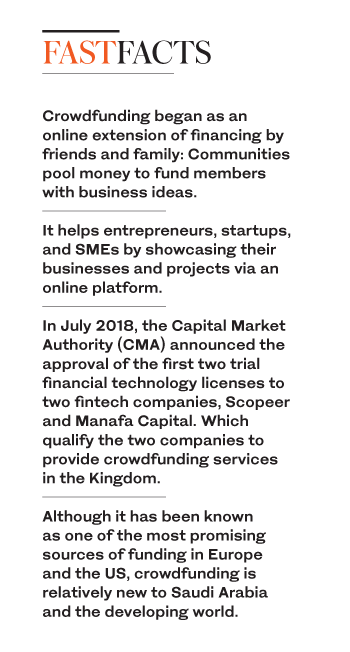
In July 2018, the Capital Market Authority (CMA) announced the approval of the first two trial financial technology licenses to two fintech companies, Scopeer, and Manafa Capital. This qualified the two companies to provide crowdfunding services in the Kingdom as the first results of the Financial Technology Laboratory initiative (FTIL) launched by the CMA at the beginning of 2018.
Abdulrahman Altheeb, CEO of Scopeer, told Arab News: “We worked with the CMA since March 2017 on developing the crowdfunding framework before obtaining the announced license.
“Through benefiting from other newly developed regulations and practices around the world, such as the Financial Conduct Authority in the United Kingdom, the CMA launched its FITL to introduce a set of regulations for the P2P sector that fits the Saudi market needs and behavior. It is aimed that the FITL will function for two years for research and investigatory work which will end with comprehensive market regulations.”
Scopeer is an equity-based crowdfunding platform that connects entrepreneurs, startups, and SMEs in Saudi Arabia with potential local and international investors.
“We consider ourselves a startup, and we understand the issue faced by both startups and SMEs in raising fund, and obtaining financing,” Altheeb said.
“The main goal of Scopeer is to fill the financing gap in Saudi Arabia and provide alternative financing options for startups and SMEs by introducing crowdfunding to the market.”
Crowdfunding is one of the fintech solutions, the practice of funding a project or a venture by raising money through the collective effort of a large number of people who each contribute a small amount.
It helps entrepreneurs, startups, and SMEs by showcasing their businesses and projects via an online platform.
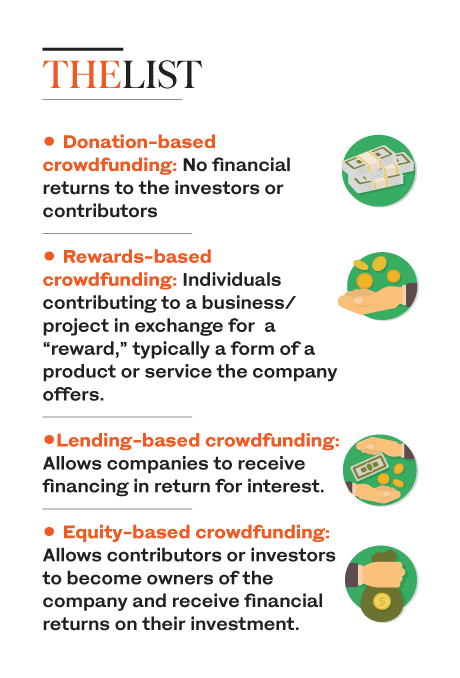
Altheeb explained: “There are a variety of crowdfunding types that include donation-based crowdfunding, rewards-based crowdfunding, lending-based crowdfunding, and equity-based crowdfunding.”
Currently, he said, “CMA is only issuing licenses for equity-based crowdfunding, which is what we do.”
As its name suggests, equity-based crowdfunding allows contributors or investors to become owners of the company by trading capital for equity shares. As equity owners, contributors receive a financial return on their investment and ultimately receive a share of the profits in the form of a dividend or distribution.
In addition to crowdfunding activities, Scopeer will offer a comprehensive entrepreneurial network that facilitates entrepreneurs’ communication with each other and with investors.
The CEO said: “We will also offer a network of business services providers to help companies in meeting our basic requirements in order to be listed for a crowdfunding campaign. Basically, that will include reputable professionals and consultation companies who will be providing their services for free.”
He also added “requirements would include the companies’ financial position, legal frame, and scalability. And all companies will be evaluated and reviewed by our team before being listed in order to ensure their scalability and sustainability for investors.”


Although it has been known as one of the most promising sources of funding in Europe and the US, crowdfunding is relatively new to Saudi Arabia and the developing world.
A recent report issued by the World Bank suggests that “Crowdfunding currently is predominantly a developed world phenomenon, but the potential exists for developing countries to capitalize on this new form of funding. We estimate that there are up to 344 million households in the developing world able and willing to make small crowdfund investments in community businesses.”
In its announcement earlier in July, the CMA said: “The Financial Technology Laboratory License is one of the CMA’s strategic initiatives resulting from the CMA’s ‘Financial Leadership 2020’ program which works under the umbrella of the Financial Sector Development Program, one of the Kingdom’s 2030 Vision execution programs.”

FASTFACTS

CROWDFUNDING

•Crowdfunding: The practice of funding a project or a venture by raising money through the collective effort of large number of people who each contribute a relatively small amount. •Scopeer: an equity-based crowdfunding platform that connects entrepreneurs, startups and SMEs in Saudi Arabia with potential local and international investors. •Crowdfunding is an internet-enabled way to raise money — typically from about $1,000 to $1 million – in the form of either donations or investments from multiple individuals. This new form of capital formation emerged in the wake of the 2008 financial crisis.


From moros to mass tourism — historical bonds fuel Saudi-Spanish tourism takeoff, says ex-Balearic leader

Updated 10 sec ago
Follow

From moros to mass tourism — historical bonds fuel Saudi-Spanish tourism takeoff, says ex-Balearic leader

  • Jose Ramon Bauza says Saudi-Spanish tourism ties may be in their infancy but are poised for a fruitful relationship
  • ‘Kingdom has everything to become global leader on vacational and family destinations,’ former Spanish senator tells Arab News

MADRID: Saudi-Spanish tourism ties may still be in their infancy, but for Jose Ramon Bauza Diaz, they already have the makings of a “family affair.”

“We are at the very beginning of what should be a fruitful and successful relationship,” the former Spanish politician turned tourism consultant told Arab News on the sidelines of FITUR, the flagship global tourism fair.

“Everything has yet to be done. I think we are not starting from scratch, but we are at a starting point, and we have both the opportunity to do a lot of things together.”

Spain welcomed a record 93 million visitors in 2024, overtaking the US as the world’s second most visited country by international arrivals. The Kingdom represents a small proportion, with around 182,000 Saudis visiting in 2023.

Even so, Bauza believes the two countries are “warming up” fast, helped by deep historical links dating back to the presence of ‘moros’ — ancient Arabs whose legacy is etched into the Iberian Peninsula’s culture and architecture.

“We believe in the same principles. We believe in family, we believe in trust. We believe in doing things (together). We love being together; we are not people who want to be isolated,” he said. “This is a specific and privileged starting point.”

Tourism is a central pillar of Saudi Arabia’s Vision 2030, with the Kingdom only fully opening up to global visitors about a decade ago. In 2025 it welcomed more than 122 million domestic and international visitors, a 5 percent year-on-year rise that keeps it on track to reach 150 million by the end of the decade.

Religious tourism has been a key driver alongside a strong push into the luxury segment, but Bauza warned that overreliance on a narrow niche could limit the sector’s full potential.

“Saudi (Arabia) is currently very focused on the luxury (segment); that’s perfect — it is (already) one of the best in the world (in that market). But I think the Kingdom can (also) be the best in the world in vacation tourism, family tourism, and the upper middle to high-end (segment),” he said.

Drawing on Spain and Europe’s experience as industry leaders, he argued that no country can afford to compromise on quality.

“Everyone that (sets) quality (apart) is penalized,” he stressed. “Saudi has everything to be a top luxury destination. But as well that, to be the top vacational and family destinations (offering) high quality standards.”

Despite sluggish global growth, the tourism market is set to expand in the coming years, driven by rising consumer demand and easier access to international travel. The sector already accounts for just under 10 percent of global gross domestic product, supports more than 330 million jobs, and is growing about 1.5 times faster than the world economy. A recent report by the World Economic Forum and Kearney projects that annual tourist trips will reach 30 billion by 2034.

For Bauza — who during his tenure as a Member of the European Parliament served as chair of the Tourism Task Force and a member of the delegation for relations with the Arabian Peninsula — these numbers underline both the scale of opportunity and the difficulty of expanding responsibly, especially when it comes to sustainability.

“I always prefer to talk about quality than quantity,” he said. “When I was president of the Balearic Islands, I was not running for how many million tourists we had, but (rather) on how many quality tourism opportunities we could offer.” He added that with the right strategy, quality and quantity could grow together without “over-touristifying” a destination.

Spain has wrestled with over-tourism in recent years, triggering local protests over the sheer volume of visitors. The Balearic Islands, Barcelona, Andalusia and other hotspots have seen mounting anger over the impact on daily life, from water shortages to urban changes that increasingly cater to tourists rather than residents.

“What’s important is to have properly scaled infrastructure to provide the best services,” Bauza said, arguing that destinations needed clear plans taking residents’ needs into account as well as the efficiency and resilience of buildings and infrastructure.

“If we know we will grow in an area in the next 10 or 15 years, we need to provide the infrastructures and the structures (in advance),” he said, adding cities must be designed for both those who live there and the visitors who arrive from around the world, with “a common way of thinking that tourism is part of the way of living.”

Riyadh has made sustainability a core principle of its development blueprint. Flagship projects such as the Red Sea Project, Neom and Amaala are framed around 100 percent renewable energy, biodiversity conservation and bans on single-use plastics in a bid to create “nature-first” destinations.

Bauza said Saudi Arabia — which skipped this year’s FITUR despite a strong regional presence — has a chance to learn from mature tourism markets where rapid growth has brought economic gains but also environmental and social strain when not managed holistically.

“We have the knowledge of the tourism sector,” he said. “As a former president of the Balearic Islands, I’m proud that the big global brands are not only Spanish, they are from Mallorca and Ibiza. We can put this (experience) on the table — not to (tell) anyone what to do, not at all. (But) just to say to them: ‘Look at what we’ve done, see if it works for you. Copy it (if it fits). Let’s do it together because we have decades of experience’.”

In 2021, the tourism ministers of Saudi Arabia and Spain signed a joint statement to “redesign tourism,” agreeing to cooperate on three pillars — sustainability, digital transformation (including smart destinations and data sharing) and human-capital training.

These commitments were renewed in May 2025, when Madrid and Riyadh sealed four new private-sector deals to deepen investment and economic cooperation, with tourism highlighted as a strategic priority.

Spain now sees Saudi Arabia as a key Middle Eastern growth market. The 182,000 Saudis who visited in 2023 made the Kingdom Spain’s top Gulf Cooperation Council source market within a broader Gulf visitor base of 434,000 that year. That momentum has spurred a rise in investment flows.

Leading Spanish hospitality groups such as Melia Hotels International and Barcelo Hotel Group — both out in force at FITUR — are expanding their footprint in the Kingdom. At TOURISE 2025, Melia, Spain’s largest hotel operator, signed a Memorandum of Understanding with Saudi Arabia’s Tourism Development Fund to develop around 1,000 hotel rooms, while Saudia has launched direct Jeddah-Barcelona flights to complement services to Madrid and better integrate Saudi hubs with Spanish gateways.

Bauza welcomed the progress but said more must be done to unlock the full potential and build out services beyond core hospitality.

“Tourism is much more than hotel, much more than a restaurant, much more than a boutique, much more than an airport, much more than a museum. Tourism is an experience,” he said. “The goal is for Saudi people and Spaniards to work together. And the message is: It’s about to come (soon).”

“We need to trust each other, and we’re well prepared to take this step forward hand in hand, identifying the best options for quality tourism, not just quantity. Saudi Arabia is absolutely ready — globally, I see no country more committed.”

He added: “The key word is trust. We need to trust one each other, and we’re very well prepared to do this step forward together hand by hand, identify(ing) the best options for quality, not quantity tourism. And Saudi Arabia is absolutely prepared. Globally speaking, I cannot see any country who is much more committed.”

Bauza called for the Kingdom to secure a strong presence at FITUR to tell its own story: “If you’re not here, you’re not visible. You need a specific strategy for (showing) the many spectacular things you’re doing in tourism. I know because I’ve been there, but people who are not there, they don't know. (And) nobody’s telling them.”