


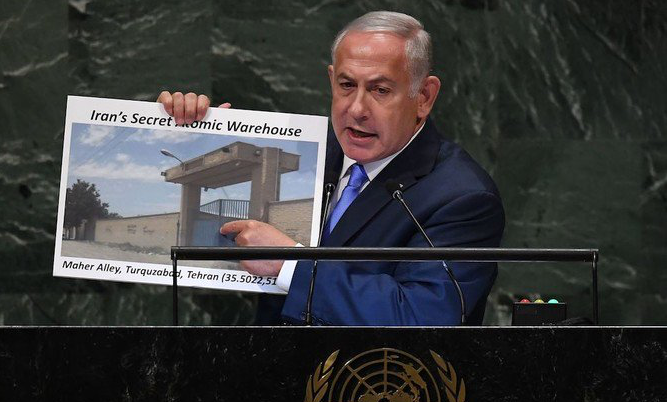
NEW YORK: Israel has discovered a second “secret” atomic storage facility in Tehran, Benjamin Netanyahu told the UN General Assembly on Thursday as he urged European leaders to abandon the Iran nuclear deal.
Holding up photos and satellite images, the Israeli prime minister pinpointed a site in the Iranian capital that he said proved Tehran was continuing to pursue a nuclear weapon.
“Today I am disclosing for the first time that Iran has another secret facility in Tehran, a secret atomic warehouse for storing massive amounts of equipment and materiel from Iran’s secret nuclear programme,” Netanyahu said.
“Since we raided the atomic archive, they've been busy cleaning out the atomic warehouse. Just last month they removed 15 kilograms of radioactive material. You know what they did with it?” he said. “They took it out and they spread it around Tehran in an effort to hide the evidence.”
Netanyahu called on the UN’s atomic agency to carry out immediate inspections at a location known to Israel.
He used the discovery to urge the European countries still committed to the 2015 deal to curb Iran’s nuclear program. Donald trump withdrew the US from the agreement earlier this year and started to reimpose tough sanctions.
Netanyahu accused nations like France, Britain and Germany of “appeasing" Iran by trying to renew trade despite Iran's nuclear activity.
He said they should join the US, Israel and most Arab countries by supporting the new tough sanctions, which will include a new phase in November targeting Iran’s energy sector.
Netanyahu in April unveiled what he said was a pile of archives taken from a warehouse in Tehran that showed Iran was secretly continuing to pursue nuclear weapons despite the deal.
He said Iranian officials had started cleaning out the atomic warehouse, but still had a lot of work to do because they “have had at least 15 ship containers, they're gigantic, 15 ship containers full of nuclear-related equipment and materials stored there,” he said.
“This means that this site contained as much as 300 tonnes - 300 tonnes - of nuclear-related equipment and materiel.”
With a dramatic zeal deployed in previous UN addresses, the Israeli leader also displayed satellite images of Beirut with Hezbollah missile sites marked on them.
They included what he claimed were missile sites under a football stadium and near the airport.
“Hezbollah is using the innocent people of Beirut as human shields,” Netanyahu said. “Israel also knows what you are doing.”


