

Pakistanis in China seek answers about detained Uighur wives

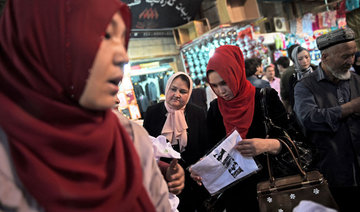
Pakistani businessman Mirza Imran Baig, right, speaks next to his compatriot outside the Pakistan's embassy in Beijing, on Wednesday, Sept. 26, 2018. (AP)
Updated 26 September 2018
Follow

Pakistanis in China seek answers about detained Uighur wives

  • There are at least 38 Pakistani men whose mostly Uighur Chinese wives are detained or unable to leave Xinjiang
  • China's foreign ministry said that it was not aware of the situation involving the Pakistani husbands

BEIJING: Two Pakistani men went to their embassy in Beijing on Wednesday to lobby for help in reuniting with their wives, who they say are ethnic Uighurs blocked from leaving China, in an example of how a sweeping crackdown has spilled across China's borders.

"I am very, very unhappy," said Mirza Imran Baig, a Pakistani cosmetics trader. His Chinese Uighur wife, Malika Mamiti, was sent to a political indoctrination camp after returning to China's far west Xinjiang region in May 2017, Baig said.
The internment camps , which have alarmed a United Nations panel and the U.S. government, are estimated to hold around 1 million Uighurs and other Muslim minorities. China denies their existence and maintains that current security measures are necessary to combat religious extremism in a region that has previously experienced ethnic unrest.
Xinjiang's security drive has swept up and separated families and also created friction with neighboring Kazakhstan over the internment of ethnic Kazakh Chinese nationals and even Kazakh citizens.
There are at least 38 Pakistani men whose mostly Uighur Chinese wives are detained or unable to leave Xinjiang, according to Mian Shahid Ilyas, a Lahore-based businessman. Ilyas has been tracking such cases since his own wife was detained in April last year.
China's foreign ministry said Tuesday that it was not aware of the situation involving the Pakistani husbands, and reiterated its stance that China's policies are aimed at creating "stability and lasting peace" in Xinjiang.
Baig said his wife has since been released from the internment camp but is confined to her hometown in a southwestern part of the region. He said her passport and that of their 4-year-old daughter, also a Chinese citizen, were confiscated.
He has visited the Pakistani Embassy in Beijing and met with the ambassador, Masood Khalid, several times. Still, he said he believes Pakistan is "not interested" in helping him.
Baig and Muhammed Asif, another Pakistani man whose wife and child are stuck in Xinjiang, met with Khalid on Wednesday afternoon to ask for help in getting China to allow their wives to leave the country. Khalid told them to return to the embassy on Thursday for an update, Baig said.

Pakistan, China to sign multiple MoUs at major agriculture investment conference today

Updated 18 January 2026
Follow

Pakistan, China to sign multiple MoUs at major agriculture investment conference today

  • Hundreds of Chinese and Pakistani firms to attend Islamabad event
  • Conference seen as part of expanding CPEC ties into agriculture, trade

KARACHI: Islamabad and Beijing are set to sign multiple memorandums of understanding (MoUs) to boost agricultural investment and cooperation at a major conference taking place in the capital today, Monday, with hundreds of Chinese and Pakistani companies expected to participate.

The conference is being billed by Pakistan’s Ministry of National Food Security and Research as a platform for deepening bilateral agricultural ties and supporting broader economic engagement between the two countries.

“Multiple memorandums of understanding will be signed at the Pakistan–China Agricultural Conference,” the Ministry of National Food Security said in a statement. “115 Chinese and 165 Pakistani companies will participate.”

The conference reflects a growing emphasis on expanding Pakistan-China economic cooperation beyond the transport and energy foundations of the flagship China-Pakistan Economic Corridor (CPEC) into agriculture, industry and technology.

Under its first phase launched in 2015, CPEC, a core component of China’s Belt and Road Initiative, focused primarily on transportation infrastructure, energy generation and connectivity projects linking western China to the Arabian Sea via Pakistan. That phase included motorways, power plants and the development of the Gwadar Port in the country's southwest, aimed at helping Pakistan address chronic power shortages and enhance transport connectivity.

In recent years, both governments have formally moved toward a “CPEC 2.0” phase aimed at diversifying the corridor’s impact into areas such as special economic zones, innovation, digital cooperation and agriculture. Second-phase discussions have highlighted Pakistan’s goal of modernizing its agricultural sector, attracting Chinese technology and investment, and boosting export potential, with high-level talks taking place between planning officials and investors in Beijing.

Agri-sector cooperation has also seen practical collaboration, with joint initiatives examining technology transfer, export protocols and value-chain development, including partnerships in livestock, mechanization and horticulture.

Organizers say the Islamabad conference will bring together government policymakers, private sector investors, industry associations and multinational agribusiness firms from both nations. Discussions will center on investment opportunities, technology adoption, export expansion and building linkages with global buyers within the framework of Pakistan-China economic cooperation.