

PM Khan writes to Modi, urges peace talks

File photo for the meeting that took place between Imran Khan Indian Prime Minister Narendra Modi in Delhi in Dec 2015. ( Imran Khan FB).
Updated 20 September 2018
Follow

PM Khan writes to Modi, urges peace talks

  • Invites Indian PM for meaningful dialogue to resolve all issues
  • Islamabad awaits formal response from New Delhi

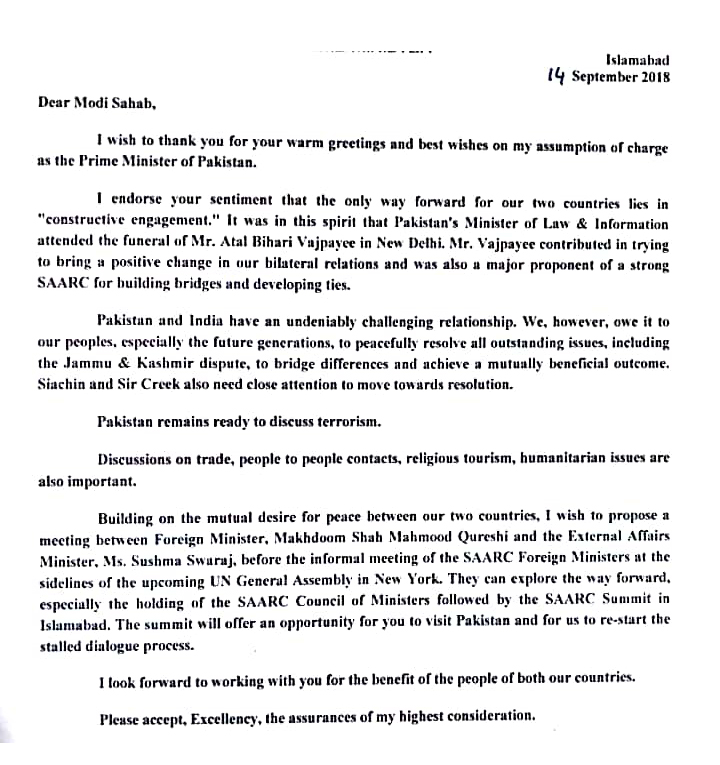
ISLAMABAD: In what may be considered as a major breakthrough in Pakistan’s stalled relations with India, Prime Minister Imran Khan on Thursday extended the olive branch to his counterpart Narendra Modi by inviting him for a “meaningful dialogue” to resolve all issues.

Iftikhar Durrani, Special Assistant to the Prime Minister said that PM Khan had written a letter to Modi on September 14 to initiate the process. “We believe in peace with our neighbors and that's why Prime Minister Imran Khan has urged his Indian counterpart for a dialogue,” Durrani told Arab News.

Arab News was able to gain access to the letter wherein PM Khan proposed a meeting between the foreign ministers of both countries, namely Shah Mehmood Qureshi and Sushma Swaraj, on the sidelines of the United Nations General Assembly to be held later this month.

Earlier on Thursday, reports circulating in the Indian media said that PM Khan was keen on resuming talks with India at the earliest, with a tweet by Pakistan’s Foreign Office spokesman, Mohammad Faisal, confirming the news. “PM has responded to PM Modi, in a positive spirit, reciprocating his sentiments. Let’s talk and resolve all issues. We await formal response from India,” he said in the tweet.


Pakistan, China to sign multiple MoUs at major agriculture investment conference today

Updated 18 January 2026
Follow

Pakistan, China to sign multiple MoUs at major agriculture investment conference today

  • Hundreds of Chinese and Pakistani firms to attend Islamabad event
  • Conference seen as part of expanding CPEC ties into agriculture, trade

KARACHI: Islamabad and Beijing are set to sign multiple memorandums of understanding (MoUs) to boost agricultural investment and cooperation at a major conference taking place in the capital today, Monday, with hundreds of Chinese and Pakistani companies expected to participate.

The conference is being billed by Pakistan’s Ministry of National Food Security and Research as a platform for deepening bilateral agricultural ties and supporting broader economic engagement between the two countries.

“Multiple memorandums of understanding will be signed at the Pakistan–China Agricultural Conference,” the Ministry of National Food Security said in a statement. “115 Chinese and 165 Pakistani companies will participate.”

The conference reflects a growing emphasis on expanding Pakistan-China economic cooperation beyond the transport and energy foundations of the flagship China-Pakistan Economic Corridor (CPEC) into agriculture, industry and technology.

Under its first phase launched in 2015, CPEC, a core component of China’s Belt and Road Initiative, focused primarily on transportation infrastructure, energy generation and connectivity projects linking western China to the Arabian Sea via Pakistan. That phase included motorways, power plants and the development of the Gwadar Port in the country's southwest, aimed at helping Pakistan address chronic power shortages and enhance transport connectivity.

In recent years, both governments have formally moved toward a “CPEC 2.0” phase aimed at diversifying the corridor’s impact into areas such as special economic zones, innovation, digital cooperation and agriculture. Second-phase discussions have highlighted Pakistan’s goal of modernizing its agricultural sector, attracting Chinese technology and investment, and boosting export potential, with high-level talks taking place between planning officials and investors in Beijing.

Agri-sector cooperation has also seen practical collaboration, with joint initiatives examining technology transfer, export protocols and value-chain development, including partnerships in livestock, mechanization and horticulture.

Organizers say the Islamabad conference will bring together government policymakers, private sector investors, industry associations and multinational agribusiness firms from both nations. Discussions will center on investment opportunities, technology adoption, export expansion and building linkages with global buyers within the framework of Pakistan-China economic cooperation.